KE2010.Instruction Manual.Ver.2.01,Rev.08.pdf - 第127页
4 − 20 W hen y ou open the Pr ogram Editing ut ility with “Y es” selected in the “Pr ompt t o” column, the basic set up screen opens when you select the [Create new] command to create a new f ile. W hen you are to edit t…
4 − 19
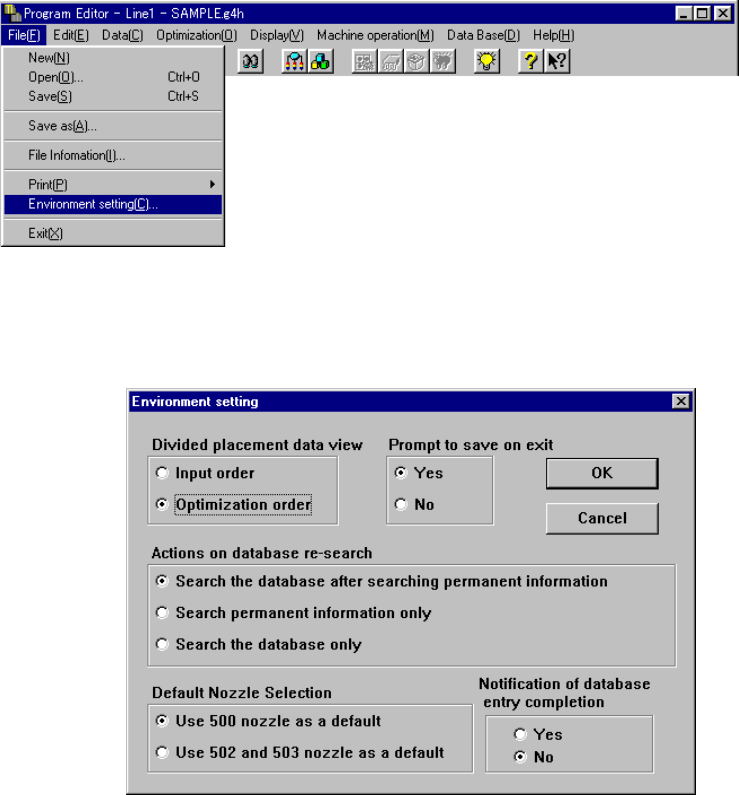
4.2.7 Environment setting
This command sets the environment for editing a program.
When you select the [Environment setting] command on the File menu, the following
dialog box appears on the screen.
Environment
This menu item specifies whether to save the environment set when you quit the
Program Editing utility.
• When you select “Yes”, the following items are reproduced at start up of the
Program Editing utility the next time:
1. Display/Not display of the tool bar
2. File name
3. Window size
• When you select “No”, a screen for a new file (Basic setup screen) appears
when the Program Editing utility starts for the first time after start-up of the
system (the name of the file used the last time cannot be automatically read into
the machine). When you start up the Program Editing utility for the second time
or later, the production program data you edited last time appears on the screen.
However, if another production program is read into the system with the [File]
command or [Production] command provided on the menu bar, it appears on
the screen.
4 − 20
When you open the Program Editing utility with “Yes” selected in the “Prompt to”
column, the basic setup screen opens when you select the [Create new] command
to create a new file. When you are to edit the saved new file, this file is
automatically read into the machine at start up of the Program Editing utility, then the
“Dimension” window opens.
The settings made on the “Environment setting” dialog box are automatically saved
regardless of the “Prompt to” setting.
Division
This menu items sets the display order of the divided Placement data.
Prompt to optimization on exit
• When you select “Yes”: the system displays the message that asks you to
optimize data if you have not optimized it.
• When you select “No”: the system performs the normal quit process.
Database file
This menu item specifies the file name of a database file to be used, and specifies
whether to use the specified database file when a production program is edited.
As a Component database file name, specify the full path name including a drive
name. The extension of the file name is fixed to “.MDB”. Even though you specify
another extension, it is replaced with “.MDB”.
To specify whether to use the specified Component database file to edit a production
program, check or uncheck the check box “Used”. When checked, it invokes the
specified Component database file when a program is created. As the default
setting, the check box is not checked. To use the Component database file to edit
a production program, check this check box. When you click the <Refer to> button,
the dialog box appears on the screen.
Note If you use a database file of another personal computer via the network, you
may be requested to enter the password. If you do not enter the correct
password in this case, you cannot access the database file.
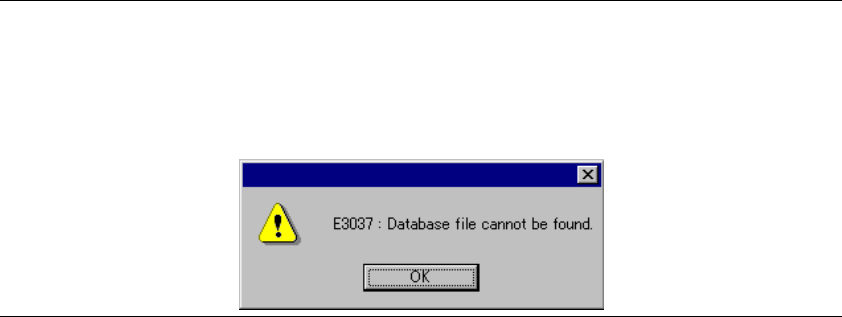
If the following message appears on the screen at start-up of the Program
Editor, check to see if there is any database file or if you can access a
database file.
Default nozzle selection
When creating Component data on the No. 500 nozzle, the system prompts you to
select which No. nozzle is to be set, No. 500 or No. 502/503 as the default nozzle.
Notification of database entry completion
Specify whether to notify of completion of database entry or not.
“No” is selected by default.
4 − 21
4.2.8 Exit
This command exits from the Program Editing utility.
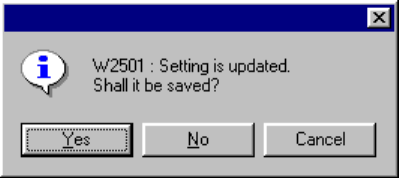
If a program is edited and not saved, the following dialog box appears on the
screen.
Yes: Saves a program. After saving, the machine exits from the Program
Editing utility.
No: Exits from the Program Editing utility without saving a program.
Cancel: Terminates the Exit process.