KE2010.Instruction Manual.Ver.2.01,Rev.08.pdf - 第554页
7 − 17 Notes : 1) W hen ther e are tw o or more A TCs t o be set autom atically , aut omatic setting can be term inated by pressing the STOP switch. When the STOP switch is pr essed during automat ic setting, t he machin…
7 − 16
− When you check the check box “use” and validate your setting, the ATC
number you set is dimmed on the “ATC nozzle setup” dialog box and
you cannot check it. (“VacUnit” is displayed as the nozzle type.)
− To disable the vacuum calibration unit position, uncheck the check box
“use”. You can assign a nozzle to an ATC position to which you already
assigned a vacuum calibration unit on the “ATC nozzle setup” dialog
box.
• Automatic setting
− When the F3 key is pressed, the machine puts the nozzle on a head
whose ATC number is focused and sets the necessary values.
− When the Auto button is selected and the ENTER key is pressed, the
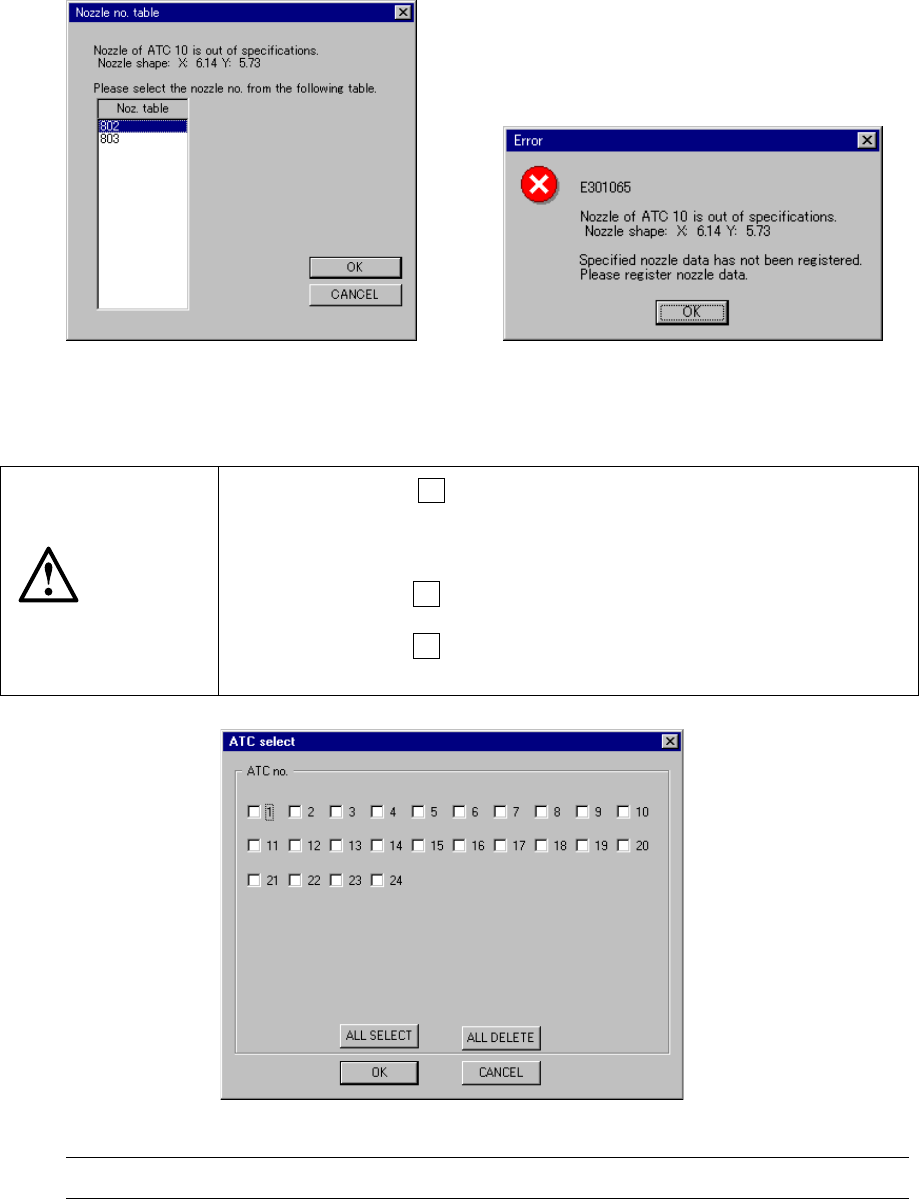
Automatic ATC number selection dialog box shown in Figure 7.2.2.1.2
appears. By selecting OK button and pressing the ENTER key,
nozzles is automatically in order of the marked ATC numbers.
1) The height of the tip of the nozzle mounted is measured to obtain the
nozzle height.
2) The nozzle number is set according to the size of the nozzle mounted.
3) The vacuum value is obtained and set with the nozzle being mounted.

7 − 17
Notes: 1)
When there are two or more ATCs to be set automatically, automatic
setting can be terminated by pressing the STOP switch.
When the STOP switch is pressed during automatic setting, the machine
asks you whether to terminate the operation. Selecting <Yes>
terminates the operation immediately. Selecting <No> continues the
operation.
Even though you click the Cancel button, you cannot terminate the
automatic setting operation.
2)
When carrying out the automatic setting, the nozzle number is also set
automatically, so, you do not have to enter it.
If the nozzle number entered before automatic setting is different from
the one obtained by the automatic setting, the nozzle number
automatically set is preferred.
3)
Since the nozzle type is automatically set when you perform the
automatic setting operation, you do not have to enter it.
4)
When the size of a nozzle obtained automatically is different from that of
the standard nozzle, the number of a customized nozzle is set
automatically if the obtained size matches the size registered in the
customized nozzle information.
If the obtained size matches two or more sizes registered in the
customized nozzle information, the system displays the “Registered
nozzle no. table” dialog box as shown in Figure 7.2.2.1.2. Select the
appropriate one from this table. The selected nozzle number is set to
the corresponding ATC.
Even though you click the <CANCEL> button at this point, the nozzle
numbers already set will not change. If you have not set a nozzle to
any ATC position, no nozzle number is set here. Manually enter the
nozzle number.
5)
If the obtained size does not match any one registered in the customized
nozzle information, or if no nozzle information is registered, the system
displays the nozzle information not-registered error dialog box as shown
in Figure 7.2.2.1.3. Register the appropriate nozzle information from a
floppy disk.
7 − 18
Figure 7.2.2.1.2
“Registered nozzle no. table” dialog box
Figure 7.2.2.1.3
Nozzle information not-registered error
dialog box
CAUTION
When you click the F3 key, the head moves to allow you to
attach/detach a nozzle.
To avoid a risk of injury, do not place your hand in the machine, nor
move your face or head close to the machine.
Before clicking the F3 key, check to see if there is no one who is
working in the machine.
Before clicking the F3 key, check to see if there is no obstacle (tool or
jig) left or attached in the machine.
Figure 7.2.2.1.4 ATC select dialog box (Screen example when a KE-2020 is used)
Note : The displayed available ATC numbers vary depending on the model you use
(3) Purpose
The nozzle height offset is used to finely control the nozzle height for laser
measurement of the components. This value, used in combination with the
non-nozzle vacuum value, determines whether the nozzle or component in
question is available or not. Note that this setting value is a supplementary
information for the nozzle and component detection because it can be detected
using the laser.