ED-7306_E.pdf - 第11页
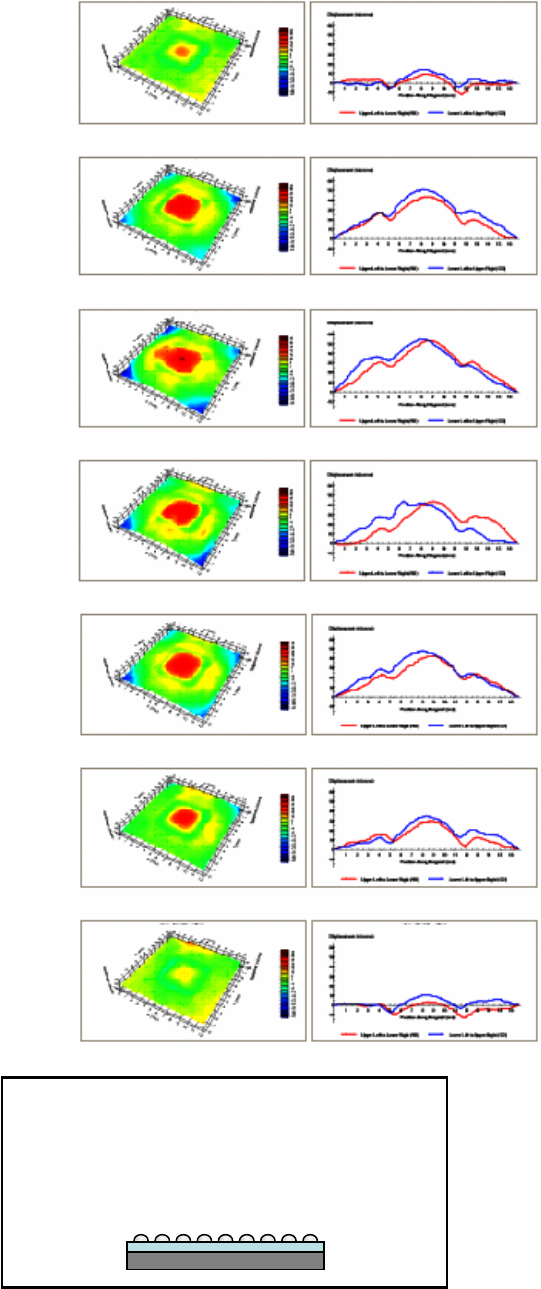
JEITA ED-7306 - 9 - Fig. 8 Recommended datasheet NOTE : The signs in the 3D plots and in the diagonal profile are opposite from the package warpage sign due to the dead bug position in the measurement. (150 ° C) (Preheat…
JEITA ED-7306
- 8 -
7. Recommended datasheet for the package warpage
7.1 Measurement temperatures for data sheet
Typical measurement temperatures for datasheet are room temperature, melting point, peak temperature,
solidification point, and room temperature after cooling.
7.2 Datasheet
Datasheet is composed of
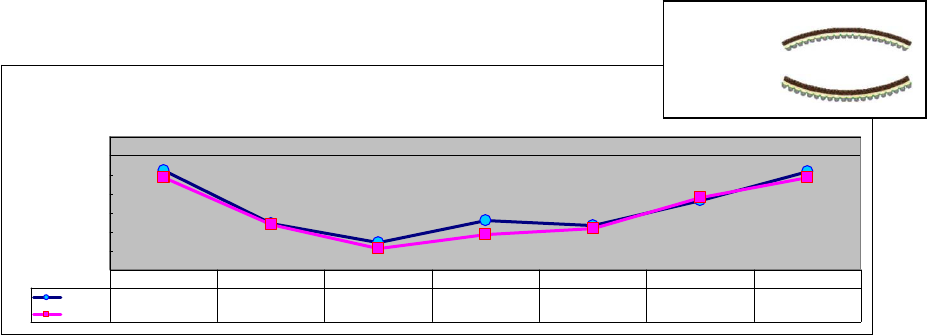
- temperature dependency of the package warpage (See Fig. 7),
- surface topography at each temperature in 3D plots (optional). (If the sign of warpage is opposite,
explanation is required; See Fig. 8),
- diagonal profile of the package at each temperature (optional). (If the sign of warpage is opposite,
explanation is required; See Fig. 8),
- explanatory figure of the sign of the package warpage (optional), and
- temperature profile for measurement.
7.3 Example of datasheets
Fig. 7 Temperature dependency of the package warpage
Average warpage
for xxxx & yyyy
-70
-60
-50
-40
-30
-20
-10
0
Warpage(um)
xxxxAVG
-17.8 -46 -55.7 -44 -47 -33.8 -18.3
yyyy
AVG
-21.5 -46.2 -58.7 -51.8 -48.5 -32 -21.8
25C 150C 220C 260C 220C 150C 25C
+/
-
Sign
+
-
Warpage(µm)
0
-10
-20
-30
-40
-50
-60
-70
25°C 150°C 220°C 260°C 220°C 150°C 25°C
JEITA ED-7306
- 9 -
Fig. 8 Recommended datasheet
NOTE: The signs in the 3D plots and in the
diagonal profile are opposite from the
package warpage sign due to the dead
bug position in the measurement.
(150°C)
(Preheat temperature)
(For reference)
220°C
Melting point
260°C
Peak temperature
220°C
Solidification point
(150°C)
(Tg of PWB)
(For reference)
Room temperature
Room temperature
JEITA ED-7306
- 10 -
Explanation
This part of the document is not a specification but is intended for the explanation of the specification and
related issues.
1. Purpose of the establishment
In an environment marked by the higher-speed and miniaturizing trend of the electronic products, BGA
packages have been used in most of the electronic products thanks to the advantages of higher pin count
and compact body size features. Along with high volume usage of the BGA packages, analysis data of
soldering failures have accumulated and the package warpage at elevated temperature has been gaining
attention as a cause of these failures. This phenomenon is that the package warps during the rising
temperature of the reflow process and solder joints fail in an open or short mode, even if the package meets
the coplanarity requirement at room temperature.
Migration to thinner package body, finer pitch balls, and lead-free material has increased package warpage
during the reflow process and raised problems of open solder joints or solder bridges between balls. It is
known that the more a package is moisturized, the more the package warps. The Subcommittee reached
an agreement that the semiconductor suppliers shall specify the maximum permissible package warpages
at elevated temperature. It is similar to the package delamination specification at reflow stress. This
specification aimed at agreement of the common terms, unification of measurement methods, and
establishment of the criteria.
2. History of deliberation
In a past TSC had focused on the standardization of the dimensions of packages. The recent expansion of
the mission to the field of the package reliability has triggered the standardization activity on the package
warpage at elevated temperature, which has been requested by customers.
The standardization task force on the measurement method of the package warpage at elevated
temperature was formed on Jun. 23, 2005. The activity plan was to establish the standard of the package
warpage measurement by Apr. 2006 as phase 1 and the criteria of warpage by Dec. 2006 as phase 2. The
deliberation started from listing the factors that may affect the measurement methods and gathering
experimental data from the task force members. After the evaluation of the seriousness of the factors, the
specification was drafted. On the way of deliberation, the task force was informed the publication of “High
temperature package warpage measurement methodology”, JESD22B112, on Aug. 2005. The task force
discussed the measurement method based on this specification with the basic policy of maintaining
international harmonization.