196396 Iss 2 Nov 2015 - Semi Appendix Manual.pdf - 第19页
SAFETY FEATURES LOCKOUT Chapter Issue 4, Nov 14 Installation Manual 1.13 Pneumatic Lockout W ARNING COMPRESSED AIR . COMPRESS ED AIR SHOULD NE VER IMPINGE UP ON THE BODY . P ORTS, PIP ES, ETC MU ST NE VER BE BLOCKED BY H…
SAFETY FEATURES
LOCKOUT
1.12 Installation Manual Chapter Issue 4, Nov 14
LOCKOUT
Electrical Lockout
WARNING
LETHAL VOLTAGE. DANGEROUS VOLTAGES EXIST IN THIS EQUIPMENT.
ENSURE ALL ELECTRONIC COVERS AND MAIN MACHINE COVERS ARE
FITTED BEFORE OPERATING THIS EQUIPMENT.
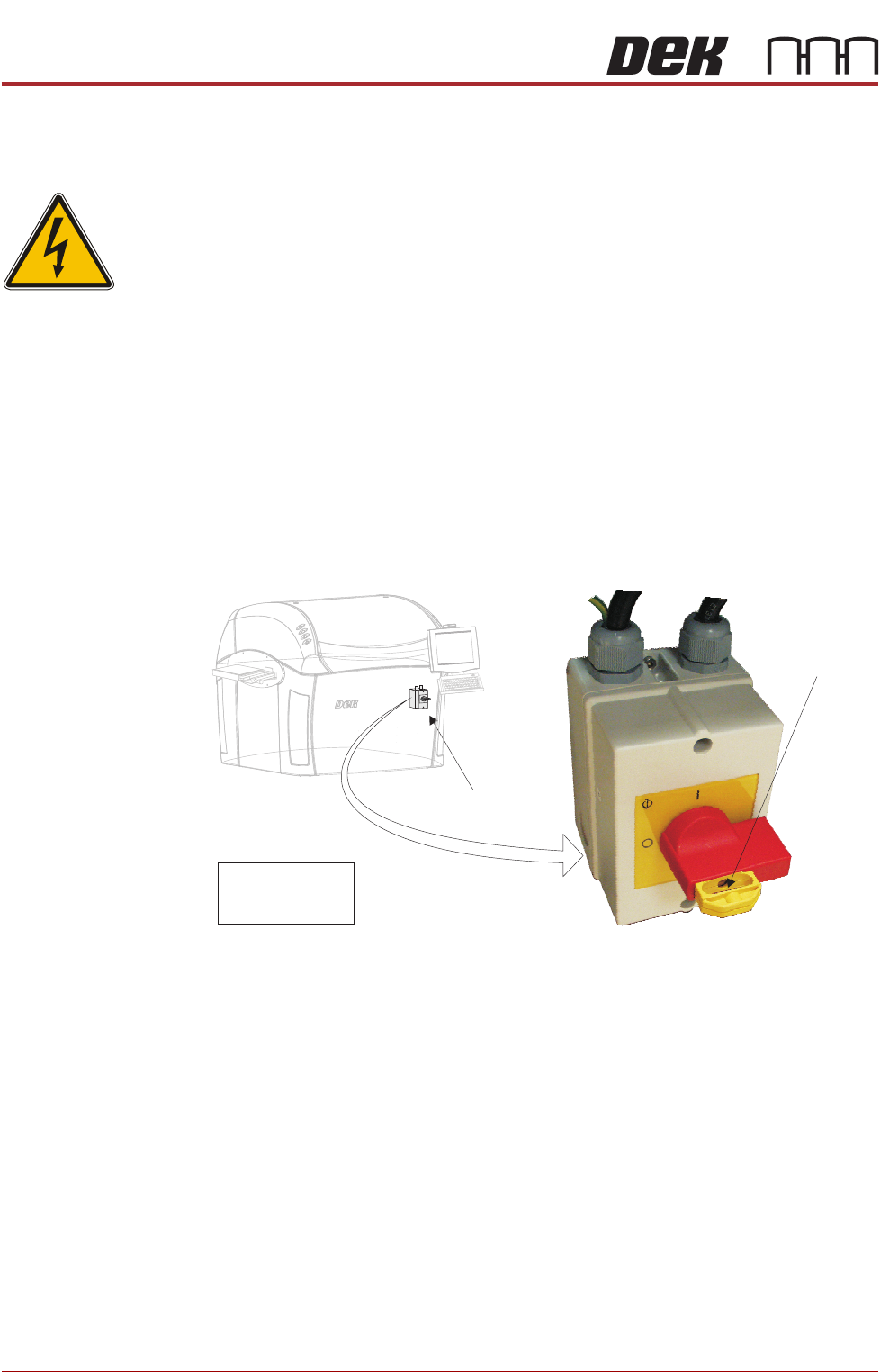
Electrical lockout of the machine is achieved by applying a padlock, or any other
suitable locking device, through the centre pull out section of the mains isolator
switch. This can only be achieved when the switch is in the OFF position.
To electrically lockout the machine, carry out the following procedure:
1. Close down the machine software.
2. Switch the mains isolator to the OFF position.
3. Pull the yellow centre section of the mains isolator switch out.
4. Fit a padlock or suitable locking device through the lockout point in the
centre section of the switch.
5. This completes the electrical lockout.
Mains Isolator Switch
NOTE
Switch shown in
the OFF position
Lockout Point

SAFETY FEATURES
LOCKOUT
Chapter Issue 4, Nov 14 Installation Manual 1.13
Pneumatic Lockout
WARNING
COMPRESSED AIR. COMPRESSED AIR SHOULD NEVER IMPINGE UPON THE
BODY. PORTS, PIPES, ETC MUST NEVER BE BLOCKED BY HAND. BEFORE
CONNECTING OR DISCONNECTING ANY PNEUMATIC COMPONENTS, ENSURE
THE COMPRESSED AIR SUPPLY HAS BEEN DISSIPATED AND DISCONNECTED
FROM THE MACHINE.
Pneumatic lockout of the machine is achieved by:
1. If the electrical lockout procedure has just been implemented, go to Step 4.
2. Close down the machine software.
3. Switch the electrical mains isolator to the OFF position.
4. Turn OFF the factory’s main pneumatic supply to the machine.
5. Dissipate remaining air in the pneumatic supply line.
6. Disconnect the pneumatic supply line from the machine.
7. This completes the pneumatic lockout.
SAFETY FEATURES
SEMI - LEVELS OF ELECTRICAL WORK
1.14 Installation Manual Chapter Issue 4, Nov 14
SEMI - LEVELS OF ELECTRICAL WORK
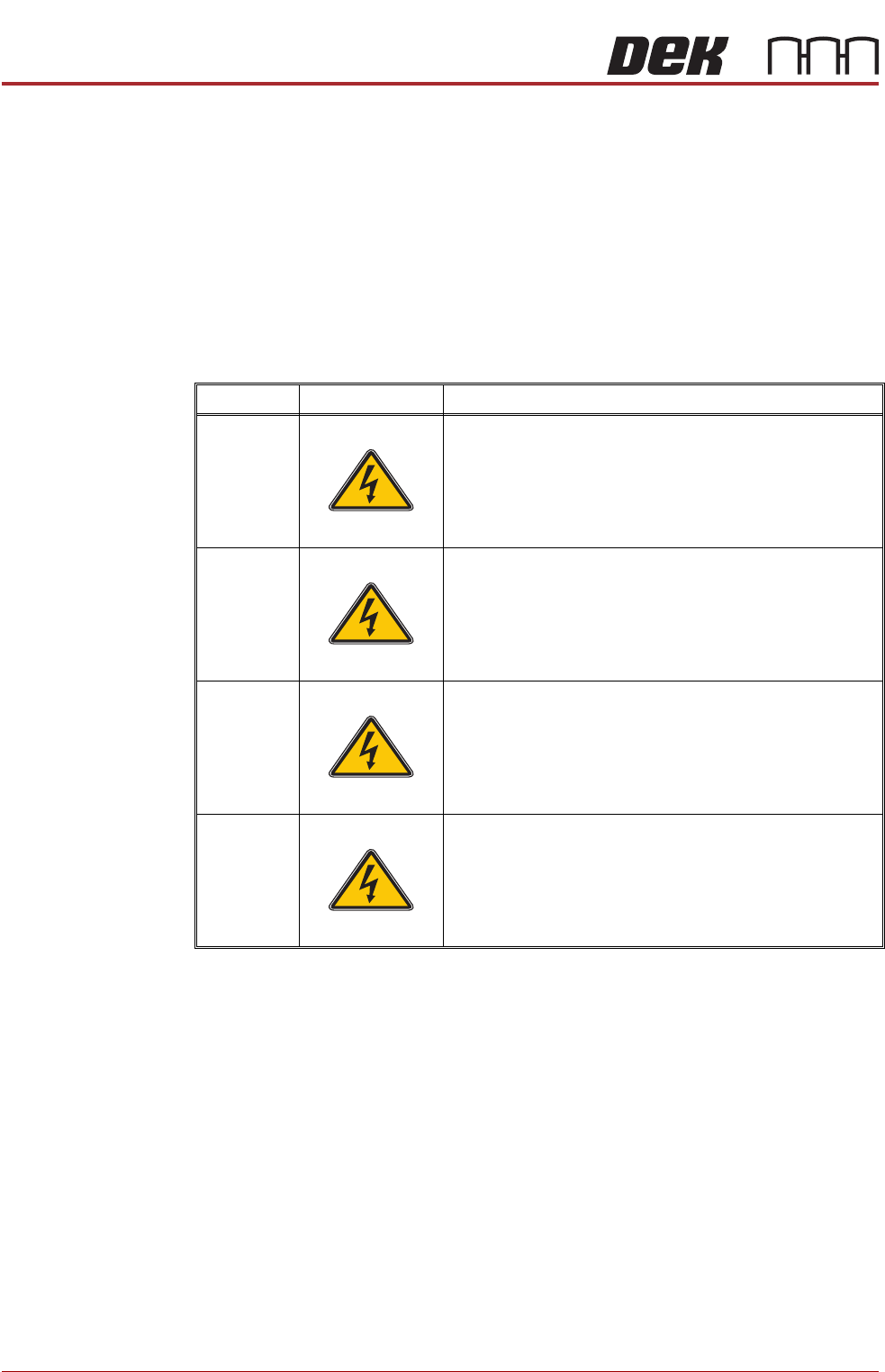
The table below show the four levels of energized electrical work carried out on
electrical equipment and its associated circuits, as defined by the SEMI S2-
0200 Standard.
Throughout all the ASM manuals when a maintenance or calibration procedure
falls within any of these four levels of energized electrical state, the appropriate
symbol is represented in the margin alongside that procedure.
A full definition can be found in the SEMI S2-0200 Safety Guidelines for
Semiconductor Manufacturing Equipment. See also NFPA 79-14.3, BS
EN60204, BS EN60950 and UL 1950.
Type Symbol Definition
1
Equipment is fully de-energized
2
Equipment is energized. Energized circuits are cov-
ered or insulated. Work is performed at a remote
location to preclude accidental shock
3
Equipment is energized. Energized circuits are
exposed and accidental contact is possible. Potential
exposures are less than 30 volts rms, 42.4 volts peak
to peak, 60 volts dc, or 240 volt-amps in dry locations
4
Equipment is energized. Energized circuits are
exposed and accidental contact is possible. Potential
exposures are greater than 30 volts rms, 42.4 volts
peak to peak, 60 volts dc, 240 volt-amps in dry loca-
tions, or radio frequency (rf) is present
SEMI 1
SEMI 2
SEMI 3
SEMI 4