DRAGF-THT-NX-UK_W - 第3页
T he p r o ce s s o f P C B as s e m b ly h a s u n d e r go n e a f u n d a me n t a l c h a n g e i n r ec e n t ye a r s . T h e c on v e n t io n a l th r o u g h- h o l e m ou n t i n g t e c h no l o g y h a s b ee…
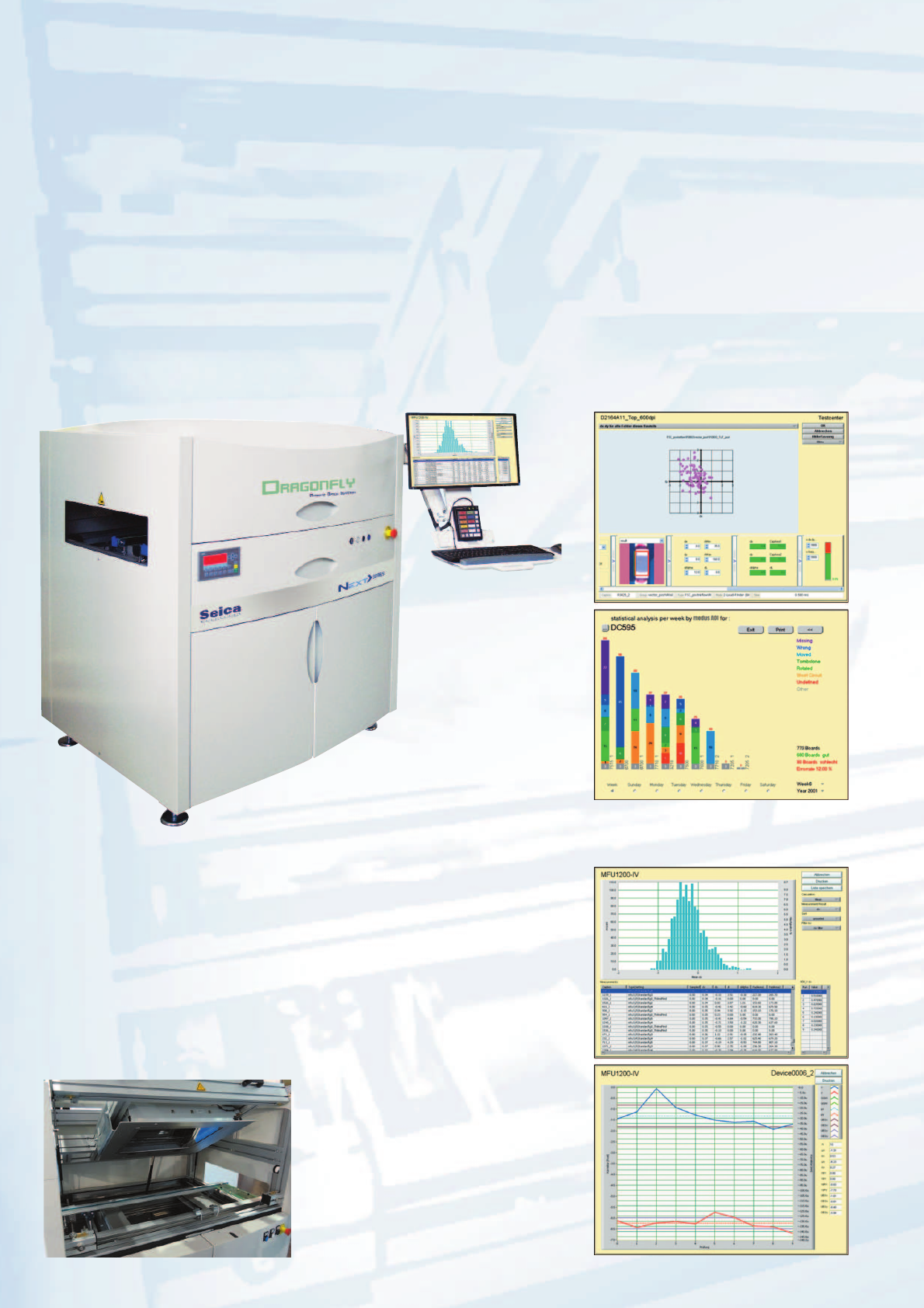
Following the winning philosophy which characterized its business in testing over three decades, based on the
constant and rapid innovation of its testing solutions, Seica introduces the
Dragonfly
T H T
NEXT>SERIES. This is the new generation of systems featuring a renovated and sleek look thanks to the
premium materials of the chassis and innovative worth discovering performances.
The automatic inspection
Dragonfly
T H T
NEXT>SERIES ensures a quick and complete
examination of all joints that may be brazed, soldered or even press fitted together.
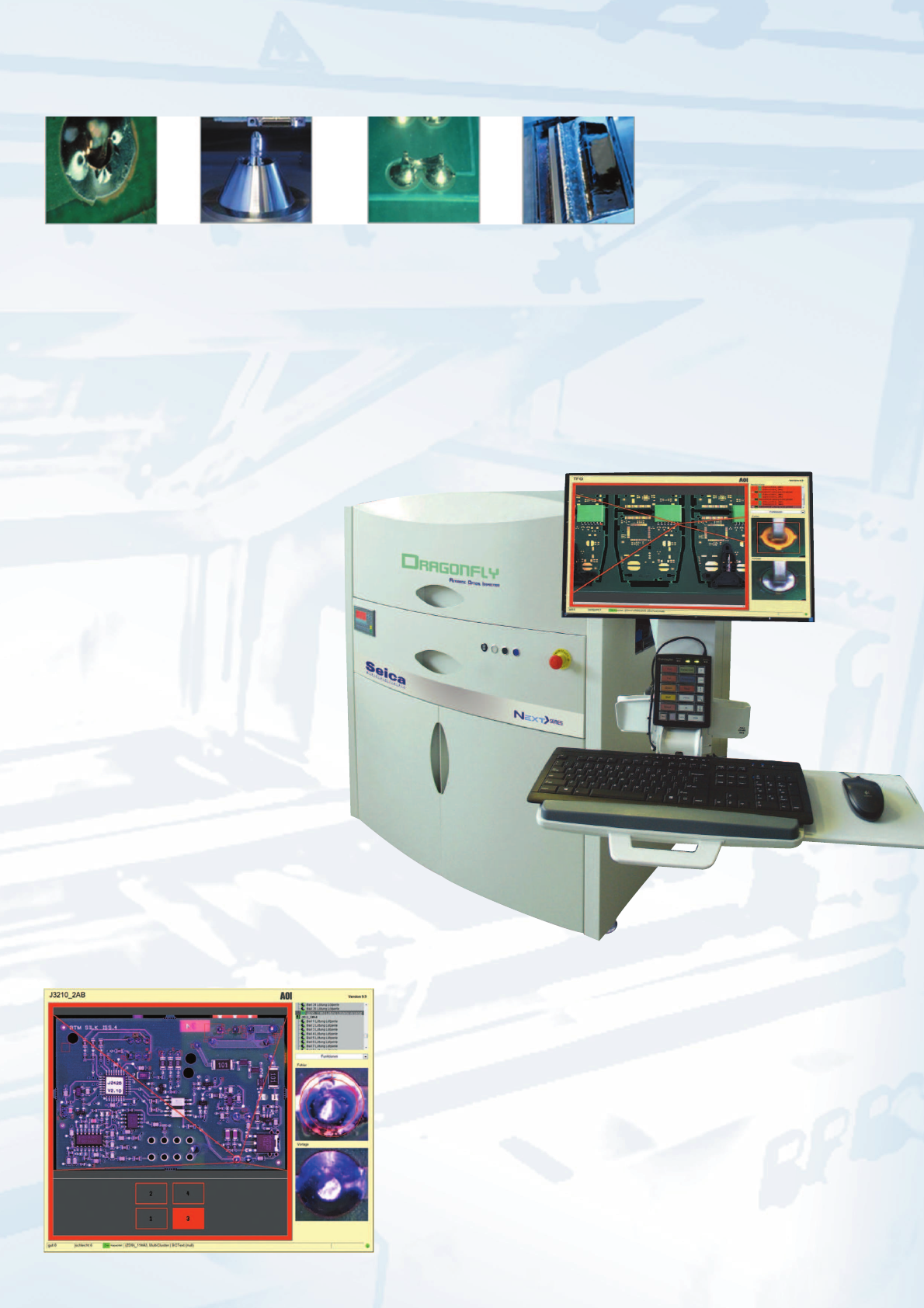
The combination of multi-colored LED lighting and color scan camera
offers a deep inspection of the solder joint meniscus and the shorts
detection, while the full scan acquisition of the PCB surface and not only of
the components allows the solder balls detection.
Compared to manual inspection, the results of
Dragonfly
T H T
NEXT>SERIES are operator free, but always act objectives and
reproducible. The inspection allows rapid feedback of process faults
(closed-loop).
The test results are displayed for
documented repair of the module
on the appropriate repair
stations. This results in time and
cost savings as well as a
significant increase in quality.
THT SOLDER INSPECTION
Dragonfly
THT
NEXT>SERIES
The process of PCB assembly has undergone a fundamental change in recent years. The conventional through-hole
mounting technology has been increasingly replaced by the SMD technology, however the electronics industry cannot
completely eliminate THT technology.
In particular, components that are exposed to high mechanical loads, such as relays, coils, capacitors and power strips
are soldered with modern selective soldering or the established scale wave soldering methods.
PROCESS OPTIMIZATION
The first-pass yield of soldering is
typically much lower than in the
reflow process.
Typical errors are, for example,
open solder joints, solder bridges
and solder bumps. High quality
and reliability standards require
test and inspection tools that not
only provide all the information for
a repair facility, but also allow an
optimization of the process.
Even with large-scale tests and
changing products, a check within
the production cycle must take
place in order to achieve a high
productivity.
The
Dragonfly
T H T
NEXT>SERIES line has all
of the capabilities needed for implementation in any Factory 4.0
scenario, providing the possibility to plug in any proprietary or
third party information system to achieve the desired goals.
All the
Dragonfly
T H T
NEXT>SERIES testers
feature the
Industrial Monitoring solution “4.0 ready” by Seica, to
monitor current absorption, supply voltage, temperature, light
indicators and other parameters useful to indicate the correct
operation, to ensure predictive maintenance and make the
systems compatible with the new standards of the fourth industrial
revolution ongoing nowadays.
INDUSTRY 4.0
Information, and the technology needed to collect
and analyze data to obtain it, is key to the successful
digitalization of the manufacturing process, which is at the
heart of the Industry 4.0 concept.
QUALITY THROUGH PROCESS CONTROL
Brochure Dragonfly-THT Next series UK ver. 01 11/2017
Reliable Fault Detection
• Solder bridges, solder splashes
• Stray solder balls up to 100µm (fully covered)
• Open solder joints, missing pins, crooked connector
• Identification of DMC / barcode on the review page
without additional Reader
High Inspection Depth and Large Test Facility
• High-resolution color scanner
• Multi-color LED lighting
• 24Bit Color, 14.040 x 20.400 Pixel per Scan
• Board size: small ver. 300mm x 400mm, large ver.
420mm x 540mm
• High speed: 25mm/Second
• Entire surface in parallax view
• Twin system for simultaneous inspection of both sides
of PCB’s TOP/BOTTOM
Clear operation
• Display the error position and representation of error and
comparison image
• Software (GUI) identical in the test system and repair
stations
• Fault is assigned by pressing a button statistics
• Easy to use and train
Statistics and Process Control
• Traceability by evaluating barcode / 2D code / RFID
• Cost savings because of quick process optimization
• Intuitive inspection plan
• Graphical interface
• Powerful and flexible vision test algorithms
PROXIMA S.R.L.
E-mail: info@proxima-ate.com
SEICA Inc.
E-mail: dave.sigillo@seicausa.com
SEICA FRANCE SARL
E-mail: dupoux@seica.fr
SEICA ELECTRONICS
(Suzhou) Co.Ltd.
E-mail: seicachina@seica.com
SEICA DEUTSCHLAND GmbH
E-mail: marc.schmuck@seica.com
SEICA SpA
via Kennedy 24
10019 Strambino - TO- ITALIA
Tel: +39 0125 6368.11
Fax: +39 0125 6368.99
E-mail: sales@seica.com
www.seica.com
Seica reserves the right to change any technical specification without notice
SEICA
WORLDWIDE
General features
• Power supply: 230V 50Hz 1Ph+N+G; 4 A
• Frame color: RAL 7035, powder coated
• Working Temp: 15-35°C
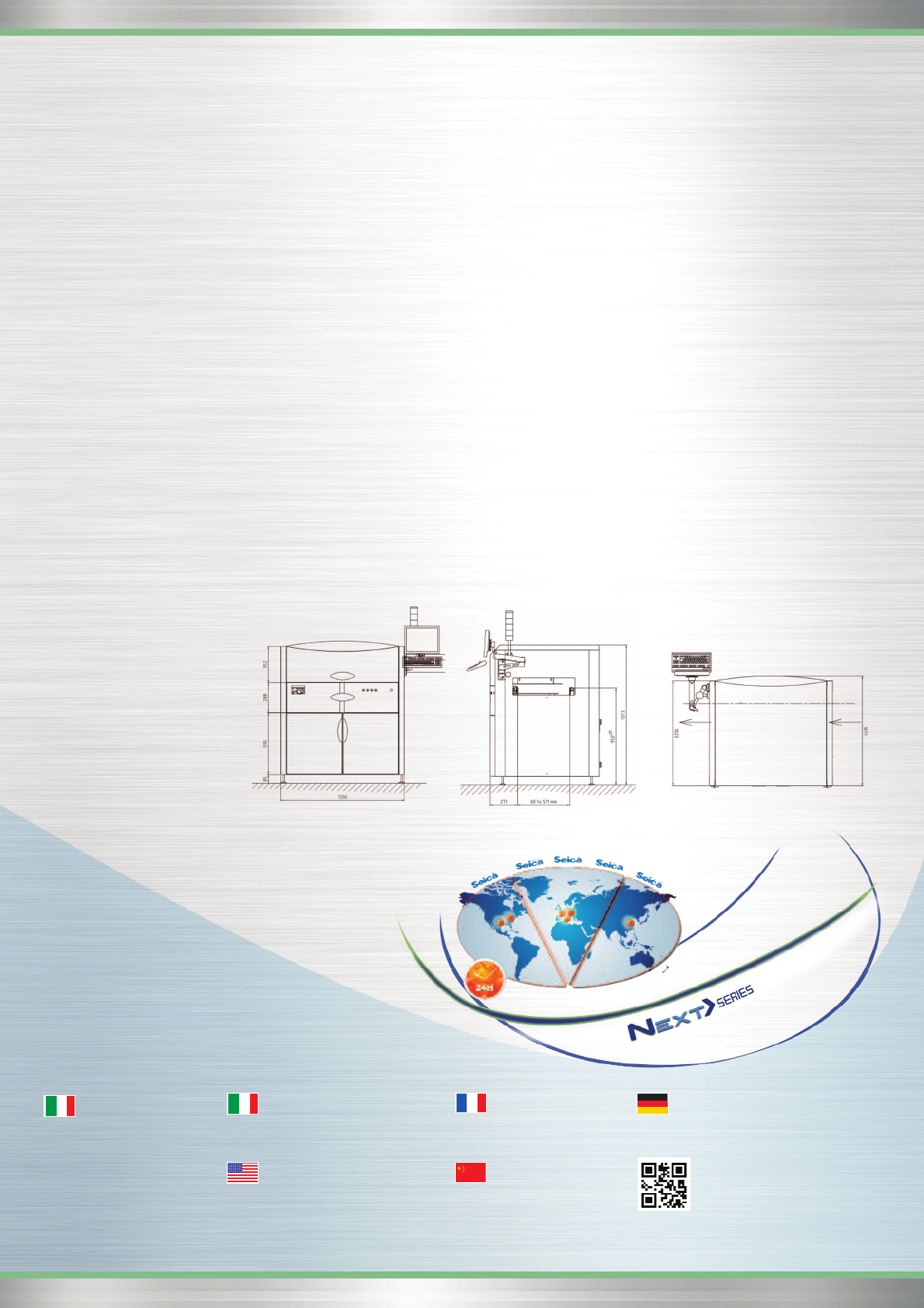
• Total External Dimensions:
1200 x 1071 x 1373mm (L x W x H)
• Weight: 560Kg
• SMEMA compatible
GLOBAL SUPPORT NETWORK
Thanks to the global extension of Seica and its
subsidiaries, Seica can ensure local service
support wherever the customer needs it,
in addition to 24-hour telephone assistance.
• MLD1200: fixed optical system, only mirrors and illumination
are moving, almost no wear.
• Low maintenance.
• MTBF = 1,300,000 Scans
• One-Pass-Scan: complete test of the board in one pass scan.
• Timing depend on board size between 6 and 25 sec.