00192299-02.pdf - 第88页
2 Retrofitting Instructions: Mechanical Ceramic Substrate Centering HS -50 SIPLACE HS -50 2.5 Sequence of Retrofitt ing 01/01 Issue 88 Å Cut off the exces s length of hose at the solenoid valve and connec t the hose end …
SIPLACE HS-50 2 Retrofitting Instructions: Mechanical Ceramic Substrate Centering HS-50
01/01 Issue 2.5 Sequence of Retrofitting
87
Perform the following work for both processing areas of the conveyor to undergo retrofitting.
Å The compressed air is turned OFF.
Å Open the cable pit running longitudinal and crosswise to the conveyor (see Fig. 2.5.7 and Fig.
2.5.9).
Å Remove the pneumatic hose running to the pneumatic hose (compressed air branch 5.6 bar)
from the crosswise cable pit (see Fig. 2.5.9) and cut through the hose.
Å Insert the Y-hose connector (manufacturer = Festo, Item no. see Section 2.4.1):
Connect the end of the hose coming from the compressed air unit, the hose leading to the stop-
per and the pneumatic hose from the retrofit kit to the Y-hose connection.
Å Put the Y-hose connection and hoses back in the cable pit.
Å Lay the free end of the hose further into the longitudinal pit (the pit running parallel to the con-
veyor) and to the location at which the solenoid station is to be mounted (see Fig. 2.5.9 and
Fig. 2.5.10).
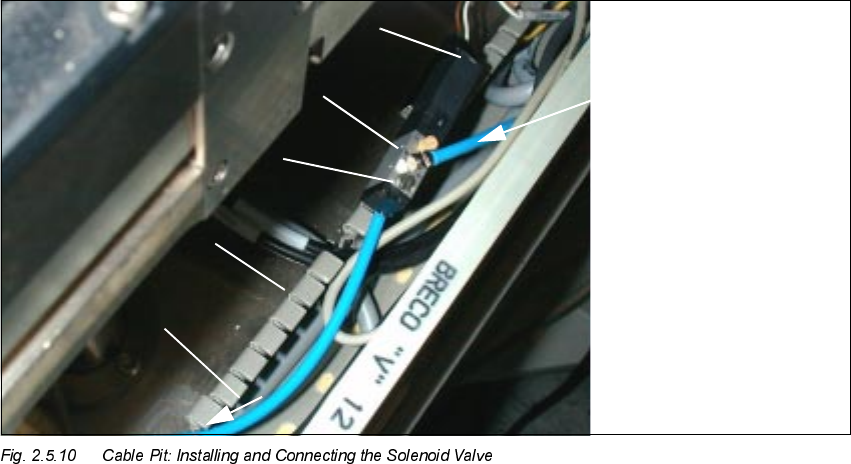
Å Put the solenoid valve into the cable pit.
.H\
1. Pneumatic hose coming from the Y-hose connector (compressed hose branch, stopper)
2. Solenoid valve (from retrofit kit)
3. Cable pit, longitudinal
4. Manual actuator
5. Plug-in connection: cable, solenoid valve
6. Pneumatic hose to the mech. ceramic substrate centering unit
2 Retrofitting Instructions: Mechanical Ceramic Substrate Centering HS-50 SIPLACE HS-50
2.5 Sequence of Retrofitting 01/01 Issue
88
Å Cut off the excess length of hose at the solenoid valve and connect the hose end at the entry
to the solenoid valve (see Fig. 2.5.10).
Å Connect the remaining pneumatic hose to the threaded hose coupling at the exit of the sole-
noid valve (see Fig. 2.5.10 and pneumatic diagramm Fig. 2.9.6).
Å Lay this hose to the cable pit running crosswise to the to the transport direction and further to
the substrate centering unit on the fixed conveyor side (see Fig. 2.5.14).
Å Lay the cables for the proximity switch and solenoid valve as appropriate based on the version
of conveyor control available (changeover or series handling) as described in the pertinent sec-
tion below.
&KDQJHRYHU+DQGOLQJ763/D\LQJDQG&RQQHFWLQJ&DEOH
– With the installed changeover handling, the electrical connection of the mechanical ceramic
substrate centering unit HS-50 is made at the conversion board ("piggyback board") of the con-
veyor control in the machine base (see Fig. 2.5.11 and Fig. 2.5.13).
In this case, use the LONG proximity switch cable and solenoid valve cable, Item no.
00357281-0.
The coding has already been integrated into the (joint) plug for the connection to the conveyor
control.
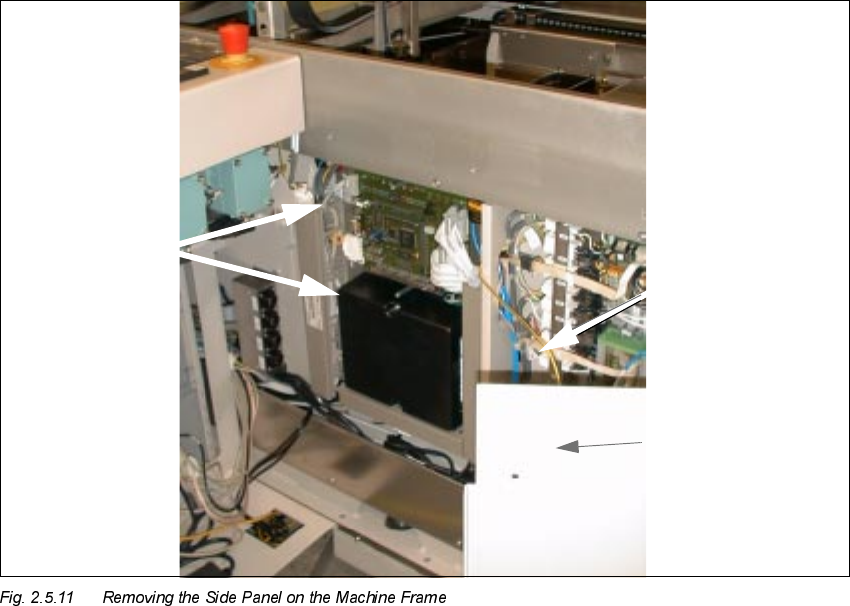
Conveyor
control
Grounding cable
Place the side panel
on one side
SIPLACE HS-50 2 Retrofitting Instructions: Mechanical Ceramic Substrate Centering HS-50
01/01 Issue 2.5 Sequence of Retrofitting
89
Å Unplug the plug-in connection of the movable component changeover table on the machine
frame.
Å Open the doors of the machine frame (see Fig. 2.5.11).
NOTE:
During the following steps, do not pull on the grounding cable that is attached to the inside of the
side panel (see Fig. 2.5.11).
Å The safety hood above the conveyor control must be open. Undo the 6 socket hex head cap
screws on the side panel (just loosen the 3 screws at the bottom!). Lift the side panel of the
machine frame up and out and place it to the side such that the conveyor control is accessible
and the grounding cable is not damaged.
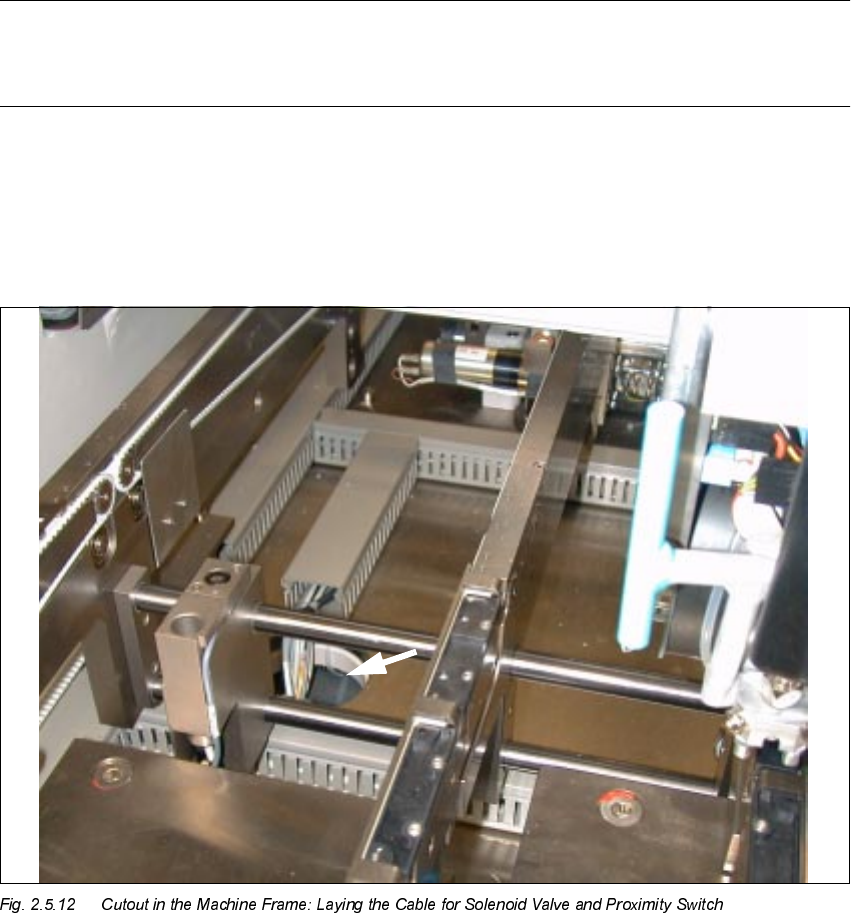
Å Remove the cover over the cable pits running from the processing area to the circular cutout
(arrow).
Å Use the long cables from the retrofit kit (Item no. 00357281-01).
Use a waterproof marker to indicate the allocation to the processing area on the pertinent cable
of proximity switch and solenoid valve: In accordance with the layout plan in Fig. 2.9.1 and Fig.
2.9.3, as appropriate, mark the pertinent connector designation,