SIPLACE-SX4-DX4-用户手册.pdf - 第128页
Service Work Conveyor 3.6.21 Replacing the Ultrasonic Sensor PXS240 [03069863 -xx] 128 Service Manual SIPLACE SX4/DX4 Removal ► Use the software to move the conveyor sides into the position w hich allows you best access.…
Service Work
3.6.21 Replacing the Ultrasonic Sensor PXS240 [03069863-xx] Conveyor
Service Manual SIPLACE SX4/DX4 127
3.6.21
3.6.21 Replacing the Ultrasonic Sensor PXS240 [03069863-xx]
Replacing the Ultrasonic Sensor PXS240 [03069863-xx]
All ultrasonic sensors used can be disconnected for replacement and dismantled.
Parts, equipment and tools
▪ Programming cable for PXS240 [03073330-xx]
▪ Sonar sensor UB100-F77 [03089004Sxx] (compatible)
Incl. 2x "Press-in thread insert M2" [03088352-xx]
(replaces: old: sonar sensor PXS240 [03069863-xx])
▪ Setting gauge for ultrasonic sensors [03076989-xx]
▪ Loctite 401 [00805104-xx], if required
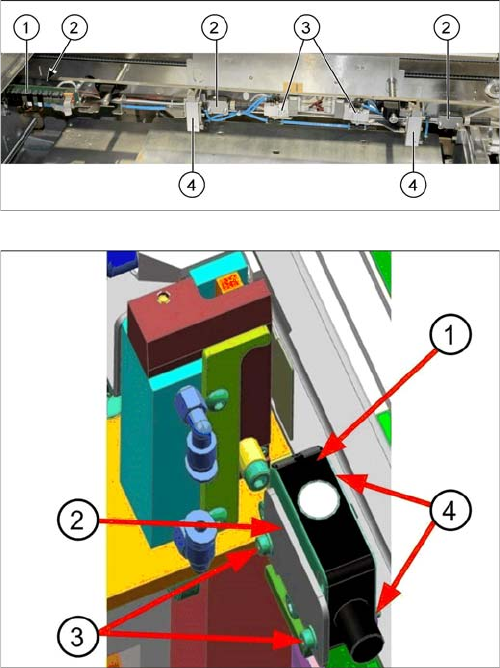
Overview
1. Conversion board
2. Ultrasonic sensors (3x)
Access to the ultrasonic sensors depends on the in-
stallation position. If the sensors are not directly ac-
cessible, you may need to remove the conversion
board.
3. Solenoid valves (2x)
4. Stoppers (2x)
Sonar sensor on the stopper positions:
1. Sonar sensor
2. Sensor rail fixture bracket
3. Fastening screws ISO4762–M2x16-A2-70
[03042529-xx] with washers DIN125-A2.2-140HV-A2
[00301541-xx].
4. Press-in nut
Service Work
Conveyor 3.6.21 Replacing the Ultrasonic Sensor PXS240 [03069863-xx]
128 Service Manual SIPLACE SX4/DX4
Removal
► Use the software to move the conveyor sides into the position which allows you best access. As an
alternative, you can loosen the clamps for the relevant sides in dual conveyors.
► Switch off the machine, disconnect it from the power supply and secure it to prevent unauthorized
reactivation. Observe the instructions in section "1.2 Preparatory Work..." [ ➙ 12].
► Dismantle the cover plate on the sensor rail.
If you need to replace the ultrasonic sensor behind the conversion board, perform the steps described
below:
► Remove a different, functional ultrasonic sensor from the rail by following the instructions above.
(You can then fit the new ultrasonic sensor in its place.)
► Fit this ultrasonic sensor in the position behind the conversion board and reestablish all connections
to the ultrasonic sensor.
► Fit the conversion board and reestablish all connections to it.
Background: the ultrasonic sensor behind the conversion board is not easily accessible for any teaching
procedures which may be required. This exchange of sensors means that this ultrasonic sonar does not
need to be taught.
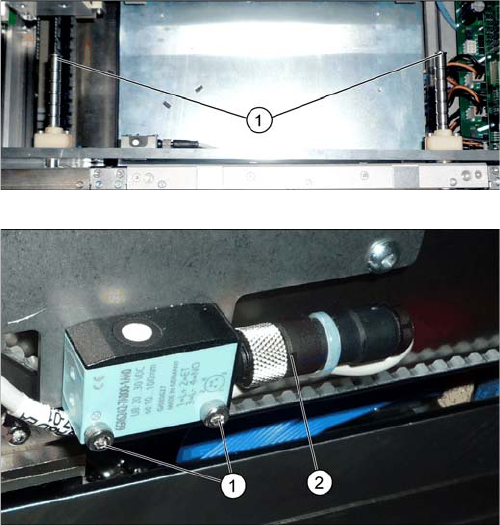
► If needed, the sensor rail can be removed to allow
better access. Simply loosen the two screws (1) on
the ends of both shafts.
► If you need to replace the ultrasonic sensor behind
the conversion board, dismantle it first. Unplug all
connections. You may want to mark the positions, to
make clear assignment easier later on.
► Loosen the screws (1) fastening the ultrasonic sen-
sors.
► Unscrew the press-fit connection (2) from the ultra-
sonic sensor and remove the ultrasonic sensor from
the machine.
Service Work
3.6.21 Replacing the Ultrasonic Sensor PXS240 [03069863-xx] Conveyor
Service Manual SIPLACE SX4/DX4 129
Installation
► Follow the removal instructions in reverse order for installation of the new ultrasonic sensor. Also ob-
serve the following instructions:
Assembly at the stopper positions
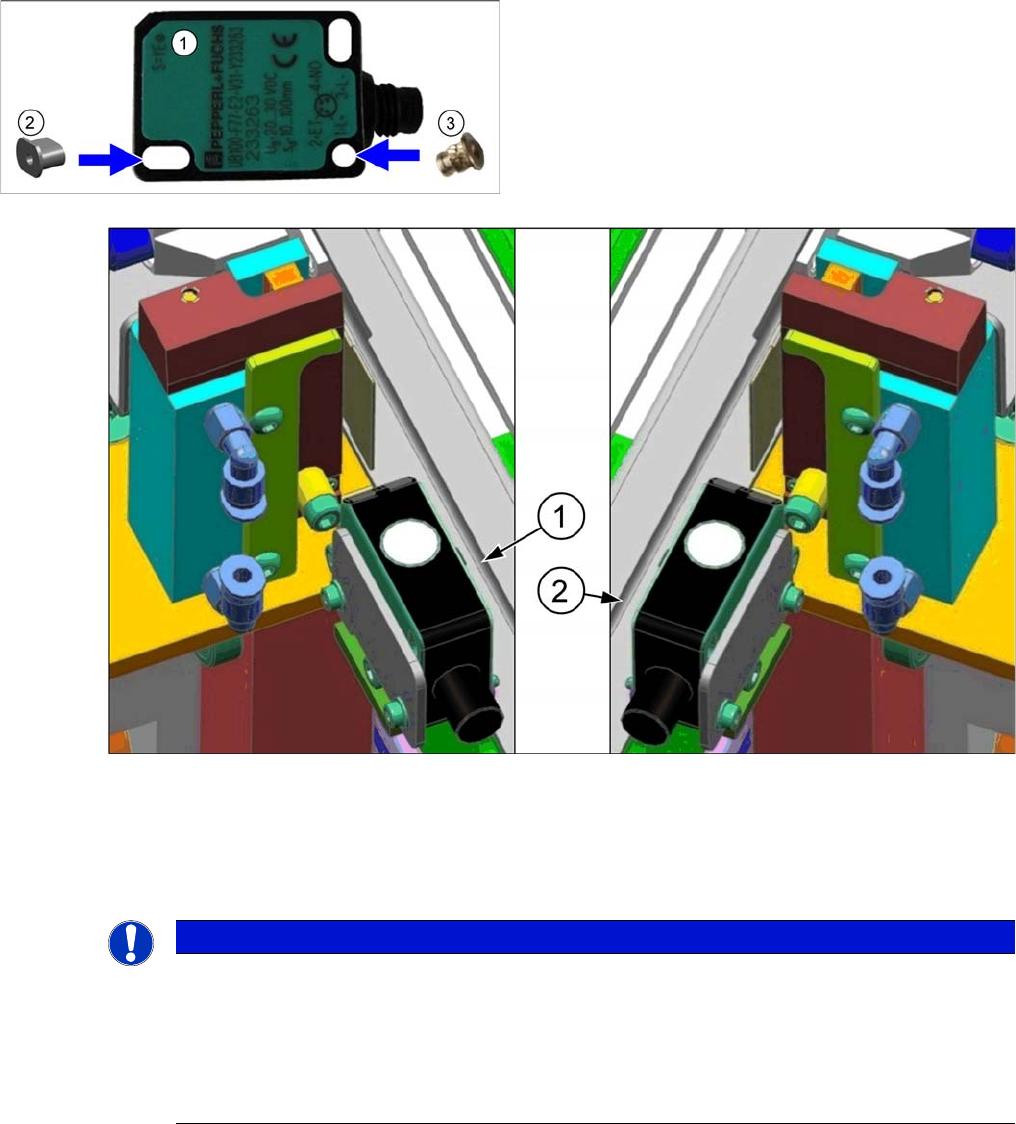
► Insert the sockets into the sensor:
1. For sonar sensors on the sensor rail of the right side, you need to position the sockets on the right,
as viewed from the connection side.
2. For sonar sensors on the sensor rail of the left side, you need to position the sockets on the left, as
viewed from the connection side.
1. Sonar sensor
2. Threaded socket P+F [03096703-xx] (oval)
3. Press-in threaded insert M2 [03088352-xx] (round)
NOTICE
Recommendation: fix socket with adhesive
The sockets do not need to be fixed with adhesive for technical reasons. However, for easier
assembly it may be advisable to fix them like this. This helps to prevent them from falling out or
from the socket being turned with other parts.
► Use suitable adhesive to fix the sockets. It should be designed to bind plastics with metal
e.g. Loctite 401 [00805104-xx].