SIPLACE-SX4-DX4-用户手册.pdf - 第147页
Service Work 3.7.4 Replacing the Twin/VHF Head Placement heads Service Manual SIPLACE SX4/DX4 147 Overview The Twin VHF consists of t wo id entical Twin segments, which are fitted at an angle of 180°. Removal NOTICE Modu…
Service Work
Placement heads 3.7.4 Replacing the Twin/VHF Head
146 Service Manual SIPLACE SX4/DX4
Conversion to another installation height
3.7.4
3.7.4 Replacing the Twin/VHF Head
Replacing the Twin/VHF Head
Parts, equipment and tools
▪ Select the relevant placement head:
– Twin Pick&Place module [03033628-xx]
– Twin Pick&Place module THK R2 [03097485-xx]
– Very High Force P&P head [00119813-xx]
– Very High Force Twin head [00119814-xx]
– Twin VHF [03096701-xx]
▪ Torque screwdriver 100-500 Ncm [03078400-xx]
▪ Extension/straight TX20 [03073256-xx]
▪ Extension/straight [03043440-xx]
▪ Bit holder for Torque Vario-S screwdriver [03078706-xx]
▪ Calibration tool version 3 [03010565-xx]
▪ For additional work to the placement head:
Service manual "C&P head" [DE: 00197468-xx]. [EN: 00197469-xx].
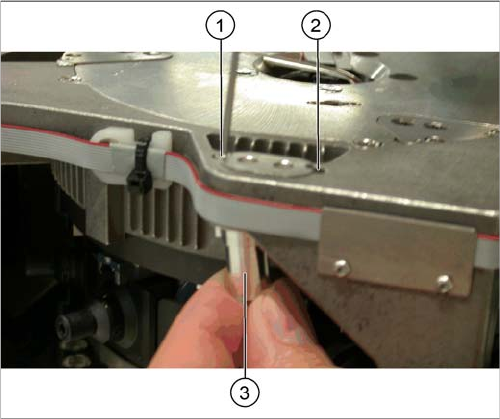
1. Drilling for the fastening screw of the bushing in "head
at bottom" position
2. Drilling for the fastening screw of the bushing in "head
at top" position
3. Bushing
All four bushings and the holding bracket must either be
fixed in top or bottom position.
Proceed as follows when replacing the bushings:
► Undo the fastening screws of the bushings.
► Insert the bushings in the correct position and re-
tighten them.
► Perform these steps for all four fastening bushings
and the holding bracket of the head.
Service Work
3.7.4 Replacing the Twin/VHF Head Placement heads
Service Manual SIPLACE SX4/DX4 147
Overview
The Twin VHF consists of two identical Twin segments, which are fitted at an angle of 180°.
Removal
NOTICE
Module 1 and 2
The removal procedure is described here for module 1 (left). Removal for module 2 (right) is the
same.
► In the case of older Twin heads, you need to remove module 1 before you can remove mod-
ule 2. During installation, module 2 needs to be fitted before module 1.
► In the case of newer Twin heads and all Twin VHF heads, the modules can be removed
and fitted individually.
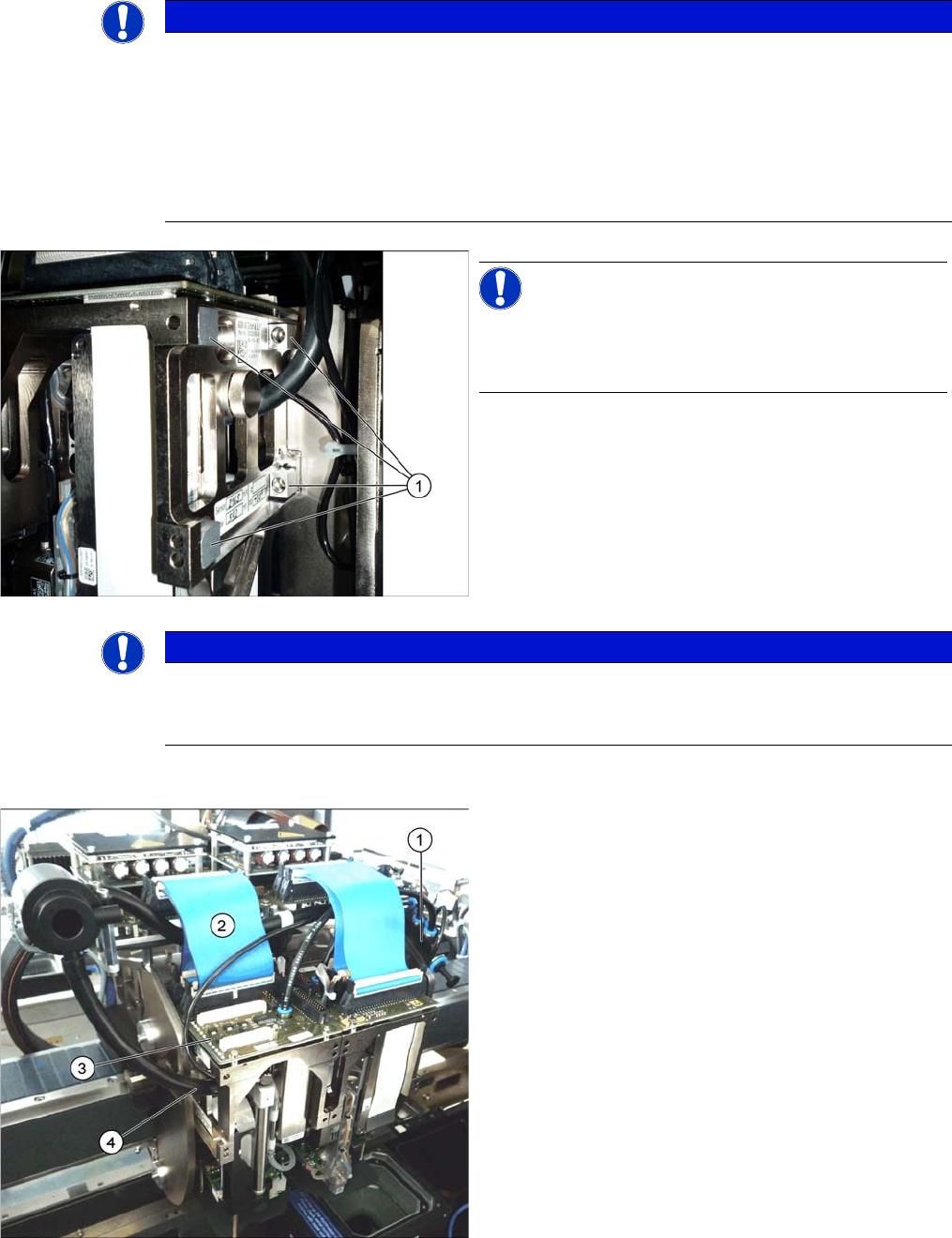
NOTICE!
When using modules with undetachable screws (1), you
may need to fit these screws on the other side, depending
on the installation position.
NOTICE
Twin and Twin VHF head
Removal and installation of the Twin VHF head follows the same procedure as that for the Twin
head. Any differences will be explicitly indicated.
► Switch off the machine, disconnect it from the power
supply and secure it to prevent unauthorized reacti-
vation. Observe the instructions in section "1.2 Pre-
paratory Work..." [ ➙ 12].
► Move the gantry into a position which allows you best
access.
► Unplug the pneumatic connection from the TwinHead
vacuum generator to the pneumatic distributor (1)
and the silencer.
► Disconnect the exhaust air silicone hose from the
TwinHead vacuum generator (4).
► Unplug the pneumatic connection from the pneumat-
ic distributor (1) to the TwinHead return cylinder.
► Unplug the flat ribbon cable (2) from the head main
board (3) on the TwinHead.
Service Work
Placement heads 3.7.4 Replacing the Twin/VHF Head
148 Service Manual SIPLACE SX4/DX4
Installation
► Follow the removal instructions in reverse order for installation. Also observe the following instruc-
tions:
See also
5.8.2 Calibration [ ➙ 267]
5.8.2.1 Calibrating the Heads and Cameras [ ➙ 267]
3.7.2 Replacing the C&P20/A/M Head [ ➙ 139]
3.7.3 Replacing the CPP Head [ ➙ 142]
3.7.5 Installation Positions on the Head Plate [ ➙ 149]
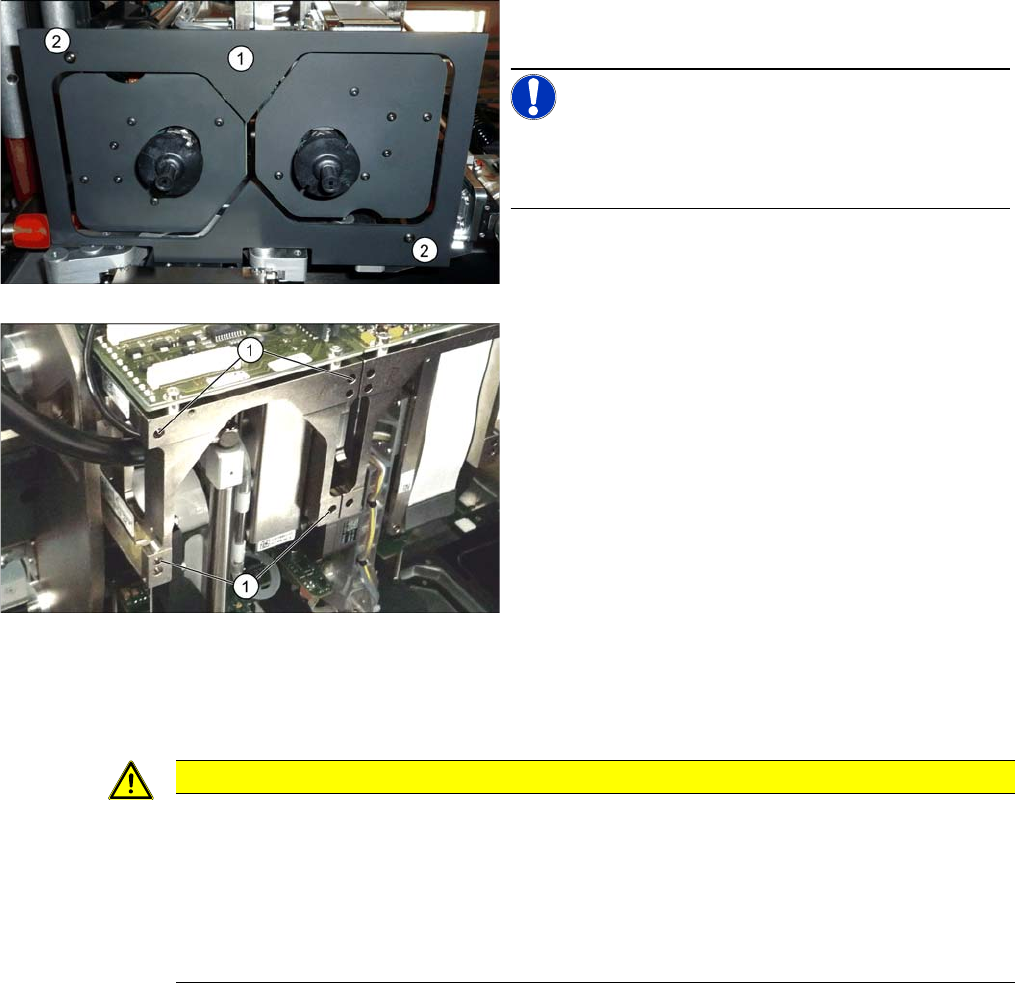
► Remove the camera screen (1). This is fastened with
two black screws (2).
NOTICE!
Only use these screws to fix the camera screen. This pre-
vents reflection when measuring components with the
stationary camera.
Each module is fixed with four screws to the head plate
and is positioned with two pins.
► Loosen the four M4x14 fastening screws (1) with a
long Allen key.
► Pull the module out of the locating pins.
CAUTION
Installation instructions
► Fit the fastening screws on the other side of the module, if needed (see above).
► Make a note of the force values for the new module. These force values can be found on a
label at the side of the module.
► Make sure that the assembly position is correct.
► Perform head calibration.