CX200-4(Maint).pdf - 第277页
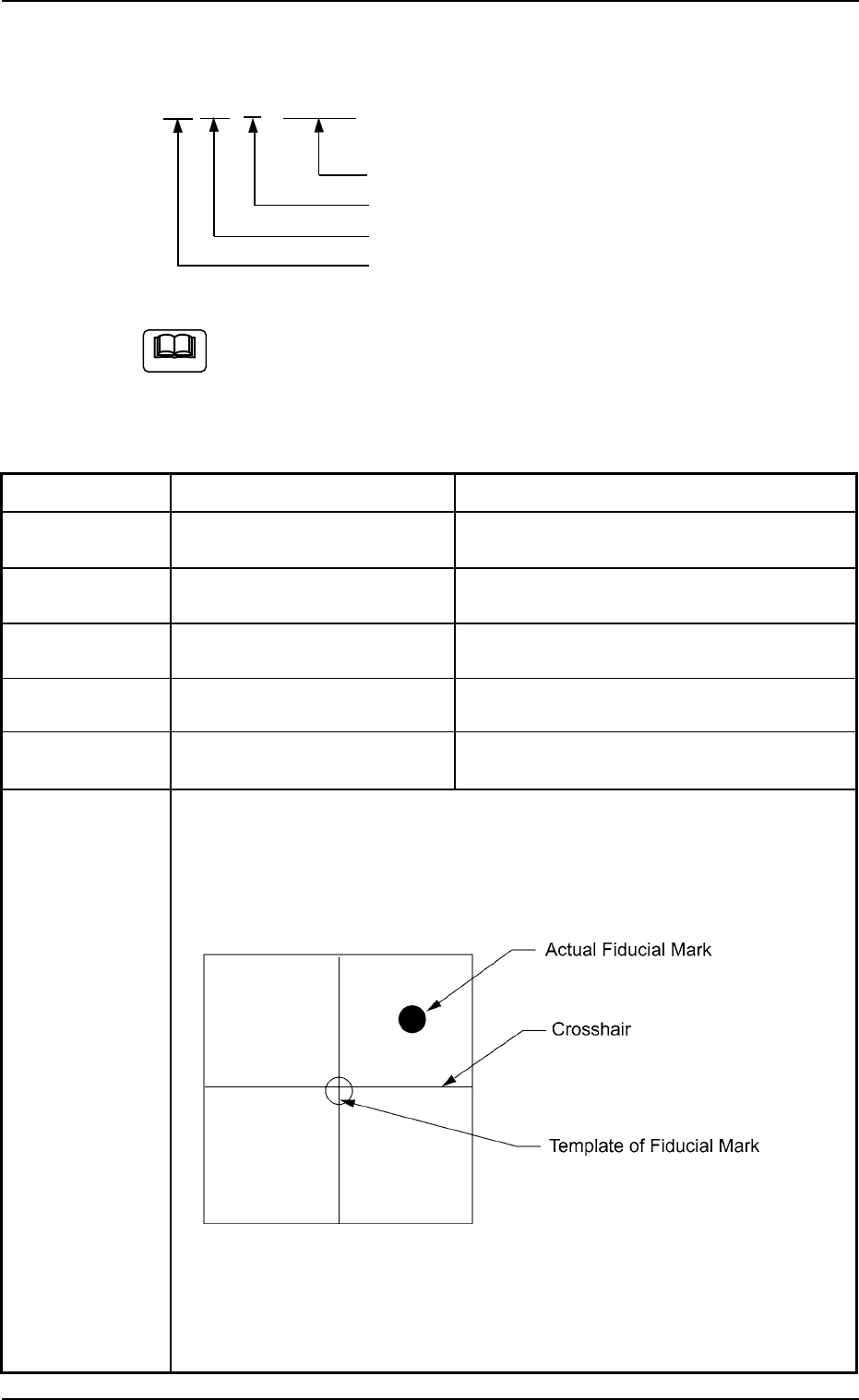
(2) Manipulate the trackball until the actual fiducial mark and the tem- plate of the fiducial mark (located at the center of the crosshair) overlap each other . Note: Enlarge the view for accurate alignment operation. O…
4.3.3 P.E.C. Recognition Errors
AA BB C DDDDD
Detail Code
Secondary Error Classification (1 to 4)
Primary Error Classification (0 to 1)
Classification (03) of Recognition Functions
(a) Error IDs “*” will be filled with detail codes.
(b) When an error ID other than the described ones is issued,
contact our service personnel for some advice.
Table 4B12
Recognition Error ID Item Description
03 00 1 ***** ---- Specified Mark Not Found in Recognizable
Range.
03 00 2 ***** ---- Unstable Image around Fiducial Mark.
03 00 3 ***** ---- Extensive Error in Similitude of Mark Shape.
03 00 4 ***** ---- Extensive Error in Similitude of Mark Shape or
Size.
03 01 1 ***** ---- Specified Mark Not Found in Recognizable
Range.
(Cause 1)The fiducial mark and the fiducial mark coordinates X and Y or the mark
data are not suitable.
(Remedy 1) Follow the steps below to reset the machine to the normal condition.
(1) When the [RETURN] button is pressed, the following recognition
window appears.
Fig. 4B24 Sample Display of Recognition Window
(Continue to the next page. )
01 10-003 2-187 AFO01ETRP
Note
4.3 Recognition Error IDs and Remedial Procedures
(2) Manipulate the trackball until the actual fiducial mark and the tem-
plate of the fiducial mark (located at the center of the crosshair)
overlap each other.
Note: Enlarge the view for accurate alignment operation. Other-
wise, components may not be placed accurately.
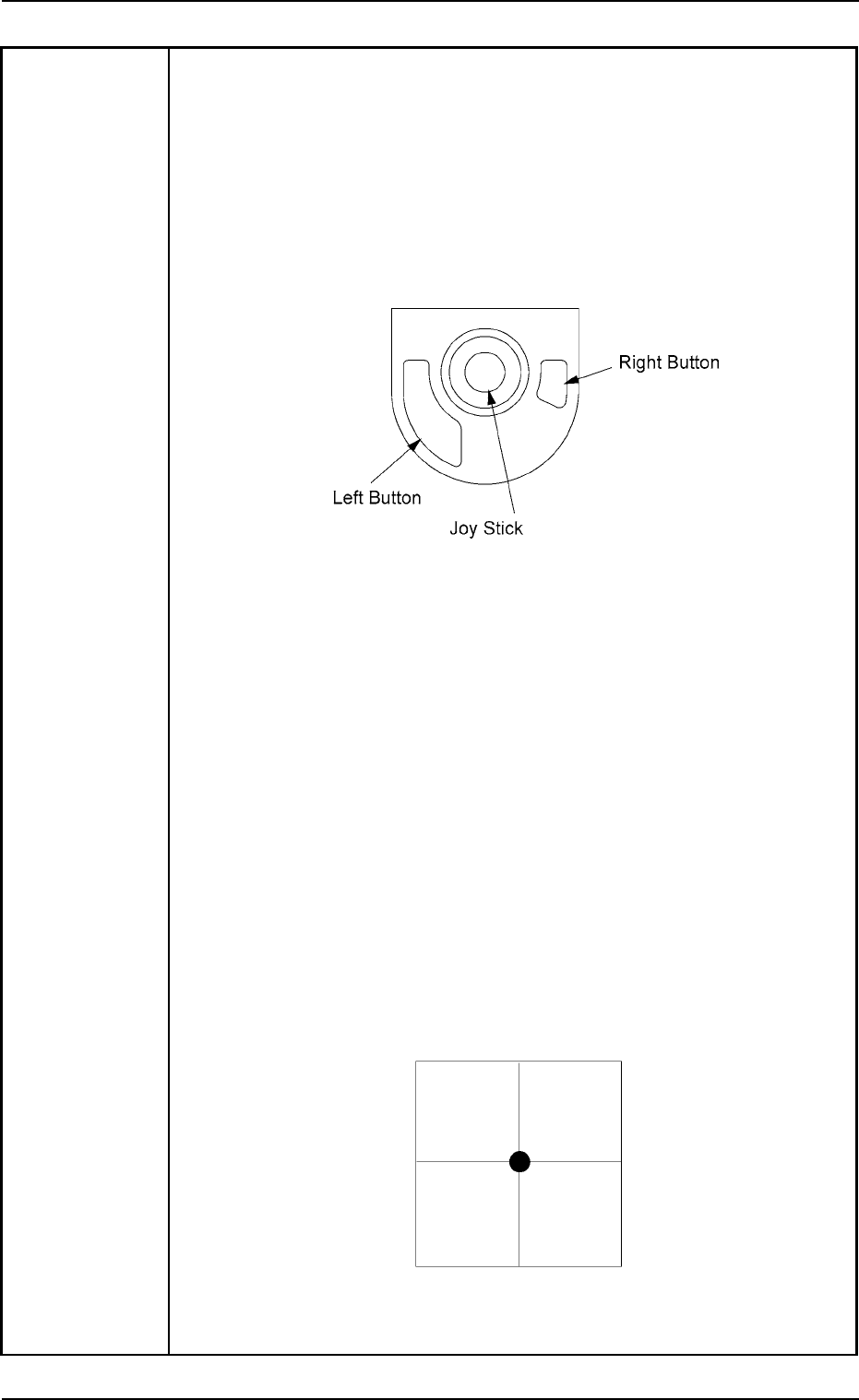
How to manipulate the trackball
• Move the actual fiducial mark with the trackball.
• Use the right button to enlarge the view.
• Use the left button to reduce the view.
Fig. 4B25
(3) After adjusting the actual fiducial mark and the template accurately,
press the right and left buttons of the at the same time.
The “AUTO OPN.” window resumes.
When the [START] button is pressed, the automatic operation starts
again.
Note: Pressing both right and left buttons at the same time is vali-
dated only once.
If the actual fiducial mark and the template are not adjusted
correctly, components may not be placed accurately. In this
case, follow the remedial operation described below.
(3-1) Press the [STOP] button to stop the machine.
(3-2) Press the [Cancel] button to interrupt the automatic opera-
tion.
(3-3) Perform the zeroing operation on all axes.
(3-4) Open the “Run Mode” tab sheet. (Operation Sequence: [OPN.
MODE] Button Æ “Run Mode” Tab Sheet) Press the [SEMI-
AUTO (STEP)] button to re-start the automatic operation.
Fig. 4B26 Sample Display of Recognition Window
at Completion of Alignment Operation
01 10-003 2-188 AFO01ETRP
4.3 Recognition Error IDs and Remedial Procedures
4.3.4 Nozzle Recognition Errors
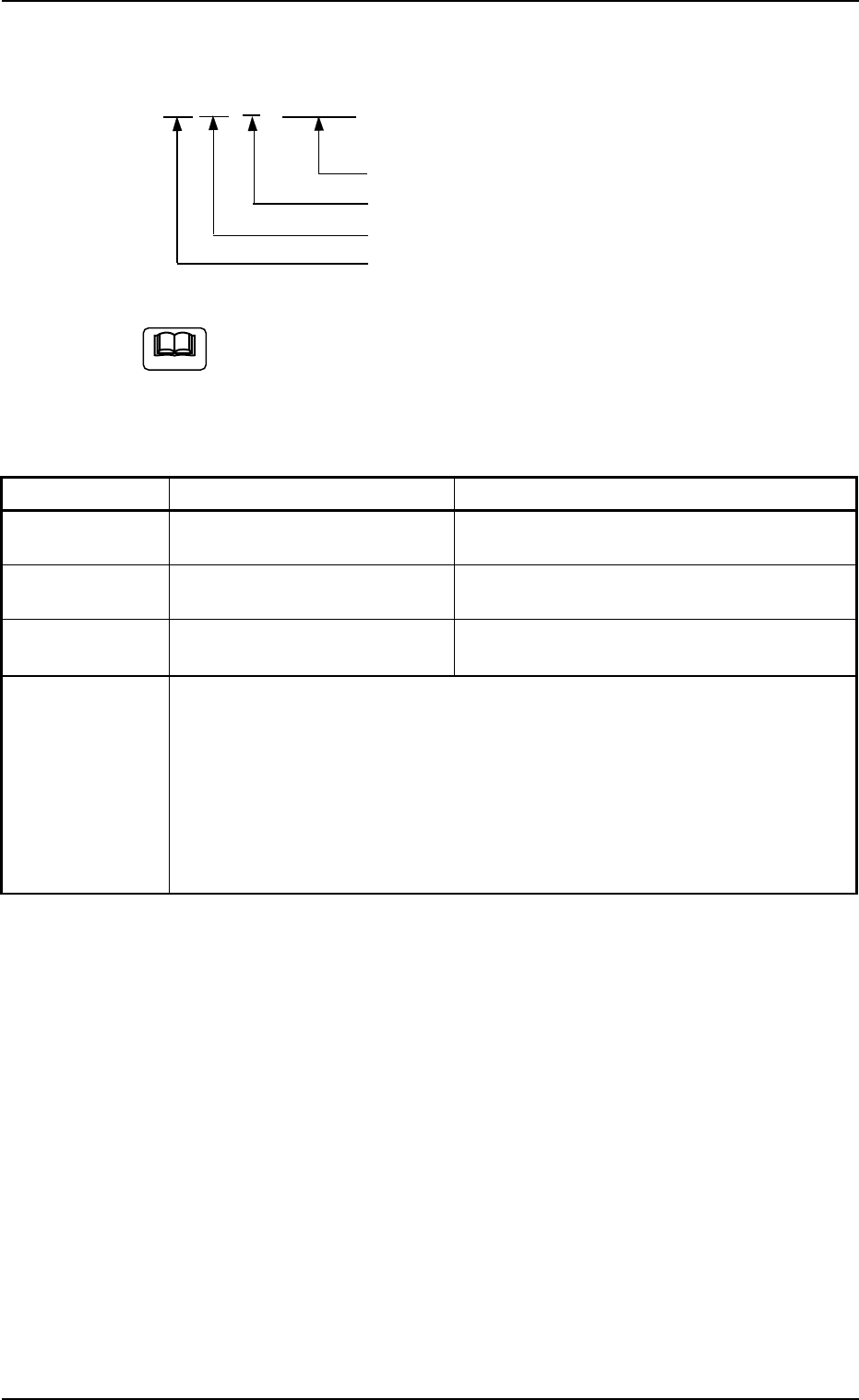
AA BB C DDDDD
Detail Code
Secondary Error Classification (1 to 3)
Primary Error Classification (0)
Classification (04) of Recognition Functions
(a) Error IDs “*” will be filled with detail codes.
(b) When an error ID other than the described ones is issued,
contact our service personnel for some advice.
Table 4B13
Recognition Error ID Item Description
04 00 1 ***** ---- Nozzle Not Detected.
04 00 2 ***** ---- Nozzle size has exceeded the allowable range.
04 00 3 ***** ---- Nozzle position has exceeded the allowable range.
(Cause 1) The nozzle is attached abnormally.
(Cause 2) The nozzle type data is abnormal.
(Remedy 1) Attach the nozzle correctly.
(Remedy 2) Check the nozzle type data. If necessary, correct it.
01 10-003 2-189 AFO01ETRP
Note
4.3 Recognition Error IDs and Remedial Procedures