D-serie level 1 EN.pdf - 第73页
Reference Run Vacuum Reference Run Reference Run (D-Series) S tude nt Guide Advanced Level 1 SIPLACE D-Series EN 05/2007 Reference Run 5-5 5.1.4 V acuum Reference Run 5.1.4.1 Nozzle Cleaning, Followed by V acuum Measurem…
Reference Run
Reference Run (D-Series) Axis Reference Run
Student Guide Advanced Level 1 SIPLACE D-Series
Reference Run EN 05/2007
5-4
5.1.3.2 Gantry Axis Reference Run
The first reference run also includes the commutation point search for the 3-phase drive of the gantry
axes.
Sequence:
Initializing the 3-phase drive system and the position measuring system of the gantry axes:
Search for the commutation point of the X/Y axes.
Position at the hardware end stoppers.
The Y gantry axes are stepped to the outer end stoppers.
The target position is predefined. If this is not reached and if no counter pulses can be detected at
the incremental encoder, this means that the axis has reached the hardware end stopper.
Reverse direction of axis movement and search for the zero pulse on the incremental scale.
– Load the X or Y axis zero point correction.
The axis reference run is now finished and the axes can be positioned for placement operation.
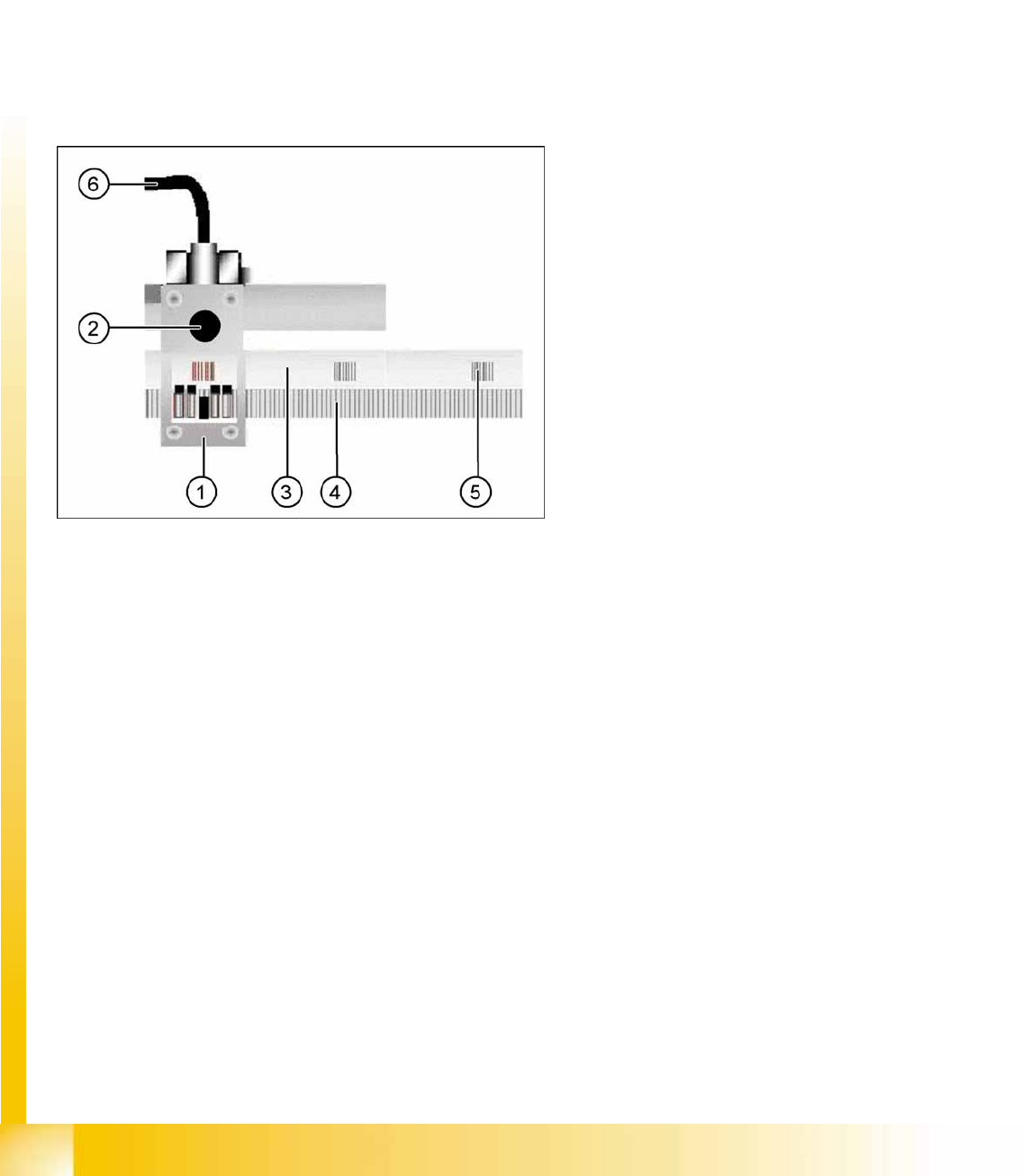
5-4: Diagram of the incremental encoder with scale
Legend
1. Incremental encoder
2. Test plug for track signals (analog)
3. Incremental scale
4. Increments on the scale (1µm resolution)
5. Zero pulse
6. Connection cable to gantry distributor/gantry
head distributor
Reference Run
Vacuum Reference Run Reference Run (D-Series)
Student Guide Advanced Level 1 SIPLACE D-Series
EN 05/2007 Reference Run
5-5
5.1.4 Vacuum Reference Run
5.1.4.1 Nozzle Cleaning, Followed by Vacuum Measurement
The vacuum values "open" and "closed" can only be measured if the nozzles have been cleaned by air
blast to remove any contaminants.
Sequence:
X The gantry axes move the placement head to the reject position.
X The star rotates in an anticlockwise direction to move all segments through the working positions.
X The electromagnetic valve is activated in a cycle for "reject component" and "clean nozzle".
X The vacuum "open" and "closed" placement values are measured for the nozzle types.
Should an error occur, this means that the nozzle opening is too small or that the vacuum duct is
blocked. --> exchange the nozzle.
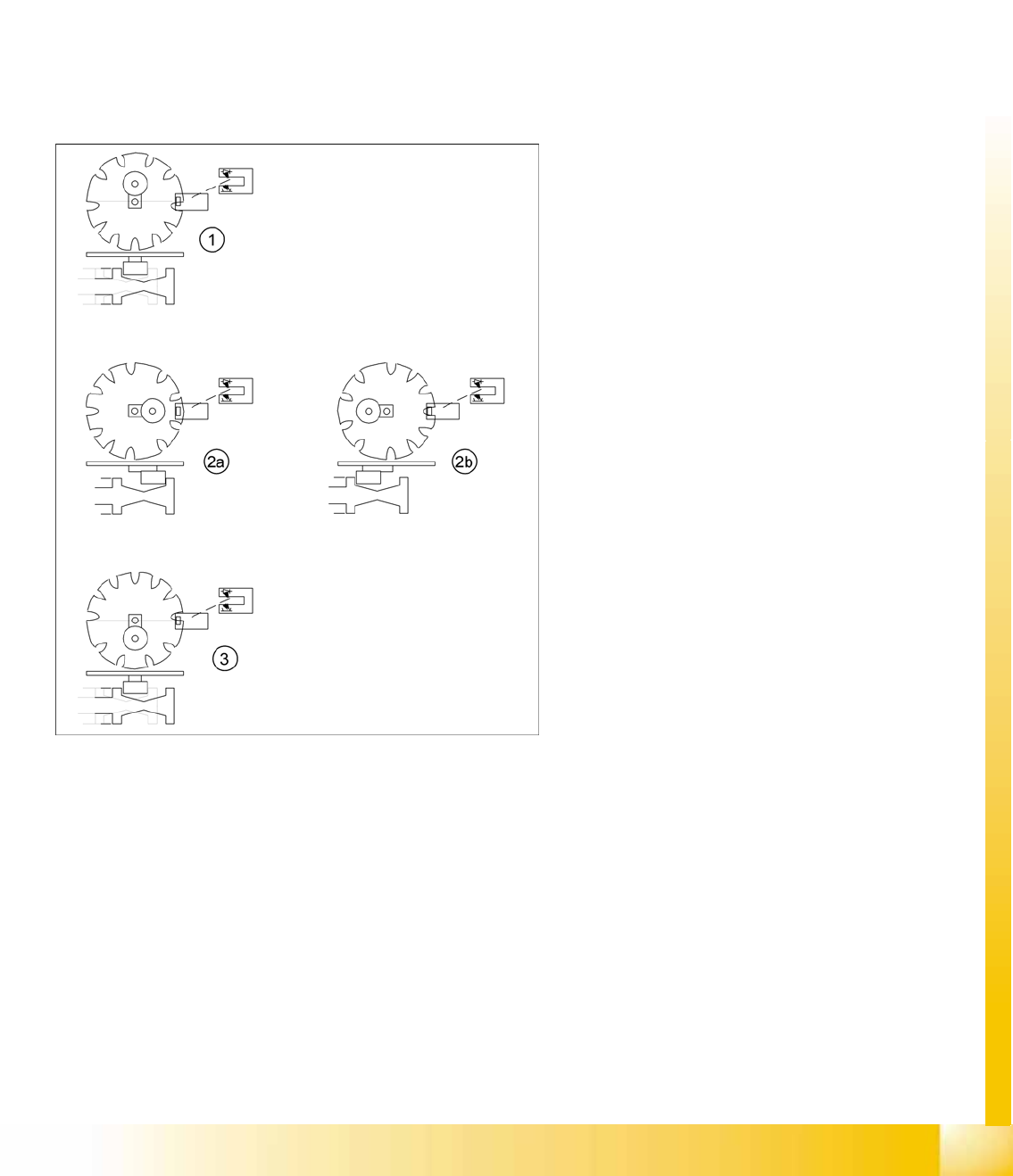
5-5: Switching over the valve positioning drives for pickup/place and reject
positions
Legend
1. Starting position. Give way free for Star axis
movement.
2. 2a: The mode "Valve positioning drive pick/
place" is switched to vacuum for "nozzle
open".
2b: The mode "valve positioning drive pick/
place" is switched to vacuum for "nozzle
closed". Parallel to this (diagram 2b) the "valve
positioning drive reject" is switched back to air
blast (and then back again).
3. Counter position to initial position. Give way
free for Star axis movement.
– The stepping motor of the valve
positioning drive is turned to the home
position. The stepping motor runs and the
light barrier on the cam disk sets the end
signal.
– Because of the special shape of the cam
disk, the stepping motor is able to
recognize the home position (1) or (3).
Reference Run
Reference Run (D-Series) Vacuum Reference Run
Student Guide Advanced Level 1 SIPLACE D-Series
Reference Run EN 05/2007
5-6
5.1.4.2 Determining the Vacuum and Threshold Values
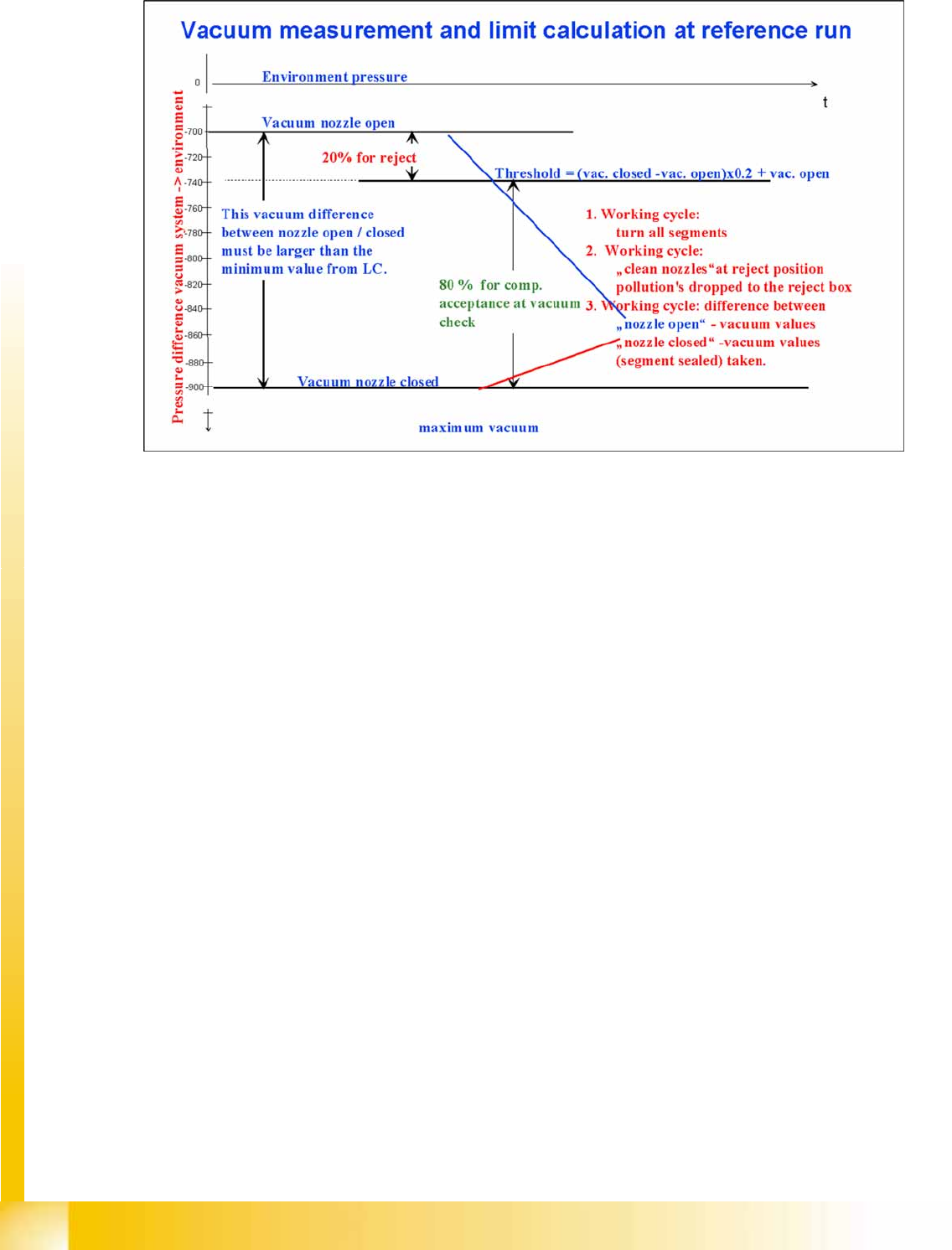
5-6: Measuring and calculating the vacuum values for a reference run
Legend
1. The vacuum is measured twice during the reference run:
– Once with closed
– and once with open valve, while air flows through the nozzle.
2. The value with closed valve depends on the ambient pressure and may vary, according to the local
weather conditions and altitude. The higher the ambient pressure, the lower the vacuum at closed
valve.
3. The value with open valve depends on the nozzle size and condition. The smaller the nozzle, the
greater the open valve value will be. A contaminated or blocked nozzle will also give a higher valve.
4. The difference between the open and closed nozzles has been preset by the line controlling line
computer (LC or SIPLACE Pro), as a minimum value. This value is different for all nozzle types e.g.
120 mbar for 914 and 904 nozzles. If these values are not achieved, the error message
"Vakuumdifferenz offen-geschlossen zu gering" (vacuum difference open-closed is too low) will
appear.
5. The threshold for component acceptance is also set now. In this case we have a value of 700 mbar
when the nozzle is open and a value of 900 mbar when the nozzle is closed. The calculation is
performed as follows:
Threshold = (900(closed) - 700(open))= x 0.2 + 700(open) = 200 x 0.2 + 700 = 740