ASM-SMT-Technical Conditions of Order and Deliveries (TCOD).pdf - 第29页
29 www.asm-smt.com - ad 1): Company name “ASM AS” . - ad 2): The part number with FS (functional version) is speci fied in the manufacturing documentation. - ad 3): The serial number must be specified if unique tracea bi…
28 www.asm-smt.com
9.6.1. General requirements
Labeling method: Adhesive label, print, engraving, laser marking, stamping, etching, eroding, other methods as agreed
with ASM AS.
• Permanent attachment to support material
• Abrasion resistance of the labeling
• Functional impairments must be excluded.
• Maximum resistance against solvents and contamination
• Temperature resistance in the range of -20°C to +7 0°C
• Non-conductive labels on electric assemblies
• Labeling should be visible in the installed condition, if possible
• Labeling should be legible even after surface treatment
• Font: Helvetica or Arial; other fonts to be agreed with ASM AS
• Character size: 1.5mm minimum (5 pts)
• Single line spacing
• Centered orientation.
9.6.2. Requirements for label markings
Acryl ate butyl adhesive for labels, PNS adhesive type and adhesive strength class T according to DIN 30646
The label size on the packaging should be not more than 90 x 60 mm.
The label size on the modules should be not more than 40 x 30 mm
Label background color: white
Font color: black
9.6.3. Labelling design
9.6.3.1. Individual parts, functional assemblies and purchased assemblies
These include manufactured parts and assemblies as well as purchased assemblies that need to be labeled to achieve a
clear identification and traceability.
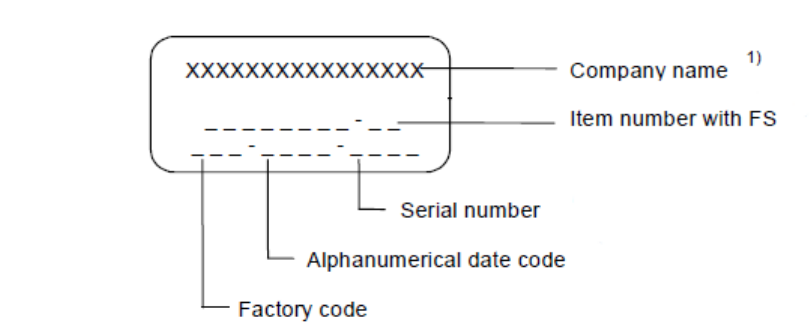
Fully designed labeling layout
2)
3)
4)
5)
29 www.asm-smt.com
- ad 1): Company name “ASM AS” .
- ad 2): The part number with FS (functional version) is specified in the manufacturing documentation.
- ad 3): The serial number must be specified if unique traceability is required.
- ad 4): The alphanumerical date code is defined in Subsection 9.6.4.
- ad 5): The factory code is specified by Purchasing.
-
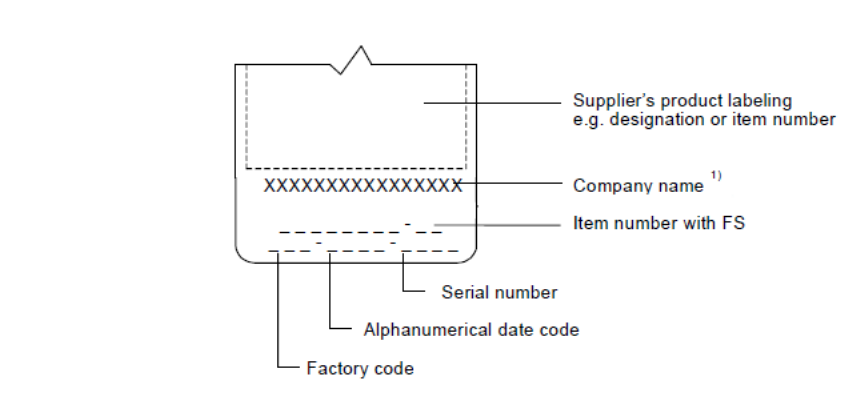
Alternative designs:
In the case of insufficient space, the labeling may have a two-line or two-part (two separate labels / fields) design.
The required labeling may be integrated with the supplier’s product labeling (see example):
Layout with smallest space conditions
With smallest space conditions at least the marking of the production plant is necessary.
The characteristic for the production plant is communicated by ASM AS purchasing.
If more space should be available, it is to be indicated additionally in the labeling depending upon available place:
- the Series/counting number, if clear parts-related traceability is necessary the Letter/number key date is
defined in section 9.6.4.
With further available place:
- the article number with FS (function conditions), which is to be taken out of the documents.
9.6.3.2. Labelling using 2D barcode
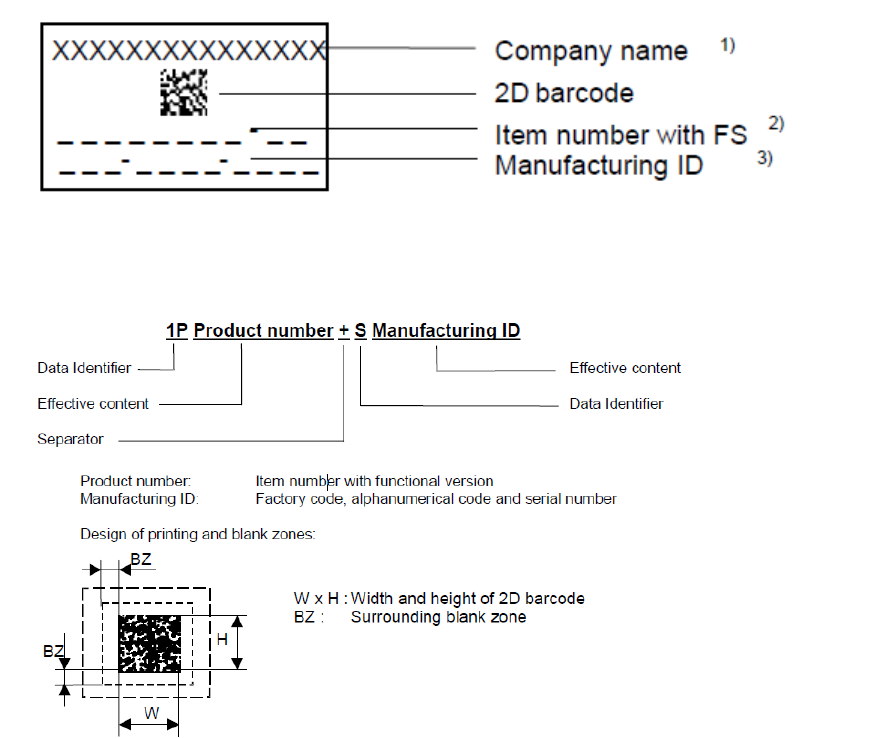
For reasons of traceability, a labeling using 2D barcode can be required as an alternative to the standard labeling. In
such cases, the manufacturing documentation will contain the note: “Product labeling using 2D barcode according to
TBL”.
Permissible labeling types are thermal transfer printing, laser printing or direct inkjet printing.
The design of the entire labeling using 2D barcode shall be submitted to the
customer on First articles for verification.
2)
3)
4)
5)
30 www.asm-smt.com
Design requirements
- ad 1): Company name “ASM AS”
- ad 2): The item number with FS (functional version) is specified in the manufacturing documentation.
- ad 3): The manufacturing ID consists of:
- Factory code: Is specified by Purchasing
- Alphanumerical date code: Defined in Subsection 9.6.4
- Serial number: To be specified by suppler on specific request of customer only
Layout in case of restricted space
The 2D coding shall be implemented in Data Matrix ECC 200 according to ISO/IEC 16022.
The data string of the code has the following information content (without spaces):
The blank zone BZ shall be designed as a function of the barcode resolution X at 2X.
The resolution is determined by the application and must be adequate for the labeling and reading technology used. The
resolution according to ISO/IEC 16022 is X 0.25mm. Higher resolutions are possible but are subject to legibility testing
by the customer.
The width W and height H of the barcode depend on the resolution X and the number of characters in the data string.
This yields e.g. the following results:
− for a resolution with 6 dots and 53 characters, a barcode size of 6.6mm
− for a resolution with 4 dots and 53 characters, a barcode size of 4.4mm
− for a resolution with 4 dots and 15 characters, a barcode size of 2.4mm