ASM-SMT-Technical Conditions of Order and Deliveries (TCOD).pdf - 第38页
38 www.asm-smt.com 9.7. Guidelines on environmental compatible product design 9.7.1. Procurement and man ufacturing aspects • Minimizing production waste by means of appropriate product design • Taking account on environ…
37 www.asm-smt.com
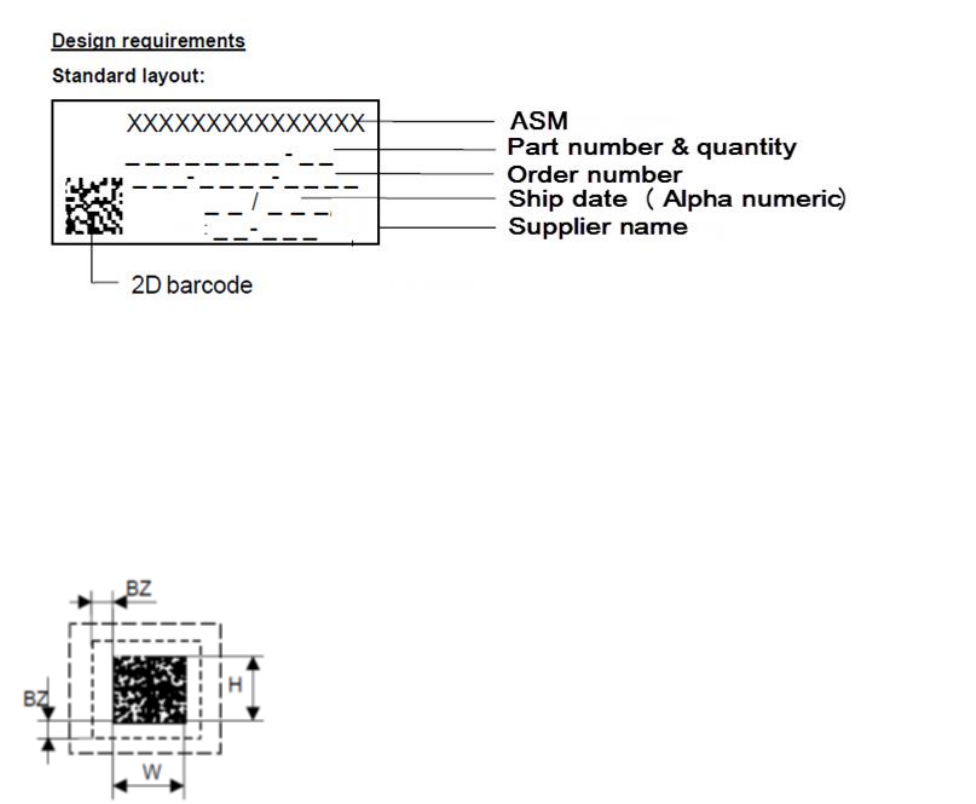
9.6.5.3. Barcode Labelling
ASM AS strongly encourage supplier to implement 2D bar code labelling on the packaging
The 2D Coding shall be implemented in Data Matrix ECC 200 according to ISO/IEC 16022
The data string of the code has the following information content
Date (11) Part Number (12) + Quantity (3) Purchase Order Number (8)
= Total of 40 characters
Product Number : Item number with functional version
Manufacturing ID: Factory Code, alphanumerical code and serial number
Design of printing and blank zones:
The blank zone BZ shall be designed as a function of the barcode resolution X at ≥ 2X
The resolution is determined by the application and must be adequate for the labelling and reading technology
used. The resolution according to ISO/ IEC 16022 is X ≥ 0.25 mm. Higher resolutions are possible but are
subject to legibility testing by the customer.
The Width W and Height H of the barcode depend on the resolution X and the number of characters in the
data string. This yields e.g. the following results:
- For a resolution with 6 dots and 53 characters, a barcode sized of 6.6mm
W x H: Width and Height of 2D barcode
BZ: Surrounding blank zone

38 www.asm-smt.com
9.7. Guidelines on environmental compatible product design
9.7.1. Procurement and manufacturing aspects
• Minimizing production waste by means of appropriate product design
• Taking account on environmental aspects in selection on procurement of semi-finished products,
components and OEM products
• Complying with legal bas and restrictions as well as with the avoidance list in the selection of material
and components
• Avoiding the use of hazardous materials in the manufacturing of products
• Minimizing energy consumption in manufacturing
• Obtaining information on the environmentally relevant properties of the semi-finished products,
components and OEM-products
• Minimizing the amount of packaging (weight, volume)
• Optimizing the environmental compatibility of the packaging in relation to the selection of material and
logistics consideration
9.7.2. Product use aspects
• Minimizing energy consumption in idle status or during operation
• Minimizing consumption of operation materials
• Excluding the possibility of harm to the environment or health caused by the materials used or by noise
• Drawing attention to operation methods that conserve resources (energy, water, etc.)
• Drawing attention to the environmental compatible disposal of consumables (batteries, toner, etc.)
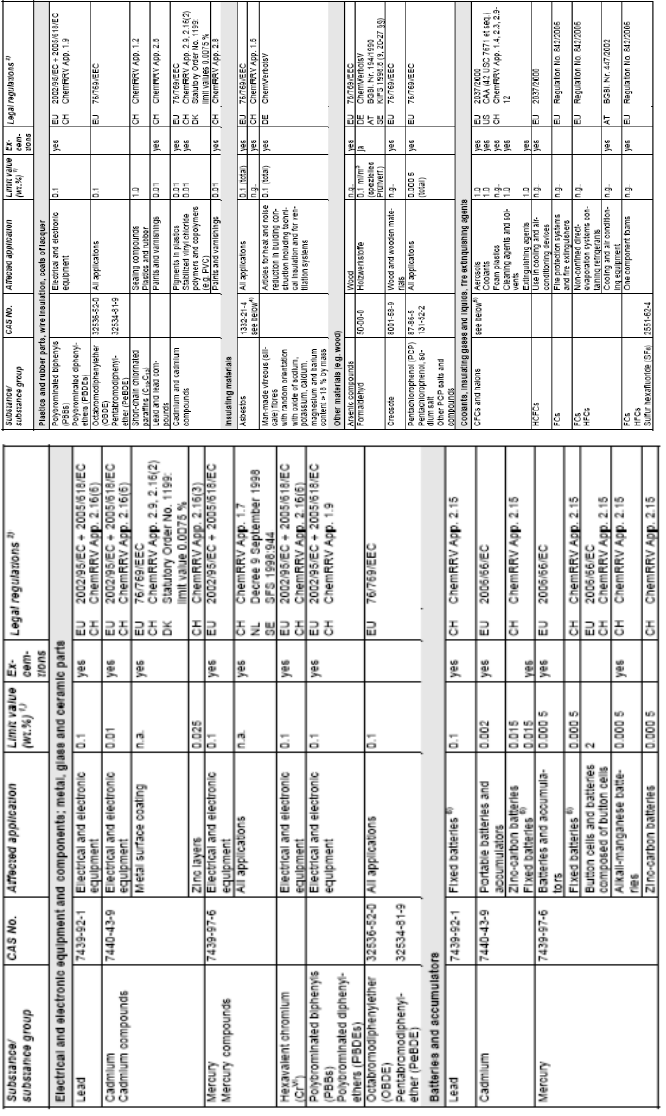
9.7.3. Prohibited substances and substances to be declared
A current overview of the prohibition substances and substances to be declared you find in the SIPLACE Internet.
http://www.asm-smt.com/sg/asm-company/suppliers
By it uninfluenced, the PRODUCTS must agree with all regulations valid in the European community, in particular
regarding restriction of contents materials in products (e.g. Regulation (EC), Regulation (EC) 850/2006, Regulation (EC),
Guideline 1907/2006 EEC)
The supplier must inform ASM AS, as soon as one of the indicated limit values is exceeded, or a special exception is
taken up.
In particular the supplier must follow his duty to supply information according to the guideline 1907/2006 EEC (Reach
regulation) in accordance with „the list of candidates” defined there. For the materials led there, an obligation to inform
exists.
The PRODUCTS must correspond to the requirements of the guideline for the restriction of the use of dangerous materials
(RoHS).
The obligation resulting from Directive on waste Electrical and Electronic Equipment (“WEEE Directive”) to declare
materials and components that are to treat separately according to annex of this directive is to be considered.
39 www.asm-smt.com