2500_Users_Manual - 第108页
Task s and Ki ts ProM aster 25 00 User Manua l 3-33 Introdu ction to Kits Kits are Tasks that have been da isy-chained together so several can be run as one large job . The most com mon use for Kits is to stri ng togethe…
Tasks and Kits
3-32 ProMaster 2500 User Manual
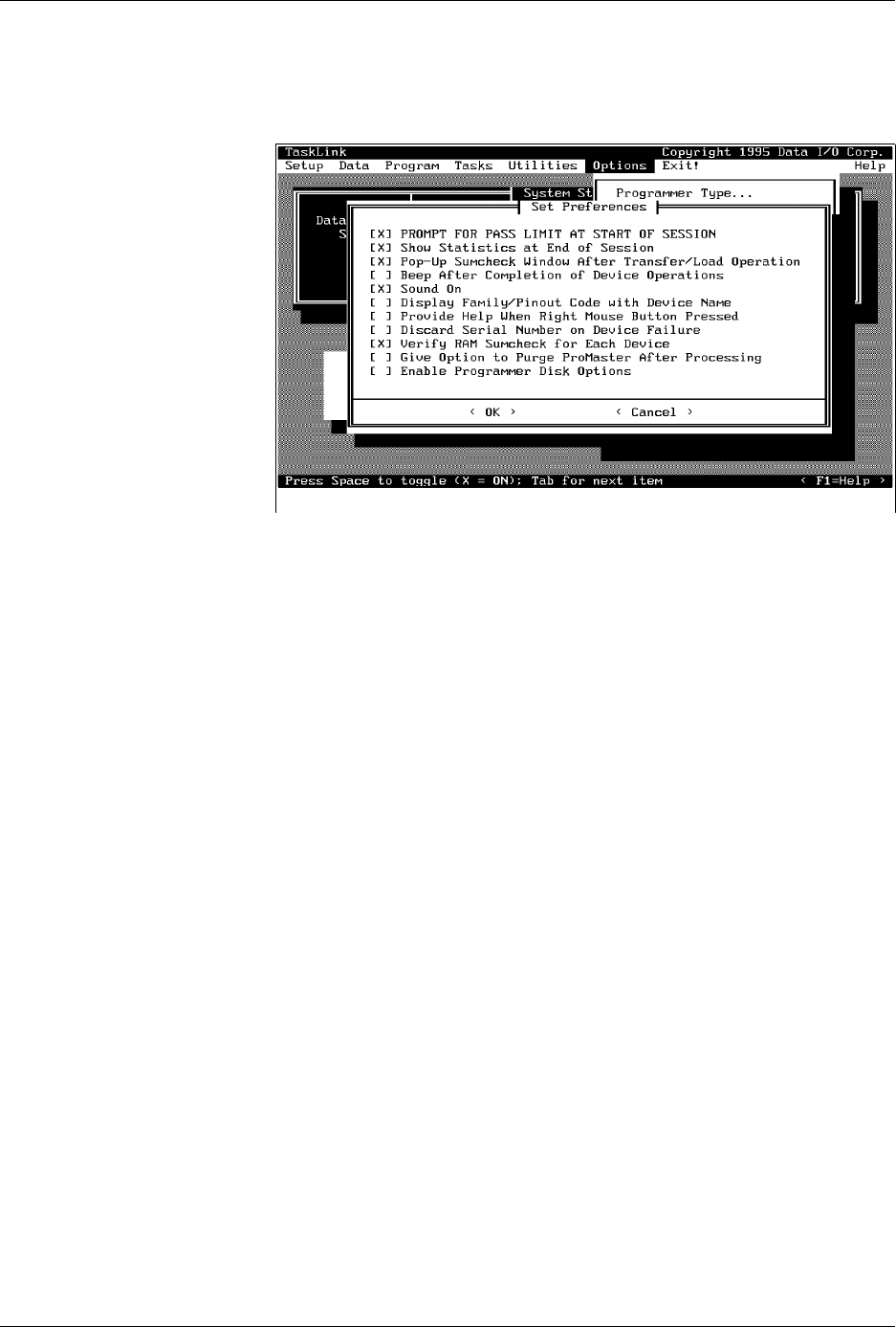
Set Preferences...
This set of check boxes allows you to configure some of TaskLink’s
optional system prompts and operating preferences. Press
F1
to invoke
TaskLink’s online Help for more information on the choices presented.
Two of the options that are particularly useful with the ProMaster 2500
are described in the following sections.
Purge ProMaster After
Processing
This option directs the 2500 to remove all devices from the track sections,
moving them to an output tube. The operator does not have to manually
remove devices from the tracks and load them, observing correct polarity,
into tubes.
TaskLink displays a purge dialog box when:
• Devices are in the track at the end of a Task or programming session.
• A Task has been terminated by the operator.
• The next Task in a Kit uses a different device type.
The
Purge...
dialog box prompts the operator to choose
<OK>
to start
purging parts from the system. If
<CANCEL>
is selected, any parts in the
tracks must be removed by the operator.
Remove the input tube if it has any devices and make sure that at least
one empty output tube is installed before selecting
<OK>
. TaskLink will
send all devices detected in the input track through the 2500 before it
completes the purge operation.
Enable Programmer
Disk
TaskLink (V1.4 or higher) will create and load your data files on either the
2500’s floppy drive or the MSM. To see the new commands displayed on
the TaskLink menus, you must select the
Enable Programmer Disk
Options
from the
Set Preferences
dialog box.
Figure 3-21
Configuring Operating
Preferences
Tasks and Kits
ProMaster 2500 User Manual 3-33
Introduction to Kits
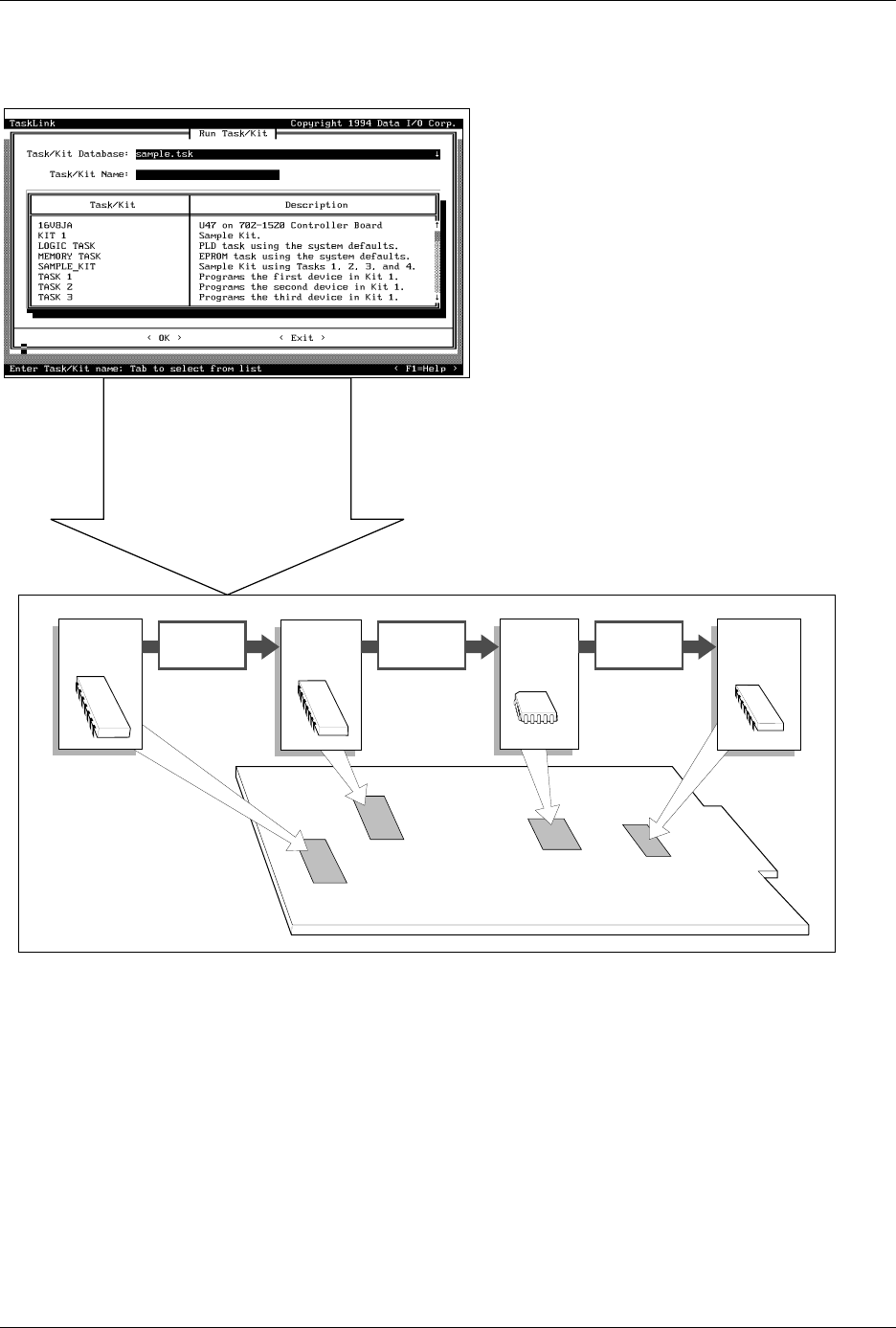
Kits are Tasks that have been daisy-chained together so several can be
run as one large job. The most common use for Kits is to string together
the separate Tasks used to program all the devices for a single board. In
Figure 3-23 there are four devices that must be programmed and labeled
for the sample board. Each device has one Task that controls the process
for producing that device. The Kit acts like a super-Task.
To illustrate this point, assume that 60 boards need to be built. When the
Kit for this board is run, the Task 1 pass limit is set to 60 devices. When
that count is reached, TaskLink displays a message prompting the system
operator to change over for the second Task. When ready for Task 2, the
operator presses
↵
. TaskLink starts Task 2, and 60 devices for that Task
are programmed. This process continues for Task 3 and Task 4.
The messages screens are typically used when the Tasks define devices
using different package types (Task 1 uses DIPs and Task 2 uses PLCCs).
In this case, a message screen might remind the operator about the steps
required to change over from one package type to another.
A Kit can include a maximum of 20 Tasks. All the Tasks for a Kit must be
in the same database file (called the
Source Database
in the Kit dialog
box), but the Kit can be stored in the Source Database or a different
database file. When the Kit is run, the system operator specifies the
number of Kits (equal to the number of complete boards) to be built.
Selecting Kit
Parameters
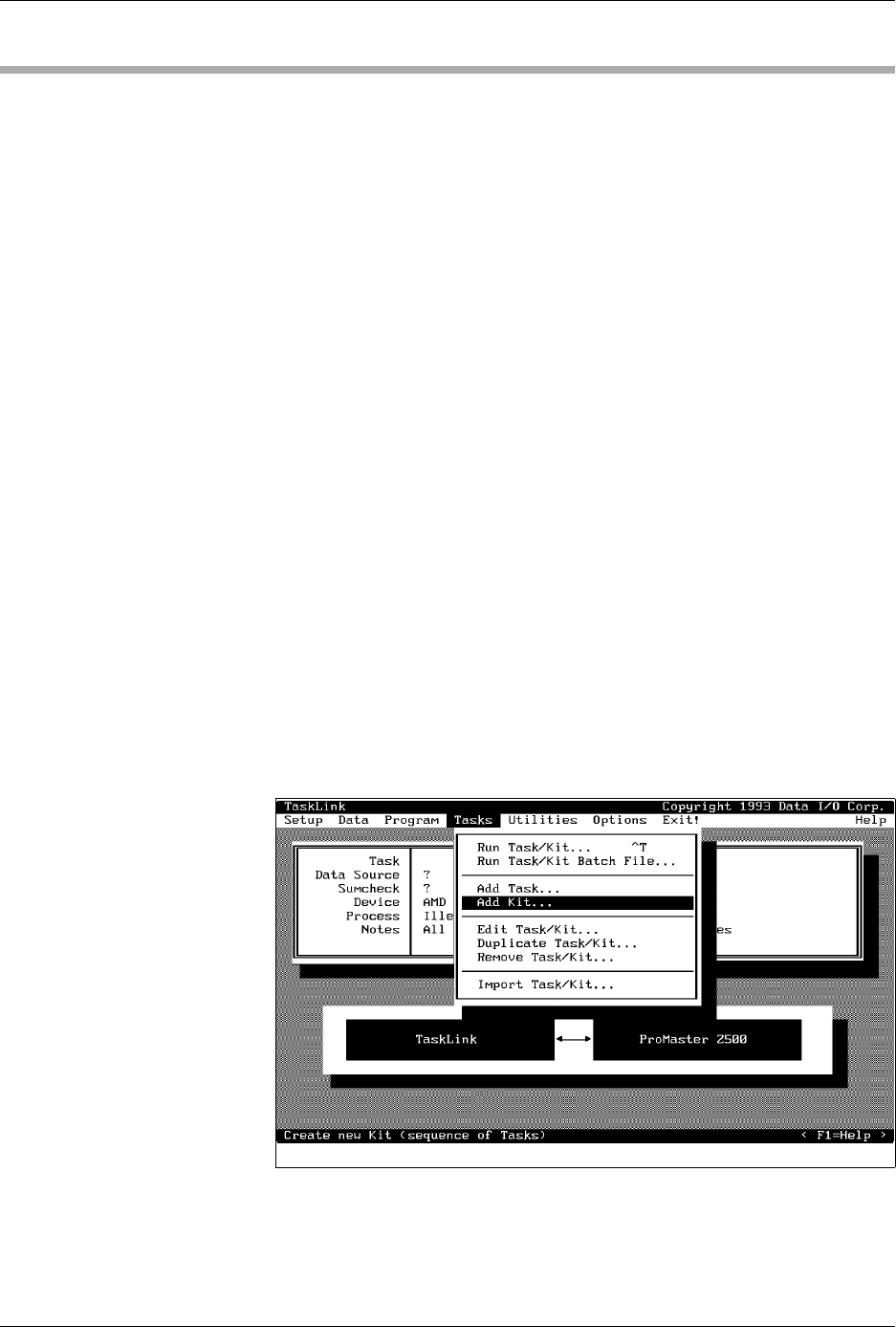
The process for creating a Kit is similar to creating a Task. From
TaskLink’s main screen, select
Add Kit...
and press
↵
(see Figure
3-22).
Figure 3-22
Selecting “Add Kit” from the
Main Screen
Tasks and Kits
3-34 ProMaster 2500 User Manual
Figure 3-23
Kits are a Series of Tasks in a Single Job
1958-2
Run Kit
Perform all Tasks in Kit
Number of Kits to Build
Session I.D.
Device
Process
•
•
•
•
•
Specify
Task 1
Task 2
Task 3
Task 4
Message
~0001
Message
~0002
Message
~0003