2500_Users_Manual - 第117页
Operation ProM aster 25 00 User Manua l 4-3 Figure 4-1 Overv iew of th e Proced ure for S tarti ng a Task 1950-3 2 4 5 6 8 9 10 7 1 3 Type "t l " on the PC keyboard 7 6 11 b a a b 11 12 a b (Insert Screen) (Ins…

Operation
4-2 ProMaster 2500 User Manual
What Is a Task?
A Task is a job setup containing all the information necessary for
programming and/or testing a particular part. A Task records all the
parameters of the job setup from the device type and data file used to the
label text printed and placed on the device. Once a Task has been
selected, TaskLink performs most of the system setup automatically and
prompts the operator to insert devices to begin processing.
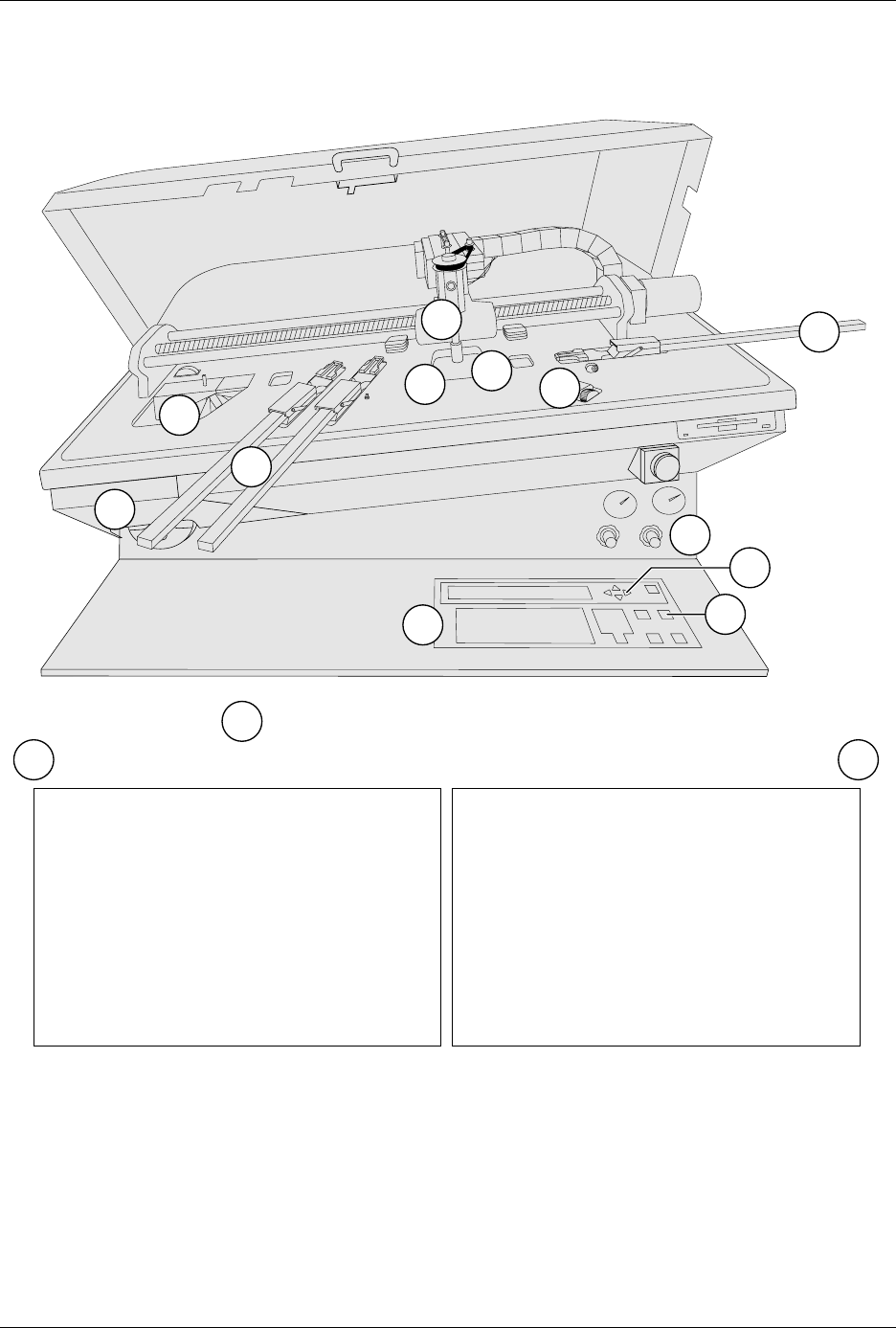
Overview: Starting a New Task
There are several steps that you will routinely need to perform each time
you select a device that uses a different package type or size. These steps
are listed below and can be used as an overview of the process for new
operators and as a refresher for experienced users. Each step has its
number called out in Figure 4-1.
1. Configure and install a new programming module (page 4-8).
2. Adjust track width (page 4-12).
3. Install new chuck (page 4-16).
4. Check high and low air pressure (page 4-17).
5. Install new labels (page 4-18).
6. Perform an ADC label calibration (pages 4-19 and 4-22).
7. Insert an input tube and two empty output tubes (page 4-22).
8. Start TaskLink (page 4-23).
9. Select a Task from the screen list (page 4-24).
10. Select device from the choices on the screen (page 4-24).
11. Align the beam-to-device and the device-to-module (page 4-27).
12. Press
START
to start the Task.
13. If needed, check the track air during operation (page 4-40).
Operation
ProMaster 2500 User Manual 4-3
Figure 4-1
Overview of the Procedure for Starting a Task
1950-3
2
4
5
6
8
9
10
7
1
3
Type "tl " on the PC keyboard
7
6
11
b
a
a
b
11
12
a
b
(Insert Screen)
(Insert Screen)

Operation
4-4 ProMaster 2500 User Manual
Antistatic
Precautions
The devices that you will be handling and programming on the 2500 are
sensitive to static and can be damaged by accidental and unintended
electrostatic discharge while you are handling them. To minimize
possible damage to devices, wear your wrist strap and plug the end into
the ground strap connector in the lower left corner of the 2500 (see Figure
1-2).
CAUTION: The devices being processed through the ProMaster 2500 and
components on the system’s circuit boards are static
sensitive and may be damaged by electrostatic discharge
(ESD). To help eliminate damage from ESD, operators and
service personnel should wear an antistatic wrist strap
while using the equipment. The wrist strap should be
connected to the grounding plug. It should contain a 1M ohm
(minimum value) to 10M ohm (maximum value) isolating
resistor.
Raising the Hood
While a Task is
Running
The 2500 has been designed to operate only when the hood is down in the
operating position (see Figure 1-2). A safety interlock switch is activated
when the hood is raised to stop all handler motion and laser marking. It
must be lowered into operating position before you can start a Task.
Do not lift the hood while the handler is processing devices. If you raise
the hood, the 2500 will immediately stop processing and leave the
condition of the devices being programmed in an unknown state. Devices
in the programming modules may not complete the programming
operation correctly and should be removed and discarded. If you need to
examine something under the hood while a Job/Task is running, select
Pause
from the TaskLink screen to stop the 2500, after the current
device(s) has completed the programming cycle.
If you lift the hood without pausing TaskLink and want to continue
running the Job/Task, lower the hood to continue operation.
WARNING:Any attempt to bypass the hood interlock could result in
operator injury. Do not attempt to defeat this safety
feature.
Operating Noise
Level
The typical operating noise level of the 2500 may exceed 70 dB because of
the many complex functions taking place at the same time, such as:
• Heavy subassemblies being driven rapidly by motors along sizable
lead screws.
• Air actuators being rapidly turned on and off.
• Vacuum motors making noise.
WARNING:Long term exposure to noise levels in excess of 70 dB could
cause hearing loss. Personnel working near the 2500
should wear hearing protection.