Utah-94-721002-System-Manual.pdf - 第46页
mä~ëã~ä~Ä póëíÉã=NMM l ñÑçêÇ =fåëíê ìãÉåíë =m ä~ëã~=qÉÅ ÜåçäçÖó== System Manual to the periphery of the wafer. Helium is the preferred g as, because it has a very good heat transfer ability. The use of other gases is pos…

System Manual lñÑçêÇ=fåëíêìãÉåíë=mä~ëã~=qÉÅÜåçäçÖó== mä~ëã~ä~Ä póëíÉã=NMM
PKR= VQJNMMJRJNO^=`êóç=L=ÜÉ~íÉÇ=ÓNRMLQMM`=ÜÉäáìãJ~ëëáëíÉÇ=äçïÉê=
ÉäÉÅíêçÇÉ=
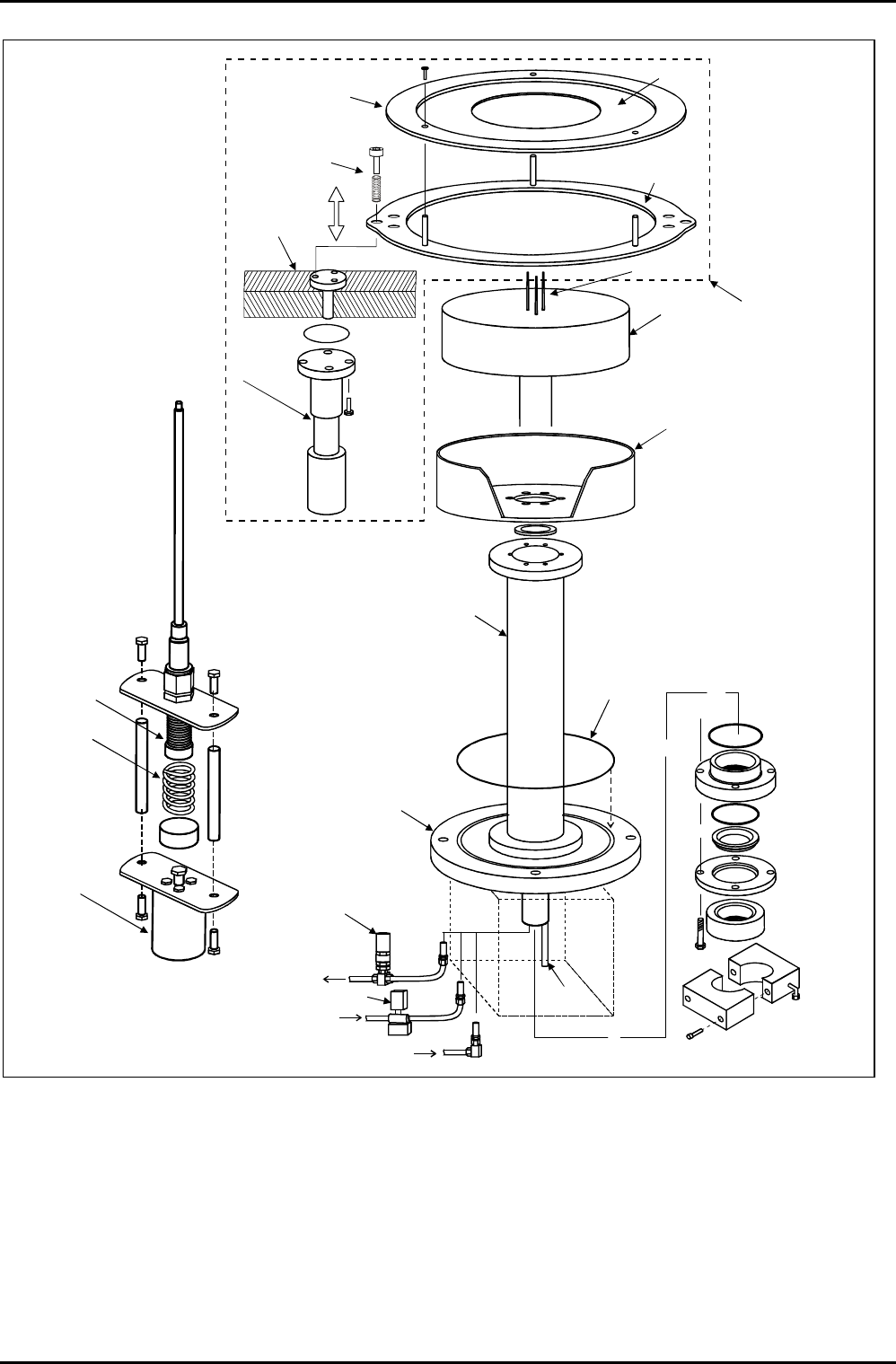
The helium-assisted lower electrode, shown in Fig 3.3, is fabricated from aluminium. The
electrode is fitted with an integral dark space shield.
The lower electrode is heated by an embedded 1250W element and cooled by liquid nitrogen
flowing through embedded tubing.
t~ÑÉê=äáÑí=
The wafer is lifted clear of the table (15mm) for transferring into a load lock or transfer
chamber by the wafer lift assembly. Compressed air flowing into the air cylinder forces its
piston and plunger upwards. The plunger contacts the base of the bellows which is connected
to a push rod. The 3-pin wafer support, mounted on top of the push rod, rises lifting the
wafer clear of the table. The push rod is lowered by the force exerted by the return spring.
t~ÑÉê=Åä~ãé=
The wafer clamp comprises a clamping ring attached to a lifting mechanism, and a clamping
plate. The clamping plate, attached to the clamping ring via three pillars and screws,
comprises an aluminium annulus with a quartz circular insert.
The wafer clamp is raised and lowered by two air cylinders, attached to the outside of the
process chamber; one located at each side of the wafer clamp. The piston of each air cylinder
is attached to a push rod, which passes through the base of the process chamber. Within the
process chamber, a circular plate mounted on the top of the push rod, is attached to the
wafer clamp by three M5 setscrews and compression springs. Rotating the setscrews changes
the compression of the springs and consequently the clamping force exerted on the wafer.
See Section 6 for the clamping force adjustment procedure.
Note that clamping plates are available with inserts for various sized wafers. Before loading a
wafer into the process chamber, ensure that the correct clamping plate is fitted. See Section 6
for the clamping plate changeover procedure.
q~ÄäÉ=íçé=éä~íÉ=
In some systems, the table top plate is fixed to the table by a ring of cap-head bolts. If your
system has a table of this type, refer to the following text and note.
The bolt heads are concealed behind screw covers, which require a special tool (supplied with
the system) for removal. (Tool part number: MD91D21726.)
NOTES:
1) When re-fixing the table top, do not over-tighten the bolts which will cause
the table top to bow. Check with a straight edge after tightening: if the table
top is not flat, release the bolt tensions until it is.
2) The screw covers (MD91D21723) are aluminium. When removing the covers,
it is recommended to use a little iso-propyl alcohol (IPA) to prevent the
thread from jamming.
eÉäáìã=Ä~ÅâáåÖ=
The purpose of helium backing is to set the temperature of the wafer close to that of the
temperature-controlled table by heat transfer. Helium is fed from a number of small holes in
the table underneath the wafer (which is clamped to the table) from where it flows radially
Description
Printed: 22-Mar-06, 7:29 Page 3-9 of 22 UC Davis 94-721001 Issue 1: March 06

mä~ëã~ä~Ä póëíÉã=NMM lñÑçêÇ=fåëíêìãÉåíë=mä~ëã~=qÉÅÜåçäçÖó== System Manual
to the periphery of the wafer. Helium is the preferred gas, because it has a very good heat
transfer ability. The use of other gases is possible, preferably inert gases.
The supply of helium is fed by a pressure control device, which receives an analogue setpoint
from the machine’s control system. The pressure control device adjusts the gas flow through
itself to control the pressure at its output side. The pressure is controlled within the range 0
to 50 Torr. A pressure of greater than 20 Torr could damage very thin substrates.
If the wafer is clamped down successfully the chamber pressure will show a slight rise of a few
milliTorr when the helium is producing a pressure of 10 Torr on the wafer.
If there is a massive pressure rise and the Turbo Controller display shows a high load, then the
wafer is insufficiently clamped and in order to achieve the set pressure the controller is using
an excessive gas flow.
The helium pressure is released into the process chamber at the end of a process (using a
normally-open valve). This prevents the wafer moving when it is unclamped.
Tip: Finish a process with a ten-second pumping step without helium. This will
reduce wafer mishandling.
A flow meter in the helium supply also reads the gas flow necessary to maintain the pressure.
A typical process uses 5 - 20 sccm to maintain 10 -15 Torr behind the wafer.
Tip: Some wafers mate very well with the electrode top surface and use less than 2
sccm to maintain 10 Torr. This can give a control problem, with the helium
feeding in pulses. Roughening the aluminium electrode with an abrasive pad
can increase the helium flow by a few sccm and allow proper control.
Do not turn on the helium unless the wafer is clamped.
Description
UC Davis 94-721001 Issue 1: March 06 Page 3-10 of 22 Printed: 22-Mar-06, 7:29
System Manual lñÑçêÇ=fåëíêìãÉåíë=mä~ëã~=qÉÅÜåçäçÖó== mä~ëã~ä~Ä póëíÉã=NMM
THERMOCOUPLE
CHAMBER
BASE
WAFER
CLAMP
TABLE
DARK SPACE
SHIELD
TABLE SUPPORT
TUBE
O RING
PUMPDOWN
PIPE FLANGE
FEEDTHROUGH
COMPONENTS
STAINLESS
STEEL
BELLOWS
SPRING
COMPRESSED
AIR CYLINDER
COMPRESSED
AIR CYLINDER
(ONE EACH SIDE
OF CLAMPING
PLATE)
WAFER
LIFT
ASSEMBLY
(FITS INSIDE
TABLE SUPPORT
TUBE)
Clamping
plate
Clamping
ring
Setscrew &
compression
spring (3-off
on each side
of clamping
ring)
3-pin wafer
support
Quartz
insert
SAFETY RELIEF
VALVE
CONTROL VALVE
LIQUID NITROGEN
IN
LIQUID NITROGEN
OUT
HELIUM IN
Fig 3.3: 94-100-5-12A Cryo / heated -150 / 400C He lower electrode
Description
Printed: 22-Mar-06, 7:29 Page 3-11 of 22 UC Davis 94-721001 Issue 1: March 06