Utah-94-721002-System-Manual.pdf - 第64页
mä~ëã~ä~Ä = póëíÉã=NMM= lñÑçêÇ=fåëíêìãÉåíë=mä~ëã~=qÉÅÜåçäçÖó= System Manual QKP= `çããáëëáçåáåÖ=íÜÉ=ëóëíÉã= Commissioning of the system will be carried out by OIPT in accordance with their standard procedures and any addi…
System Manual= lñÑçêÇ=fåëíêìãÉåíë=mä~ëã~=qÉÅÜåçäçÖó= mä~ëã~ä~Ä
=
póëíÉã=NMM
QKOKPKN= `çååÉÅíáåÖ=íÜÉ=PJéÜ~ëÉ=ëìééäó=Å~ÄäÉ=íç=íÜÉ=éçïÉê=Äçñ=
If it is necessary to connect the 3-phase supply cable to the power box, use the following
steps.
1) Ensure that the supply cable is not connected to the safety isolation box.
2) Remove the power box cover.
3) Inside the power box, remove the clear plastic safety cover from the power box
(secured to the right-hand side of the power box by four screws).
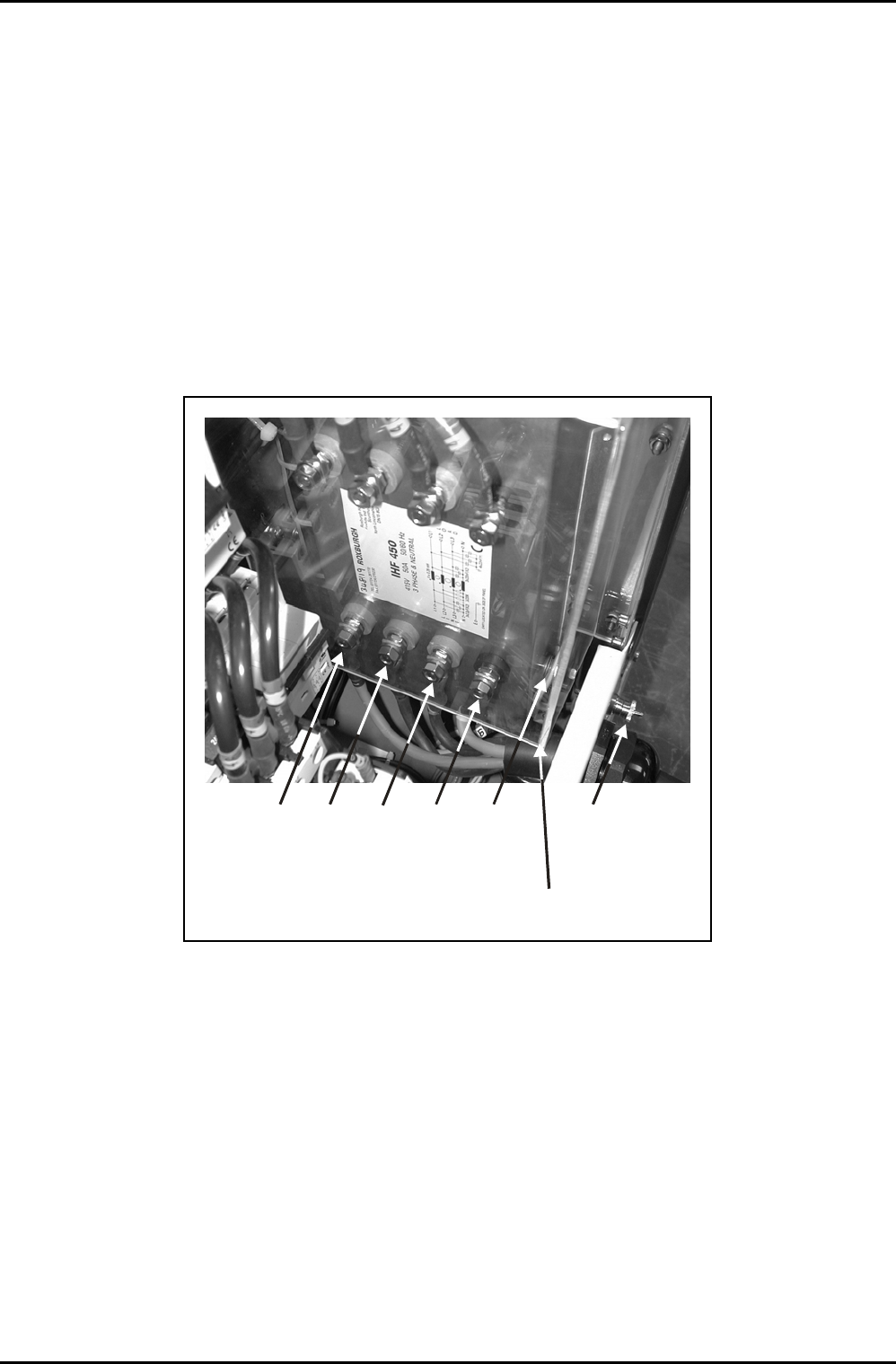
4) Connect the 3-phase supply cable wires as shown in Fig 4.1.
5) Re-fit the clear plastic safety cover and then the power box cover.
L1 L2 L3 Neutral Protective
Earth (at
side of
panel)
Connection
Terminal for
Earth cable to
Gas Pod
3-phase connections
Clear plastic
safety cover
Fig 4.1: 3-phase supply cable connections at the power box
Installation and Commissioning
Printed: 16 March 2006 11:59 Page 4-5 of 8 Issue 4: March 05

mä~ëã~ä~Ä
=
póëíÉã=NMM= lñÑçêÇ=fåëíêìãÉåíë=mä~ëã~=qÉÅÜåçäçÖó= System Manual
QKP= `çããáëëáçåáåÖ=íÜÉ=ëóëíÉã=
Commissioning of the system will be carried out by OIPT in accordance with their standard
procedures and any additional requirements stated in the sales contract. Generally, this will
include the following items:
1) Checking that the installation has been carried out satisfactorily.
2) Powering up the system.
3) Checking the operation of the system, including the Emergency Off facility and all
interlocks.
4) Ensuring that the system can perform the processes specified in the sales contract.
5) Providing training on the system.
QKQ= póëíÉã=~ÇàìëíãÉåíë=
This sub-section gives details of adjustments which may be necessary depending on system
configuration. In addition to these adjustments, refer to the Operator Adjustments sub-
section in Section 5 (Operating Instructions) of this manual.
QKQKN= eÉ~íÉêL`ÜáääÉêë=
If your Plasmalab system has a remote Betta-Tech heater/chiller, e.g. CU500, with a Eurotherm
Controller, please note the following.
The Eurotherm controller has a default temperature setpoint. For the system to operate
correctly, this setpoint must be set to a temperature suitable for the system and coolant used.
For example, if the coolant is water, do not set the setpoint to 0º C or below.
Check the setpoint before using the system and if necessary change it in accordance with the
instructions given in the Eurotherm Controller's manual.
QKQKO= mêçÅÉëë=éìãé=éìêÖÉ=
An inert gas, normally nitrogen, is added to the process chamber primary mechanical pump
for a variety of reasons:
a) When pumping condensable vapours, it is flowed via the gas ballast port. This helps
to prevent condensation during compression, and reduces the amount of liquids
such as water vapour or SiCl
4
in the pump fluid.
b) When pumping reactive gases, it is bubbled through the pump fluid, to help drive
out acidic compounds.
c) When pumping flammable or explosive gases, it is added to dilute the gas below the
threshold for explosion.
d) In dry pumps, the purge gas flow is important for managing heat and limiting
particle build up.
WARNING
DILUTION IS NOT USED TO MAKE THE EXHUAST SAFE TO BREATH: IT MUST STILL BE
DUCTED AWAY AND TREATED APPROPRIATELY.
Installation and Commissioning
Issue 4: March 05 Page 4-6 of 8 Printed: 16 March 2006 11:59

System Manual= lñÑçêÇ=fåëíêìãÉåíë=mä~ëã~=qÉÅÜåçäçÖó= mä~ëã~ä~Ä
=
póëíÉã=NMM
If your Plasmalab system is supplied with a dry pump, e.g. Alcatel ADP122P or ADS602P, that
includes its own purge gas monitor, with an output suitable for inclusion in a hardware
interlock chain, it is permissible to use this instead of the OIPT purge kit.
If your Plasmalab system is supplied with an oil filled rotary pump, e.g. Alcatel A2063C2, the
purge kit supplied is configured for the process gases specified. Note that information about
the Rotameters used is given in Appendix R.
For purge requirements not covered by the standard OIPT purge kits or dry pump purge gas
monitor an additional purge supplement is included at the end of this section.
fåÉêí=éìãéáåÖ=
Tools that are pumping only atmospheric gases need no purge, other than any minimum
purge the specific pump requires.
bíÅÜ=íççäë=Ó=Ü~äçÖÉå=Ö~ëÉë=
Tools that use gases containing halogens (fluorine, chlorine, and bromine – including
compounds which contain these elements, e.g. CHF
3
), are supplied with purge into the pump,
via a rotameter of full scale at least 4 standard litres per minute (slpm).
bíÅÜ=íççäë=Ó=Ñä~ãã~ÄäÉ=Ö~ëÉë=
Certain processes use the flammable gases hydrogen (H
2
) and methane (CH
4
), often in
combination with chlorine (Cl
2
) to etch compound semiconductors. The primary pump for
these is purged with sufficient gas to bring the exhaust to one third of the lower flammability
limit.
A rotameter is used to set and read the flow. A flow switch monitors the purge. The process
gases are turned off by means of a hardware interlock if the flow switch reports low flow
below 7.5slpm.
aÉéçëáíáçå=éêçÅÉëëÉë=Ó=éóêçéÜçêáÅ=Ö~ëÉë=
Tools that use silane to deposit thin films containing silicon shall be purged with sufficient gas
to bring the exhaust to one third of the lower explosion limit.
A rotameter is used to set and read the flow. A flow switch monitors the purge. For low rate
processes (<25sccm SiH
4
) the process gases are turned off by means of a hardware interlock if
the flow switch reports low flow below 5.2slpm. For high rate processes (<50sccm Si H
4
) the
process gases are turned off by means of a hardware interlock if the flow switch reports low
flow below 10.5slpm.
Installation and Commissioning
Printed: 16 March 2006 11:59 Page 4-7 of 8 Issue 4: March 05