Utah-94-721002-System-Manual.pdf - 第75页
System Manual lñÑçêÇ=fåëíêìãÉåíë=mä~ëã~=qÉ ÅÜåçäçÖó== mä~ëã~ä~Ä póëíÉãNMM s~Åììã=éìãéë= An auxiliary circuit on the pump contactor detects pump failure due to overload or short circuit, and the process gases are immediat…

mä~ëã~ä~ÄpóëíÉãNMM lñÑçêÇ=fåëíêìãÉåíë=mä~ëã~=qÉÅÜåçäçÖó== System Manual
RKPKT= póëíÉã=êÉëéçåëÉ=íç=äçëë=çÑ=ëÉêîáÅÉë=
This sub-section briefly describes the system’s response to the loss of services.
bäÉÅíêáÅ~ä=
Process and pumps stop. Air operated gas and vacuum valves shut. Where the chamber APC
function and main chamber vacuum valve are combined in one unit, it is automatically closed
on loss of electrical power. Load lock wafer transfer valve(s) retain their current state, or
finish their current transition. A Hine arm robot will finish its current movement. Other wafer
transfer devices stop moving immediately. Information on the current process and wafer
position is lost.
Loss of one of three phases: rotary vacuum pump stops. If the phase powering the process
controller remains live then the process aborts, all valves shut but the system controller
retains information on the current state of the machine. If the process controller phase is lost,
then current information is lost.
`çãéêÉëëÉÇ=~áê=
All air operated gas inlet and vacuum valves shut. (Exceptions: air-operated valves with
electrical solenoids unaffected; normally open gas interlock valves open). Gas flows stop and
the chamber is not pumped. Process power(s) are turned off as soon as a flow or pressure
exceeds a tolerance band - normally within 5 seconds. Load lock wafer transfer valve(s) go to
an undefined state. Rotational movement of the air operated 4-way load lock stops.
`ççäáåÖ=ï~íÉê=
Certain components are protected by a water flow switch. If the flow is low, a warning
message is displayed on the PC, and the associated device is turned off.
Leybold dry pumps have their own internal over-temperature switches. Loss of flow for these
pumps will eventually cause a temperature trip causing a process abort (process chamber
pump) and the relevant pump to be switched off. Devices such as turbo pumps have their
own internal protection against overheating and are not protected by external flow switches.
qìêÄçãçäÉÅìä~ê=éìãé=åáíêçÖÉå=éìêÖÉ=
A flow meter monitors the nitrogen purge flow rate downstream of the purge flow
regulator. Low pressure (< 50 sccm) will cause the process to be aborted, all gas and vacuum
valves to shut and PC 2000 will display the alert shown below.
N2 Too Low
mêçÅÉëë=Ö~ëÉë=
Loss of process gas is detected when a mass flow controller goes out of tolerance during
process. The active process devices (normally plasma power) are paused, and gas flows remain
active. The process will resume automatically if gas is restored.
Operating Instructions
UC Davis 94-721001 Issue 1: March 06 Page 5-8 of 52 Printed: 22-Mar-06, 10:42

System Manual lñÑçêÇ=fåëíêìãÉåíë=mä~ëã~=qÉÅÜåçäçÖó== mä~ëã~ä~ÄpóëíÉãNMM
s~Åììã=éìãéë=
An auxiliary circuit on the pump contactor detects pump failure due to overload or short
circuit, and the process gases are immediately halted.
If a rotary vane or dry vacuum pump stops pumping for other reasons during a process, e.g. if
it fails or its power is disconnected, and the vacuum interlock switch’s contacts remain closed,
process gas will continue to flow into the process chamber. Gas flow will stop when the
chamber pressure exceeds the vacuum switch trip level of 600 mbar absolute. The front-end
software will show the interlock status as ‘fault’.
WARNING
DISCONNECTING THE POWER TO AUXILIARY EQUIPMENT, ESPECIALLY VACUUM
PUMPS, WHILE RUNNING A PROCESS CAN CAUSE A HAZARD IN THE PROCESS
CHAMBER.
ENSURE THAT THE SYSTEM IS SHUT DOWN USING THE PROCEDURE GIVEN IN SUB-
SECTION 5.3.5 BEFORE DISCONNECTING ANY POWER CABLES FROM THE POWER
BOX, OR SWITCHING OFF ANY ELECTRICAL SUPPLIES TO AUXILIARY EQUIPMENT.
WARNING
IF THE EQUIPMENT HALTS DURING PROCESS BECAUSE THE VACUUM SWITCH HAS
OPENED, THERE MAY BE A SERIOUS GAS HAZARD IN THE CHAMBER AND PUMPING
LINES.
ASSESS THE RISKS BEFORE TRYING TO PUMP OR VENT THE CHAMBER.
PERSONAL PROTECTIVE EQUIPMENT MAY BE NECESSARY.
Operating Instructions
Printed: 22-Mar-06, 10:42 Page 5-9 of 52 UC Davis 94-721001 Issue 1: March 06
mä~ëã~ä~ÄpóëíÉãNMM lñÑçêÇ=fåëíêìãÉåíë=mä~ëã~=qÉÅÜåçäçÖó== System Manual
RKQ= léÉê~íçê=Åçåíêçä=
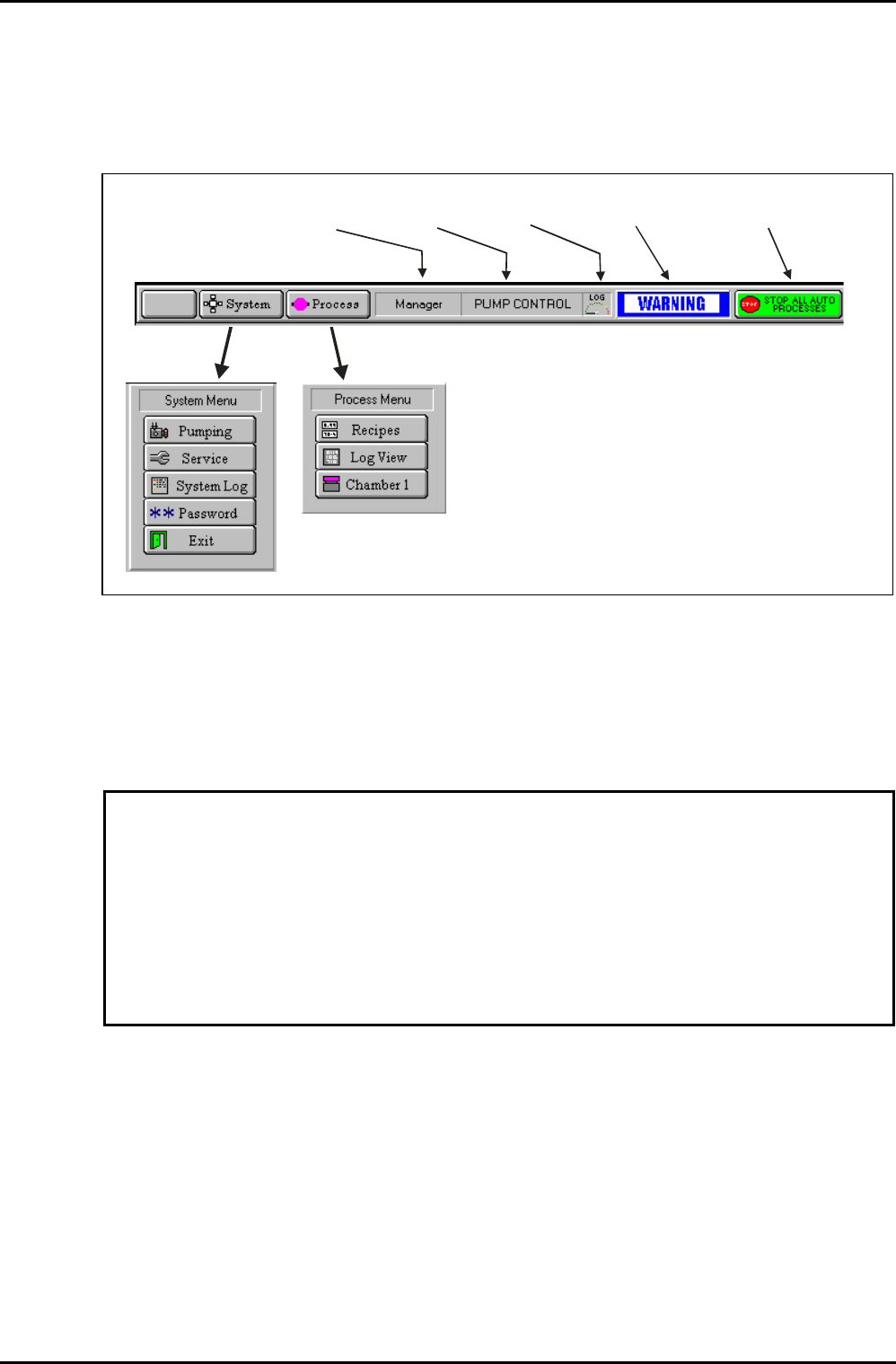
The PC 2000 facilities are accessed from the menu bar at the top of the screen as shown in Fig
5.1.
LOG-ON
STATUS
PAGE
TITLE
SYSTEM LOG
FILE SPACE
SYSTEM ALERT
BANNER
STOP ALL AUTO
PROCESSES BUTTON
Fig 5.1: Menu bar
This system incorporates an ICP 180 processing station, and an automatic single-wafer load
lock chamber. Refer to sub-section 5.8, page 5-33 for diagrams and brief descriptions of the
screens/pages.
RKQKN= qìêåáåÖ=ëÅêÉÉå=ë~îÉêë=~åÇ=éçïÉê=ë~îÉê=çéíáçåë=çÑÑ=
CAUTION
When running the PC 2000 software, using a Screen Saver or allowing the PC to
enter any of the Power Saver modes can cause the PC to lose communications
with the PLC.
Before starting the PC 2000 software, ensure that Screen Savers and all Power
Saver options are turned off. A procedure to do this is given in the following
text.
Use the following procedure to turn the screen savers and power saver options off. Note that
this procedure is applicable to Microsoft Windows XP™; for other versions of Windows, refer
to the on-line help.
1) Right-click anywhere in a clear area on the Windows desktop and then, on the
displayed menu, select the Properties option. The Display Properties dialogue box
is displayed.
2) Select the Screen Saver tab.
3) In the Screen Saver drop-down list, select the (None) option.
4) Click on the OK button.
Operating Instructions
UC Davis 94-721001 Issue 1: March 06 Page 5-10 of 52 Printed: 22-Mar-06, 10:42