00190802-02.pdf - 第331页
User’s Manual Line Computer UNIX 11 Production Tools / Optimization Software Version 402.xx Edition 06/96 11.4 Optimizati on Dialog 11 - 35 Fig. 11.4.5 „Produc ibility resul ts f or xx.la“ window f or a job 11.4.5 Comman…

11 Production Tools / Optimization User’s Manual Line Computer UNIX
11.4 Optimization Dialog Software Version 402.xx Edition 06/96
11 - 34
Utilization Chart
For each station, each placement head and the entire line, the results of the optimization process are
displayed in the following columns:
-
Production time [%]:
represents the production time for each placement head in the form of a bar.
The red bar indicates the placement heads with the longest production time.
-
Cycle t. [sec]:
indicates the cycle time for each placement head and the total cycle time for each sta-
tion in seconds. The total cycle time of the line additionally comprises all waiting and transport times.
-
Placement positions:
indicates the number of placement positions per placement head and the total
number of placement positions for each station and for the entire line.
-
Number cycles:
indicates the number of cycles per placement head and the total number of cycles
for each station and for the entire line.
-
Perform. [PP/h]:
indicates the placement rate for each placement head and for each station. The total
placement rate of the line additionally comprises all waiting and transport times.
Command field „OK“
Clicking on the "OK" command field causes the window to be closed.
Displaying results of producibility checks for individual jobs:
●
Click on .
●
Click on the lot file containing the job whose results are to be displayed.
The results of Optimization are displayed in the „Optimization results for xx.lose“ window.
●
Click on the job in the „Jobs“ selection field.
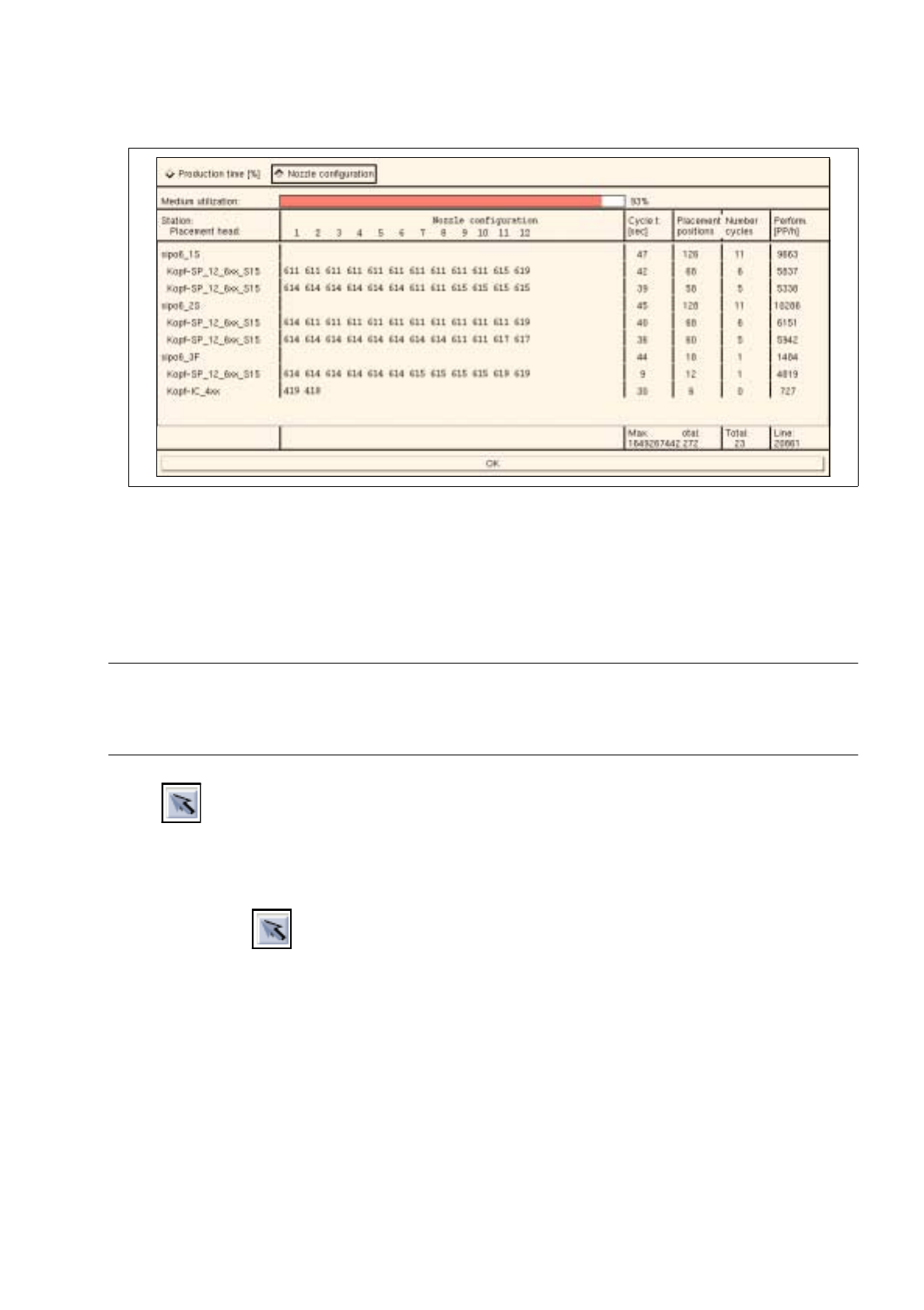
The results of the producibility check are displayed in the „Producibility results for xx.la“ window (see
Fig. 11.4.5).
The organization of the „Producibility results for xx.la“ window is identical to that of the „Optimization results
for xx.la“ window described further above.
During the producibility check, the nozzle configuration is determined and can be displayed in this window
for the current job. Clicking on the „Nozzle configuration“ button causes the nozzles required for each head
and for each segment to be displayed.
User’s Manual Line Computer UNIX 11 Production Tools / Optimization
Software Version 402.xx Edition 06/96 11.4 Optimization Dialog
11 - 35
Fig. 11.4.5 „Producibility results for xx.la“ window for a job
11.4.5 Command Area „Edit“
In the command area, the icons are displayed by means of which lot files can be selected, created, edited and
displayed.
☞
NOTE
Upon opening the Optimization Dialog, the "Select" icon is initially active. The latter remains active until
another icon is clicked on.
-
Select
This icon allows the jobs and basic optimization data of a lot file to be displayed. Moreover, the
options of the SERVICES menu can be invoked for the selected lot file.
●
Click on
●
Click on a lot file in the "Lot file“ display area.
In the „Jobs“ display area the jobs are listed that are contained in the lot file that was clicked on.
In the „Basic optimization data“ field the associated basic optimization data are displayed.
●
From the SERVICES menu click on an option for the selected lot file.
The appropriate windows are opened.
11 Production Tools / Optimization User’s Manual Line Computer UNIX
11.4 Optimization Dialog Software Version 402.xx Edition 06/96
11 - 36
-
Create
This icon allows a new lot file to be created.
●
Click on
The window „Optimization dialog: create“ is opened.
●
Enter the name (xx.lose) of the new lot file.
●
Click on the
OK
button.
Job Control is opened.
●
Create lot file (see chapter 14).
-
Change
This icon allows an existing lot file to be edited.
●
Click on
●
Click on the lot file you wish to edit.
Job Control is opened.
●
Edit the lot file (see chapter 14).
-
Read in directory
This icon allows the directory of the lot files to be displayed. Moreover, by clicking on this icon a newly
created lot file can be read into the "Lot file" selection field.
●
Click on
All lot files are being newly read in. The new lot file is displayed in the "Lot file" selection field.