00190802-02.pdf - 第536页
17.2 Description of Components and PCBs User’s Manual SIPLACE Line Com puter UNIX 17.2.3 PCB 3: F ocus on Cluster T echnique Software V ersion 402.xx Edition 06/96 17 - 36 No ink spot is pr esen t. Loading cluster data a…
User’s Manual SIPLACE Line Computer UNIX 17.2 Description of Components and PCBs
Software Version 402.xx Edition 06/96 17.2.3 PCB 3: Focus on Cluster Technique
17 - 35
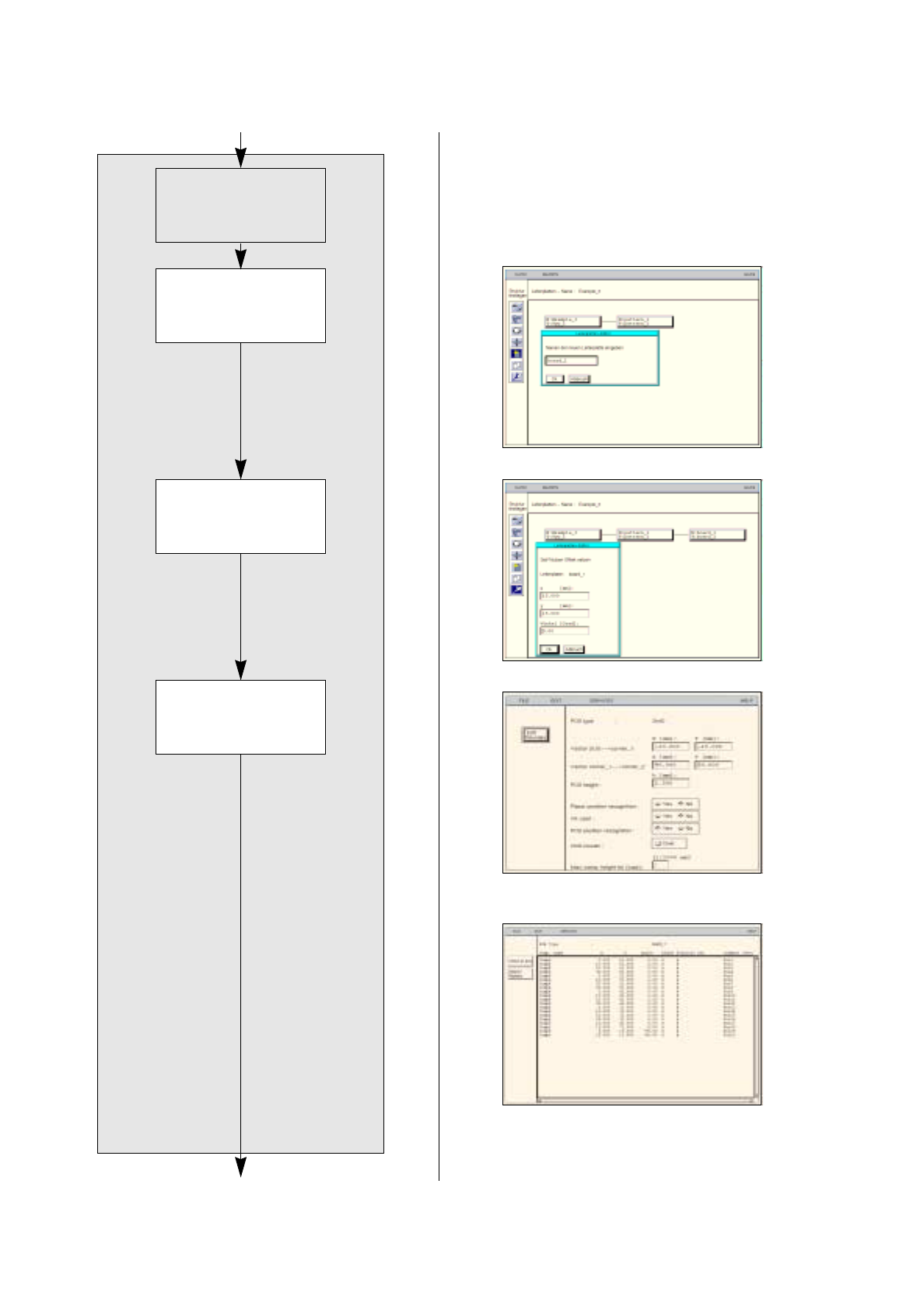
To create a cluster on the PCB, create as follows:
15. In the PCB Editor, click on the Create icon .
16. Click on the PCB, here:
Example_3
.
A dialog box is opened.
17. Click on the editing field.
18. Enter the name of the cluster, here:
pattern_1,
and click on the
OK
button.
The dialog box is closed. The new cluster is displayed at the second level.
To enter the cluster offset values, proceed as follows:
19. Click on the Coordinate system icon .
20. Click on the cluster, here:
pattern_1
.
A dialog box is opened.
21. Click on the individual editing fields and enter the offset values, see Fig. 17.2.7 on page 17-31.
22. Click on the
OK
button.
The dialog box is closed.
To enter the dimensions of the cluster, proceed as follows:
23. Click on the Menu icon .
24. Click on the cluster, here:
pattern_1
.
25. Click on the
Cluster Editor
option on the
SERVICES
menu.
The Cluster Editor is opened.
26. Enter the dimensions of the cluster, see Fig. 17.2.7 on page 17-31.
To define the fiducials for the cluster, proceed as follows:
27. In the Cluster Editor click on the
Edit fiducials
button.
The Fiducial Editor is opened.
28. Activate the
Insert
button.
29. Click on the
Fiducial set name
editing field.
30. Enter a name for the new fiducial set, here:
Set_1
.
31. Click on the
Accept fiducial set
button.
The fiducial set Set_1
appears on the fiducial list.
32. Click on the fiducial set Set_1
on the fiducial list.
33. Click on the
Fiducial
editing field.
34. Enter the fiducial number for the first fiducial, here:
48
.
35. Click on the individual editing fields for the coordinates, enter
coordinates do not confirm with the Enter key), here: see chart:
36. Click on the
Accept fiducial data
button.
The data of the fiducial are transferred to the list of the fiducials of the fiducial set.
37. Define the remaining fiducials analogously, here:
fiducials
48
and
48
.
38. Activate the
PCB position recognition
button.
39. Click on the fiducial set Set_1 on the fiducial list.
The fiducial set name Set_1
is preceded by an
L
for the PCB position recognition.
40. Click on the
Quit
option on the
FILE
menu.
The Fiducial Editor is closed.
41. Click on the
Quit
option on the
FILE
menu.
The Cluster Editor is closed.
Ficucial number X Y
48 5 5
48 5 111
48 145 5
17.2 Description of Components and PCBs User’s Manual SIPLACE Line Computer UNIX
17.2.3 PCB 3: Focus on Cluster Technique Software Version 402.xx Edition 06/96
17 - 36
No ink spot is present.
Loading cluster data
and placement
positions
continued from page 17-34
Creating a single
circuit
continued on page 17-38
Entering offset values
for the single circuit
PCB description
Defining ink spot
User’s Manual SIPLACE Line Computer UNIX 17.2 Description of Components and PCBs
Software Version 402.xx Edition 06/96 17.2.3 PCB 3: Focus on Cluster Technique
17 - 37
Defining ink spot:
no ink spot is present.
To create a single circuit in a cluster, proceed as follows:
42. Click on the Create icon .
43. Click on the cluster, here:
pattern_1
.
A dialog box is opened.
44. Click on the editing field.
45. Enter the name for the single circuit, here:
board_1,
and click on the
OK
button.
The dialog box is closed. The new single circuit is displayed at the third level.
To enter the offset values for the single circuit, proceed as follows:
46. Click on the Coordinate system icon .
47. Click on the single circuit, here:
board_1
.
A dialog box is opened.
48. Click on the individual editing fields and enter the offset values, see Fig. 17.2.7 on page 17-31.
49. Click on the
OK
button.
The dialog box is closed.
To load the cluster data and placement positions of another PCB for the single circuit:
50. Click on the Menu icon .
51. Click on the single circuit, here:
board_1
.
52. Click on the
Cluster Editor
option on the
SERVICES
menu.
The Cluster Editor is opened.
53. Click on the
Structure Editor
option on the
SERVICES
menu.
A file selection window is opened.
54. Select a PCB by double-clicking, here:
Example_2.la
.
The PCB Editor for Example_2.la is opened.
55. Click on the PCB (rectangle), here:
Example_2
.
56. Using the key combination Alt+Tab change to the Cluster Editor of the single circuit, here:
board_1
.
57. Click on the
Load cluster data from
option on the
EDIT
menu.
A dialog box containing the name of the source cluster is displayed.
58. Click on the
OK
button.
The cluster data of the other PCB, here:
Example_2
, are transferred to the current single circuit, here:
board_1
, the dialog box is closed. The Placement Position Editor is opened.
59. Using the key combination Alt+Tab change to the PCB Editor of the other PCB, here:
Example_2.la
.
60. Click on the PCB, here:
Example_2.la
.
61. Using the key combination Alt+Tab change to the Placement Position Editor of the single circuit, here:
board_1
.
62. Click on the
Load placement position from
option on the
EDIT
menu.
A dialog box containing the name of the source cluster is displayed.
63. Click on the
OK
button.
The placement positions of the other PCB, here:
Example_2
, are transferred to the single circuit, here:
board_1
, the dialog box is closed.
64. Click on the
Quit
option on the
FILE
menu.
The Placement Position Editor is closed.