slau358q.pdf - 第37页
www.ti.com Programming MSP Flash Devices Using the MSP Gang Programmer 37 SLAU358Q – September 2011 – Revised October 2019 Submit Documentation Feedback Copyright © 2011–2019, Texas Instruments Incorporated Operation Man…
Programming MSP Flash Devices Using the MSP Gang Programmer
www.ti.com
36
SLAU358Q–September 2011–Revised October 2019
Submit Documentation Feedback
Copyright © 2011–2019, Texas Instruments Incorporated
Operation
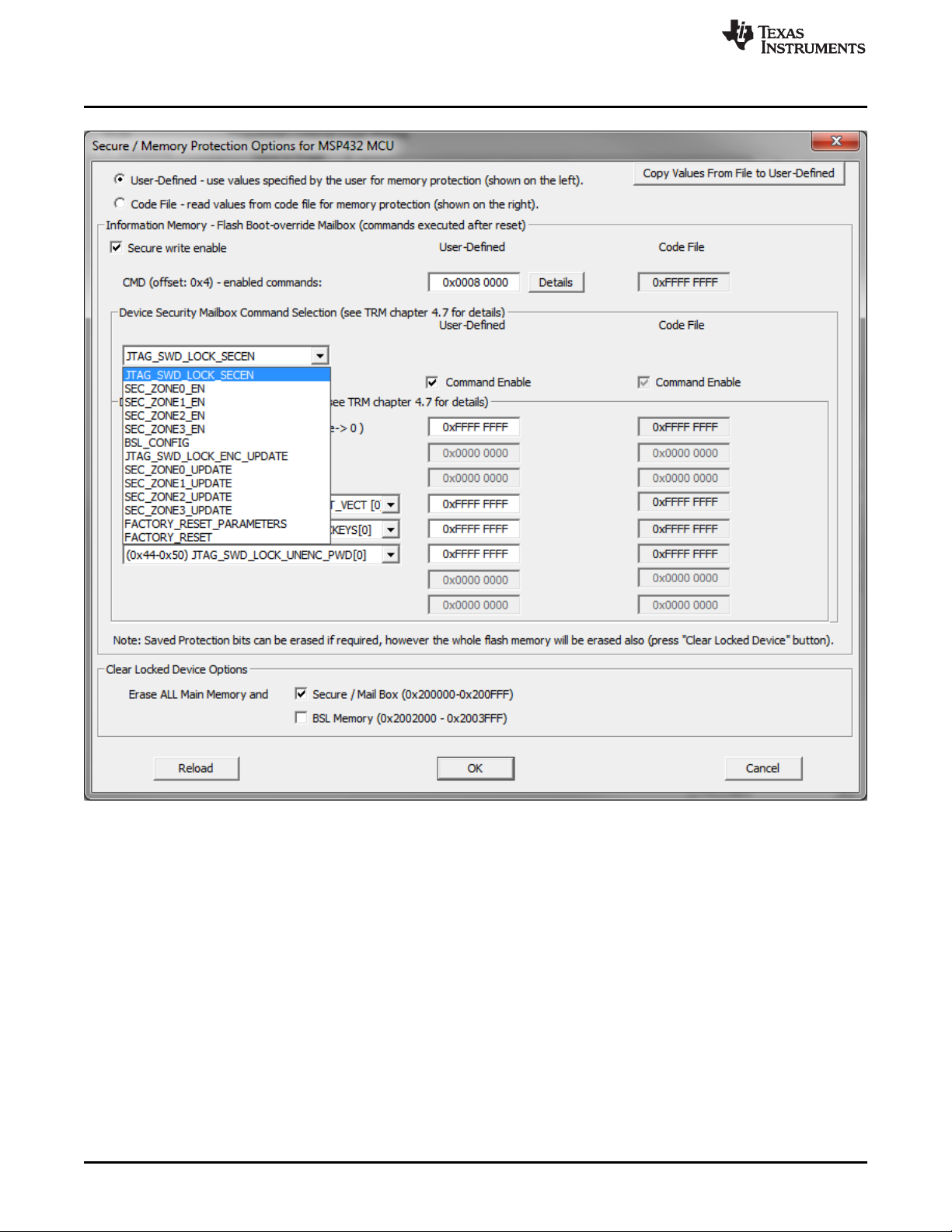
NOTE: The flash mailbox can be programmed to provide memory protection of some memory, or communication
can be blocked. Can be done automatically after programming (at end of GO operation)
Figure 2-14. MSP432 Secure Device Options
www.ti.com
Programming MSP Flash Devices Using the MSP Gang Programmer
37
SLAU358Q–September 2011–Revised October 2019
Submit Documentation Feedback
Copyright © 2011–2019, Texas Instruments Incorporated
Operation
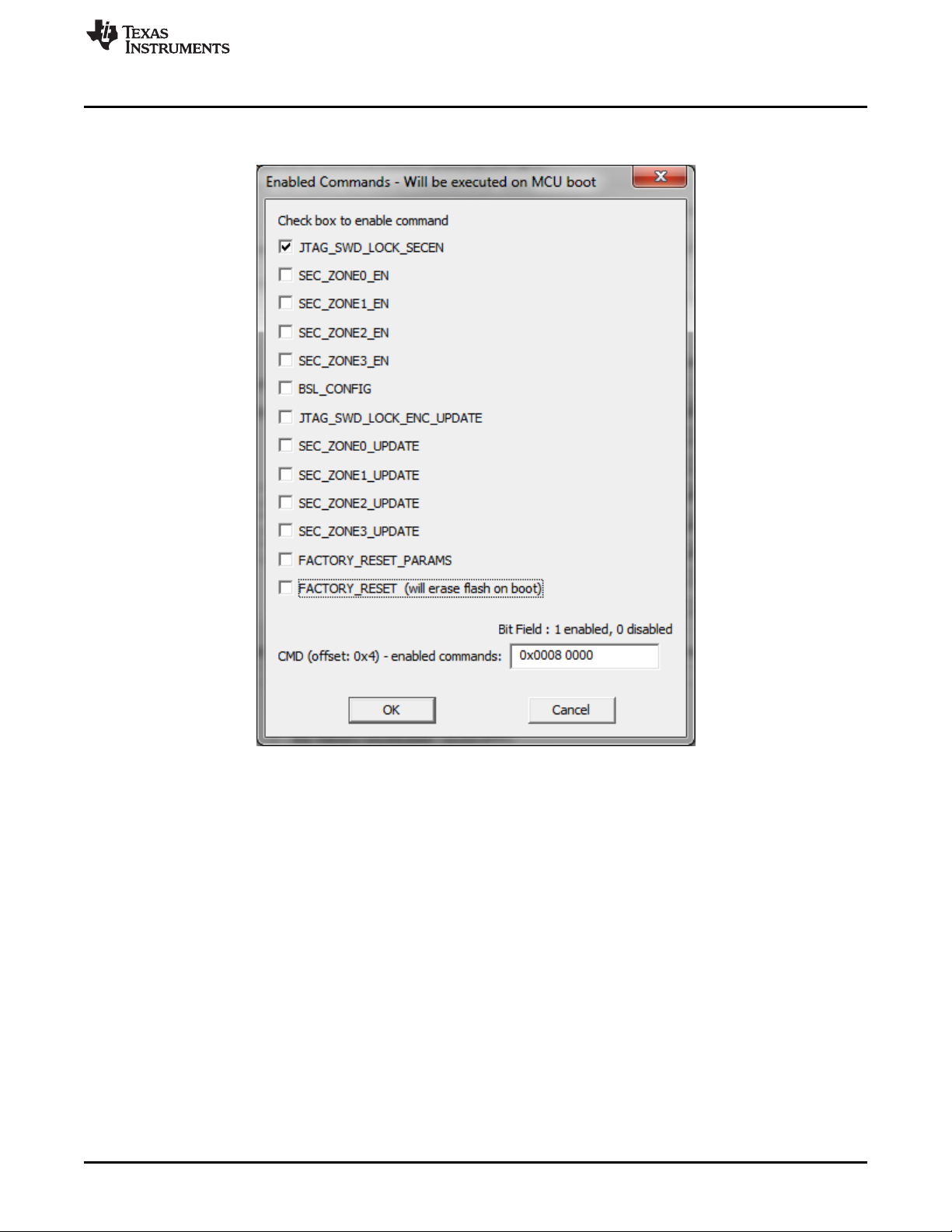
Many types of protection options are available and can be set in the Enabled Commands screen (see
Figure 2-15).
NOTE: The flash mailbox can be programmed with different instructions that provide memory protection, or block
communication.
Figure 2-15. MSP432 Secure Device Options Details
2.1.7 Programming MCU With IP Encapsulated Segment
Some FRAM MCUs have the option to protect an address range in main memory. All data from protected
memory space is read as 0x3FFF regardless of actual contents. When the protected memory is not
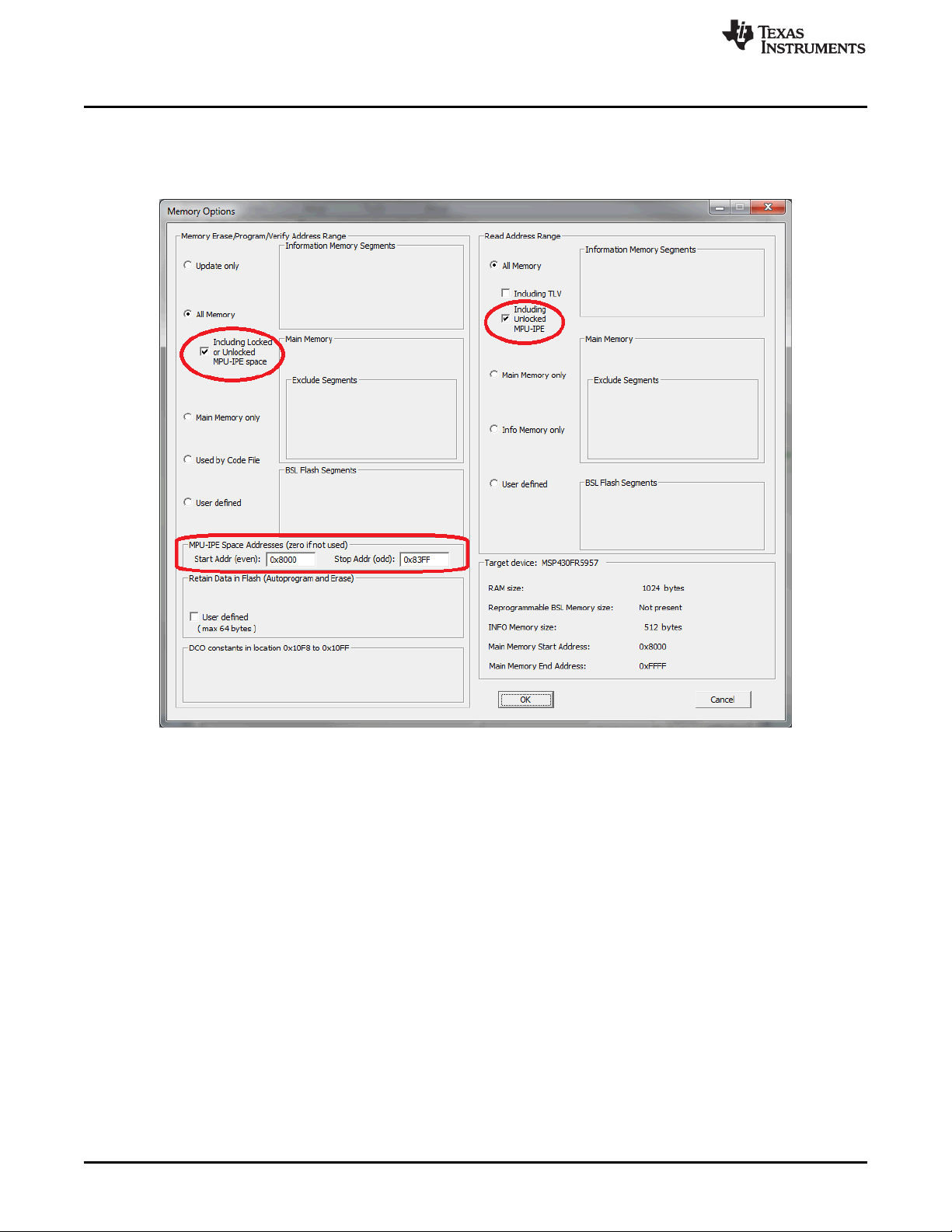
locked, then the contents can be read "as is" if the option "Including Unlocked MPU-IPE" is selected. The
programmer must have the address range of protected memory to be able to service the MCU correctly.
The protected memory range must be specified in the MPU-IPE Space Addresses Group in the Memory
Options window (see Figure 2-16). The protected memory space can be erased and reprogrammed when
the option "Including Locked or Unlocked MPU-IPE space" is selected. That option can only be selected
when the All Memory option is selected. When the memory region is protected and locked using the MPU-
IPE features (see MCU family user guide or technical reference manual for details) then all memory is
erased first before programming the MCU. The protected and locked MPU-IPE memory range can be
erased and reprogrammed only when the JTAG or SBW communication is used. When BSL
communication is used, the locked memory cannot be erased or reprogrammed. Through BSL, memory
can only be erased and reprogrammed when the locking option is not used.
Programming MSP Flash Devices Using the MSP Gang Programmer
www.ti.com
38
SLAU358Q–September 2011–Revised October 2019
Submit Documentation Feedback
Copyright © 2011–2019, Texas Instruments Incorporated
Operation
When a new code file is programmed with contents outside of the protected area, all memory (except
protected memory) can be erased, blank checked, programmed, and verified. If the protected memory
space is defined incorrectly, a blank check error will result, because 0x3FFF will be read instead of the
expected 0xFFFF.
Figure 2-16. Memory Options Window
2.1.8 Serialization
Serialization implemented in the MSP-GANG creates a unique serial number (SN) or MAC address and
saves it in the flash, FRAM, or dedicated MAC register in the target device. The SN or MAC address is
new every time a new target device is programmed. The SN or MAC number can be generated
automatically (incremented from the last number) or read from an external file every time before pressing
the GO button.
To enable serialization, select ENABLE Serialization in the Serialization screen (see Figure 2-17). Specify
the log file name where the all programmed SN and MAC numbers are saved. The SN or MAC number
can be saved in any flash or FRAM location as specified in the Start Address in Memory field (see
Figure 2-17). The address must be even, and the Used size in bytes (the size of the SN or MAC number)
must also be an even number of bytes. The In Memory Format section specifies if the SN or MAC number
is written LSB first or MSB first.