slau358q.pdf - 第42页
Programming MSP Flash Devices Using the MSP Gang Programmer www.ti.com 42 SLAU358Q – September 2011 – Revised October 2019 Submit Documentation Feedback Copyright © 2011–2019, Texas Instruments Incorporated Operation NOT…

www.ti.com
Programming MSP Flash Devices Using the MSP Gang Programmer
41
SLAU358Q–September 2011–Revised October 2019
Submit Documentation Feedback
Copyright © 2011–2019, Texas Instruments Incorporated
Operation
NOTE: Do not overwrite images unnecessarily during production
The image flash memory has a specified 10000 endurance cycles. Therefore, over the
lifetime of the product, each image can be reliably reprogrammed 10000 times.
Reprogramming images should be done once per production setup, rather than per
programming run. Reprogramming the image per programming run will quickly exhaust flash
endurance cycles and result in errant behavior.
In total, 96 different images can be saved internally in the MSP Gang Programmer or one image can be
saved on an SD card. Each image can be selected at any time to program the target devices. The MSP
Gang Programmer also allows the image to be saved in a file, either to be saved on an SD card or to be
sent to a customer. In order for the image file to be usable from the SD card, copy only the binary file
(".spgangbin") to the SD card and preserve the proper extension (Note that binary files are not encrypted).
For redistribution to a customer, the image file can be sent and encrypted with additional security features.
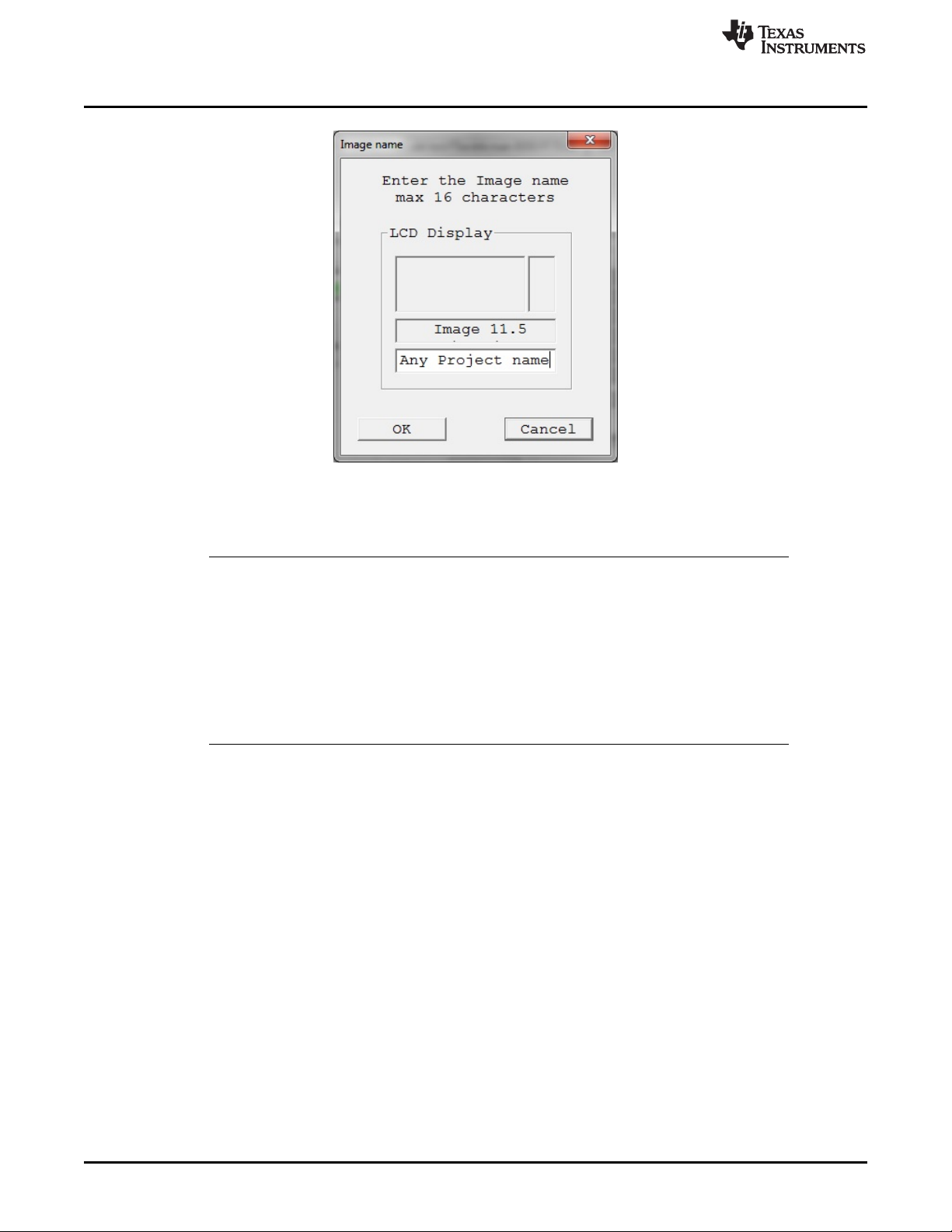
When a new image is saved to a file or to a MSP Gang Programmer internal memory, an image
configuration screen appears (see Figure 2-18). Enter any name up to 16 characters. This name is
displayed in the GUI image selector (see Figure 2-1) on the bottom line of the MSP Gang Programmer
LCD screen when the corresponding image is selected. Press OK when the name is entered.
Once you have created a programming setup using the steps mentioned above, it is useful to store it in
the form of an image. The advantage of an image is that it contains both the configuration options
necessary for programming as well as the code files that are flashed to target devices. Moreover, only
images can be saved to internal MSP Gang Programmer memory and used in Standalone mode, where
the programmer can operate without being connected to a PC.
Before the user proceeds to making images; however, it is advisable to save the MSP Gang Programmer
setup as a project first. This is recommended because images cannot be modified once created, only
overwritten. Therefore, if the user wants to change an image that has already been created without
recreating the whole configuration from scratch then it is necessary to load the corresponding project file.
Once the project is loaded, a change can be made and a new image with the same name can be created
to overwrite the old one.
Images can be saved to the programmer's internal memory, or on an external SD-Card. A total of 96
different images can be saved internally, or one image can be saved on an SD-Card. Each image can be
selected at any time to program the target devices. The MSP Gang Programmer also allows the image to
be saved in a file, either to be saved on an SD-Card or to be sent to a customer. When the code file and
configuration are ready to be saved, press the Save Image button to save to MSP Gang Programmer
internal memory, or the Save Image to file button to save to a file.
Whether the new image being created is saved to a file or to MSP Gang Programmer internal memory, an
image configuration screen appears (see Figure 2-18). Enter any name up to 16 characters. This name is
displayed in the GUI image selector (see Figure 2-1) and it is displayed on the bottom line of the MSP
Gang Programmer LCD screen when the corresponding image is selected. Press OK when the name is
entered.
Programming MSP Flash Devices Using the MSP Gang Programmer
www.ti.com
42
SLAU358Q–September 2011–Revised October 2019
Submit Documentation Feedback
Copyright © 2011–2019, Texas Instruments Incorporated
Operation
NOTE: The image name is limited to 16 characters. This name is shown on the LCD display of the MSP Gang
Programmer , and Image pulldown menu in the GUI.
Figure 2-18. Image Name Configuration Screen
NOTE: Since version 1.2.1.0, the number of images has increased from 16 (512KB each) to 96
(64KB each). Total image memory has decreased from 8MB to 6MB. For compatibility
purposes with older images, the numbering scheme for the new images uses an index and
subindex format (for example, 1.0, 1.1, 1.2... 1.7, 2.0, 2.1, 2.2... 12.7). The first index selects
the 512KB image memory block, and the subindex selects which 64KB portion of the 512KB
block is used. Old images that occupy 512KB always have the subindex as 0 (for example,
old Image 1 is now Image 1.0). Newly created images can occupy one 64KB block or more
(for example, a 128KB image stored in image number 2.1, will be saved to occupy blocks 2.1
and 2.2). Images 13 to 16 will be removed in future versions; however, during the transition
period, they can only be read or erased (that is, they are marked as read-only in the GUI).
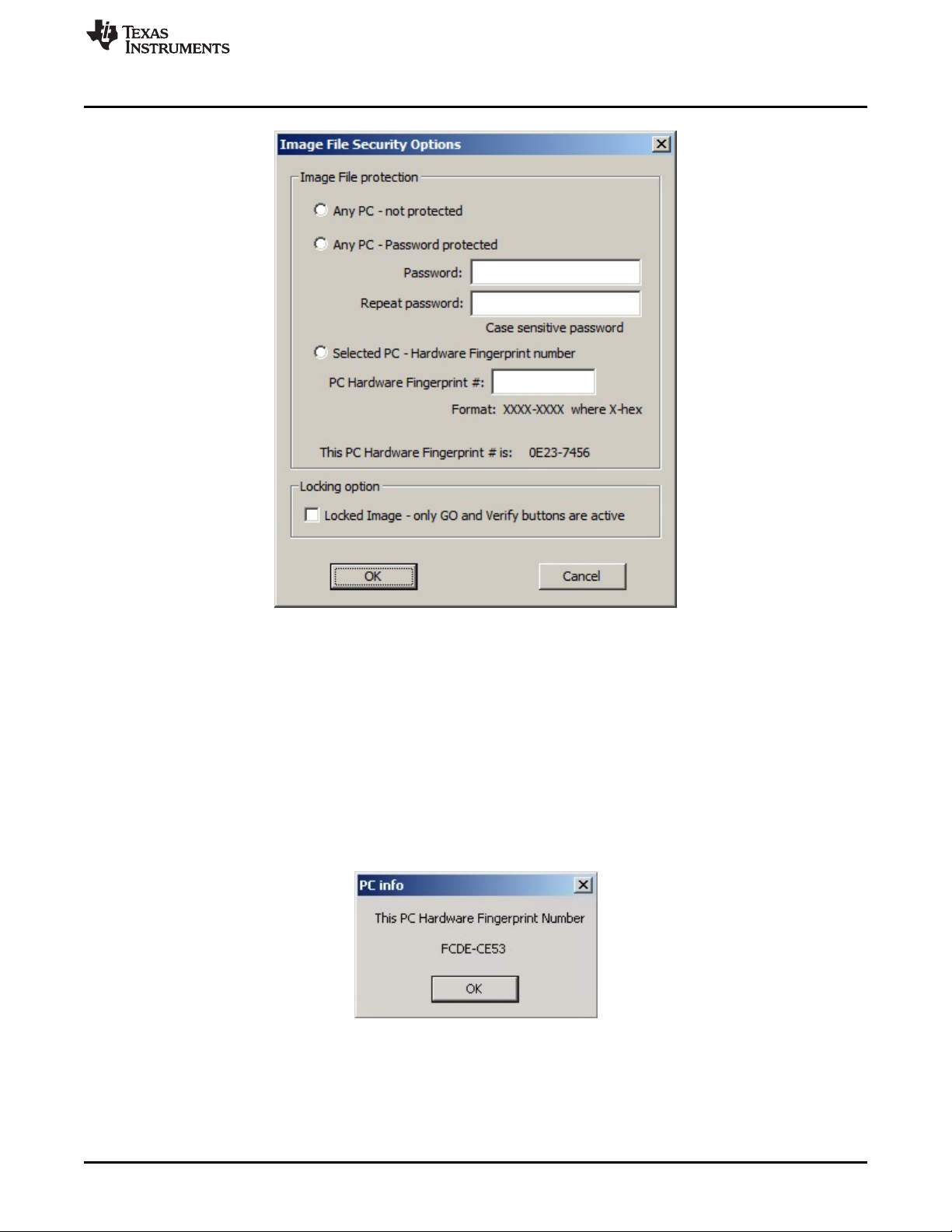
The screen shown in Figure 2-19 allows the user configure what type of security is used to protect the
image file. Three options are available; however, for all three options the contents of the code file are
always encrypted and cannot be read.
www.ti.com
Programming MSP Flash Devices Using the MSP Gang Programmer
43
SLAU358Q–September 2011–Revised October 2019
Submit Documentation Feedback
Copyright © 2011–2019, Texas Instruments Incorporated
Operation
NOTE: During project creation, the user can select to protect project information using various methods.
Figure 2-19. Image File Security Options
1. Any PC – Configuration can be opened on any computer using MSP Gang Programmer software. It
can be used for programming only.
2. Any PC – Password protected – Configuration can be opened on any computer using the MSP Gang
Programmer software, but only after the desired password has been entered.
3. Selected PC – Hardware Fingerprint number – Image can be opened only on the dedicated
computer with the same hardware fingerprint number as the number entered in the edited line above.
Figure 2-20 shows a window with the hardware fingerprint number. An example usage scenario would
involve calling an intended user to provide the hardware fingerprint number of their computer and
entering it within this configuration window. This restricts opening this image to only the dedicated
computer running MSP Gang Programmer software.
NOTE: The fingerprint can be used to secure the project where, for example, only a computer with a matching
hardware fingerprint can be used to view and edit the project.
Figure 2-20. Hardware Fingerprint of Computer in Use