SERIO_5000_DS_CC_D_E - 第7页
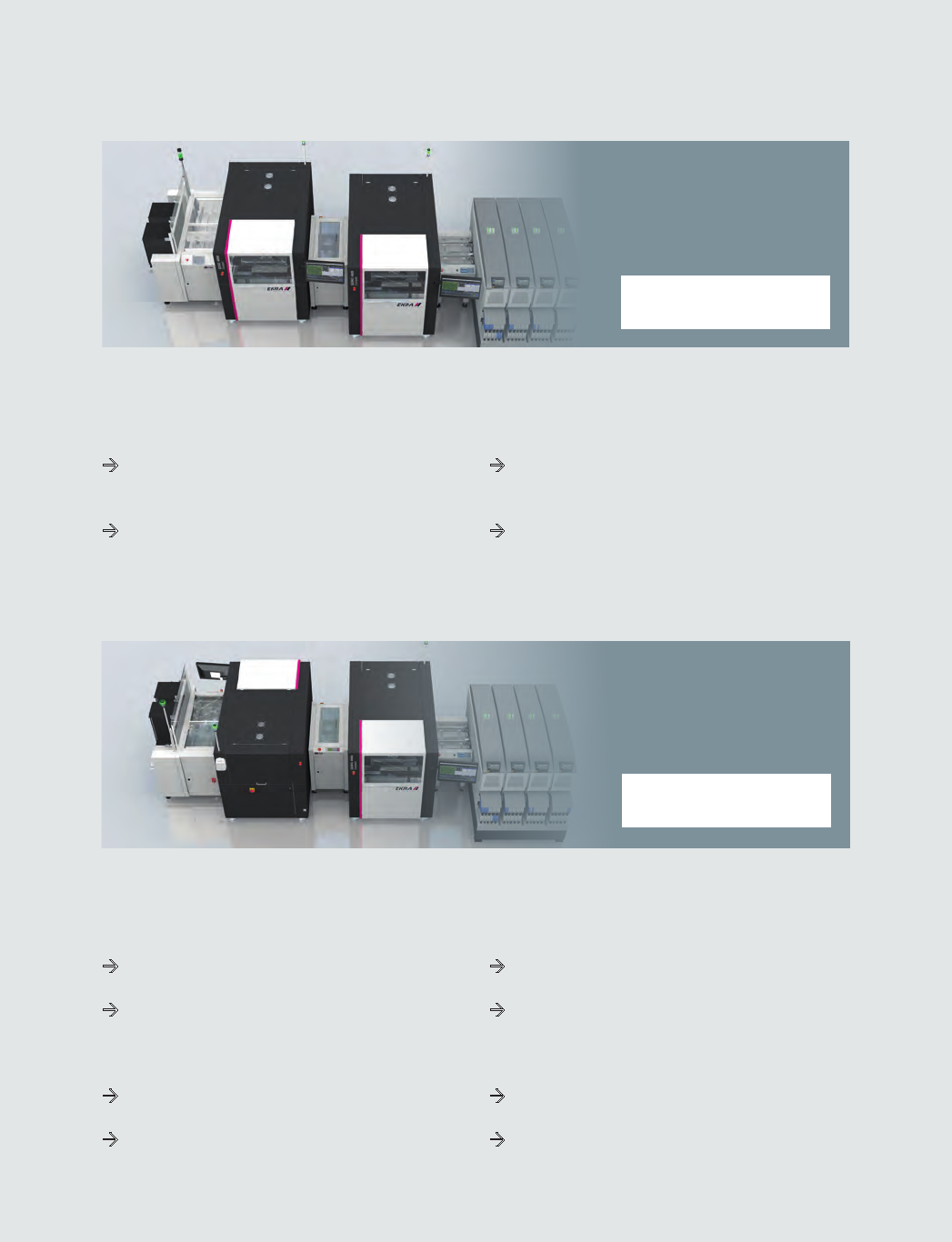
SPECIALISTS IN SCREEN & STENCIL PRINTING V arianten V ariants Side-b y-Side. B ac k-to-F ront. Beide Dr uc ker v on der gleic hen Seite bedienbar Dr uck er 1 (links) St andard Druc k er: V ordere Wangex Dr uck …

SPECIALISTS IN
SCREEN & STENCIL PRINTING
The Dual Lane Concept
In the eld of consumer electronics, small circuit
boards carrying components on both sides
must be processed. Due to that fact, short
line cycle times and throughput-optimized
production have become a necessary standard.
A redundant dual lane version of the production
machines increases the line availability and reduces
line cycle times signicantly. Different line
layouts, with single or dual operation, to support
various placement machines, can be realized.
This solution guarantees throughput-optimised
production processes.
The integration of a special designed handling
system ensures the conveing of substrates even
when one printer is turned off. For the efcient
operation of our Dual Lane concept this handling
module is mandatory.
Side-by-Side solution
The dual lane option is implemented in various
arrangements. For example, a single lane
printer and a double lane printer can be used
within a production line. This Side-by-Side solution
is the most cost-effective dual lane solution,
since only one of the machines requires the
dual lane functionality.
Back-to-Front solution
Alternatively, two dual lane printers in a Back-to-
Front arrangement can be used, in which one of
the two printers is rotated by 180°. The special
characteristic in this arrangement is that an
operator can operate the production line from both
sides. The printers can be selected and arranged
in such a manner, that makes the most sense for
the corresponding production requirements.
Both solutions can support printing of PCB
formats from 80 x 50 mm to 400 x 253 mm.
These formats are supported by all variants of the
dual-lane option. The variants are described on the
following page.
Das Dual Lane Konzept
Im Bereich der Consumer Electronics ist es Stan-
dard, dass kleine Leiterplattenformate, die beid-
seitig bestückt sind, verarbeitet werden. Kurze
Linientaktzeiten und eine durchsatzoptimierte Pro-
duktion sind hier gefordert.
Mit der redundanten Doppelspur-Ausführung lässt
sich die Linienverfügbarkeit erhöhen und Takt-
zeiten deutlich verkürzen. Selbst unterschiedliche
Linienlayouts, mit ein- oder beidseitiger Bedie-
nung, zur Unterstützung verschiedener Bestück-
automaten, sind realisierbar. Mit dieser Lösung
sind durchsatzoptimierte Produktionsprozesse
garantiert.
Die Integration von einem eigens entwickeltem
Handlingmodul, dass zwischen den Drucksyste-
men installiert wird, stellt den Transport der Lei-
terplatten auch dann sicher, wenn ein Drucker ab-
geschaltetist.FürdenefzientenBetriebunserer
Doppelspurkonzepte ist diese Handling unbedingt
erforderlich.
Side-by-Side-Lösung
Mit dem Dual Lane Konzept sind verschiedene
Anordnungen realisierbar. Beispielsweise können
jeweils ein Singlespurdrucker und ein Doppelspur-
drucker innerhalb einer Produktionslinie eingesetzt
werden. Diese Side-by-Side-Lösung ist die kosten-
günstigere Doppelspurlösung, da nur ein Drucker
mit der Doppelspurfunktionalität erforderlich ist.
Back-to-Front-Lösung
Alternativ können zwei Doppelspurdrucker in einer
Back-to-Front-Lösung zum Einsatz kommen. Einer
der beiden ist um 180° gedreht. Das Besondere
hierbei ist, dass eine Bedienung von beiden Seiten
der Produktionslinie erfolgen kann. Die Drucker
können so ausgewählt und angeordnet werden,
wie es für die jeweiligen Erfordernisse am sinn-
vollsten ist.
Mit beiden Lösungen lassen sich Leiterplatten-
formatevon80x50mmbis400x253mmbedru-
cken. Diese Formate werden von allen Varianten
des Doppelspur-Konzepts unterstützt. Die Varian-
ten werden auf der folgenden Seite beschrieben.
SPECIALISTS IN
SCREEN & STENCIL PRINTING
Varianten
Variants
Side-by-Side.
Back-to-Front.
Beide Drucker von der
gleichen Seite bedienbar
Drucker 1 (links) Standard Drucker:
VordereWangex
Drucker 2 (rechts) Doppelspur-Drucker:
Wange1und3x
Drucker sind um 180º
zueinander gedreht
Drucker 1 (links) Standard Drucker
vordereWangex
Drucker 2 (rechts) Doppelspur-Drucker
Wange1und4x
ODER
Drucker 1 (links) Doppelspur-Drucker
Wange1und4x
Drucker 2 (rechts) Doppelspur-Drucker
Wange1und4x
Both printers can be operated
from the same side
Printer 1 (left) standard printer
Front rail xed
Printer 2 (right) dual lane printer
Conveyor rails 1 and 3 xed
Printers are rotated by 180°
between each other
Printer 1 (left) standard printer
Front rail xed
Printer 2 (right) dual lane printer
Conveyor rails 1 and 4 xed
OR
Printer 1 (left) dual lane printer
Conveyor rails 1 and 4 xed
Printer 2 (right) dual lane printer
Conveyor rails 1 and 4 xed
Characteristics
Dual Lane Concept
The printing system at the beginning of the line
can be equipped with a single lane. The bottom
side of the PCB is printed here. The second
printer of the line has the same specifications,
but offers two lanes. A pass-through lane and a
second lane where the top side of the PCB is
printed.
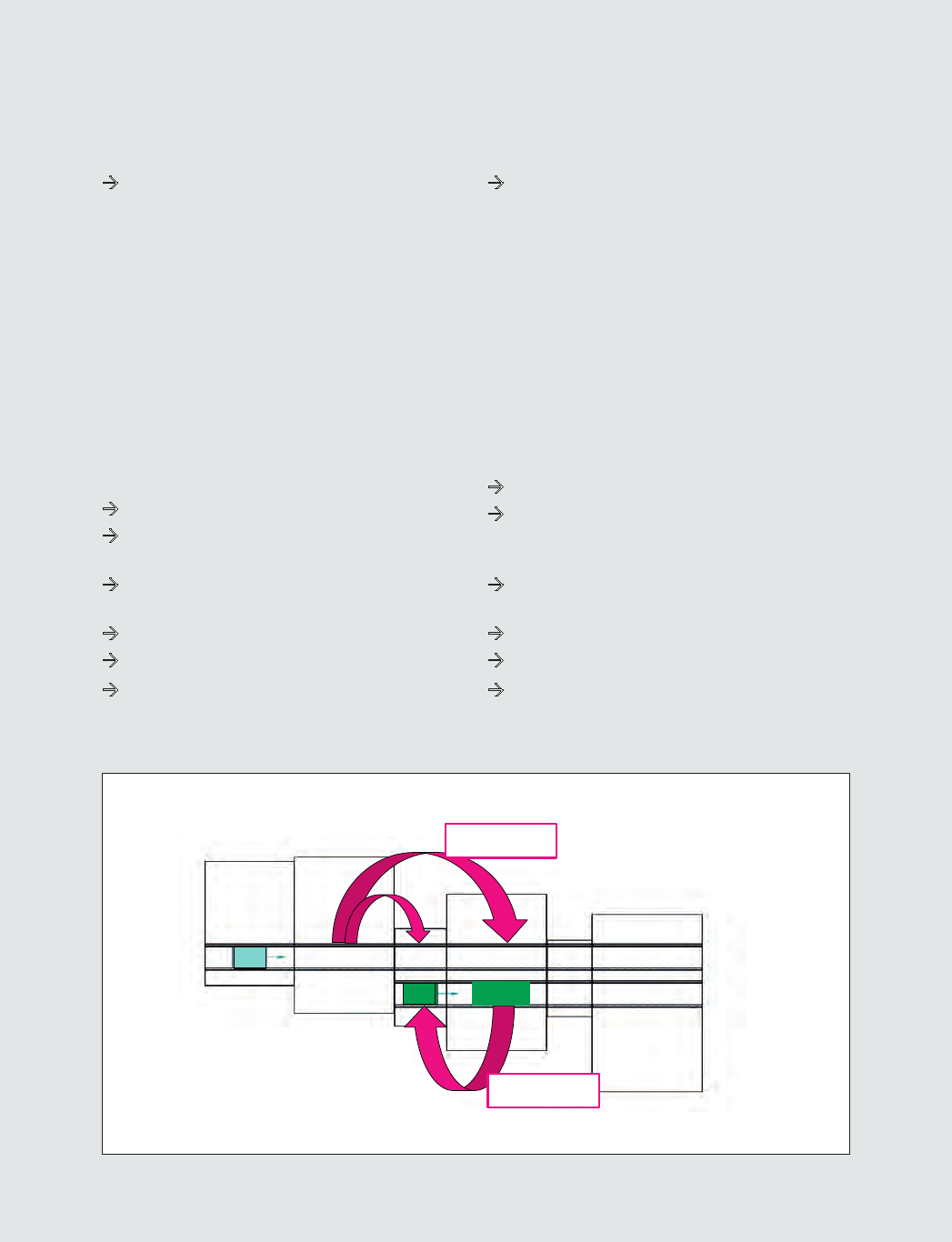
The pass-through lane of the dual lane
continues to run even if the covers are
opened, since it is fully controlled by the rst
printer. During maintenance of the second
printer, the rst printer can still continue with
the production process (see gure below).
All options can be used in combination.
The pass-through lane is powered and
controlled by the rst machine
(see gure below).
All machines can be used for Left-To-Right /
Right-To-Left production ow
Interfaces: SMEMA / Siemens / TCP-IP
Distance between rail 1 and 4 = 686 mm
Distance between rail 2 and 3 = 178 mm
(other distances on request)
Eigenschaften
Dual Lane Konzept
Das Drucksystem zu Beginn der Linie kann
mit einer Single-Spur ausgestattet sein.
Hier erfolgt dan die Bedruckung der Rück-
seite einer Leiterplatte. Der zweite Drucker
hat die gleichen Spezifikationen, jedoch zwei
Spuren – eine Durchlaufspur und eine Spur
zur Bedruckung der Vorderseite.
Die Durchlaufspur im zweiten Drucker wird
vom ersten Drucker angesteuert wird. Das
heißt, beide Spuren in der zweiten Anlage
arbeiten unabhängig voneinander. Bei War-
tung oder Produktwechsel, kann auf dem
zweiten Drucker unterbrechungsfrei gedruckt
werden(sieheGrak).
Alle Optionen sind in Kombination möglich
Die Durchlaufspur wird von der ersten Anlage
gesteuertundkontrolliert(sieheGrak).
Alle Maschinen sind nach dem Prinzip
Left-To-Right / Right-To-Left einsetzbar
Schnittstellen: SMEMA / Siemens / TCP-IP
Abstand Wange 1 und 4 = 686 mm
AbstandWange2und3=178mm
(andere Spurabstände auf Anfrage)
SPECIALISTS IN
SCREEN & STENCIL PRINTING
Power supply*
and control*
STOP
Power supply*
and control*
Dieses Konzept ist nur realisierbar, mit ASYS BDS-I Transport System.
This concept ist only feasable with ASYS BDS-I transport system.