TR7600 SIII_Series_Maintenance_en_v_2_0_3 - 第28页
Test Research, Inc. 18 TR7600 SI II Series User Guide – Maintenance c) For mac hines with f requent overload, please follow the ins tructions mentioned above to test diff erent voltages and c urrents and then report the …
Test Research, Inc.
TR7600 SIII Series User Guide – Maintenance 17
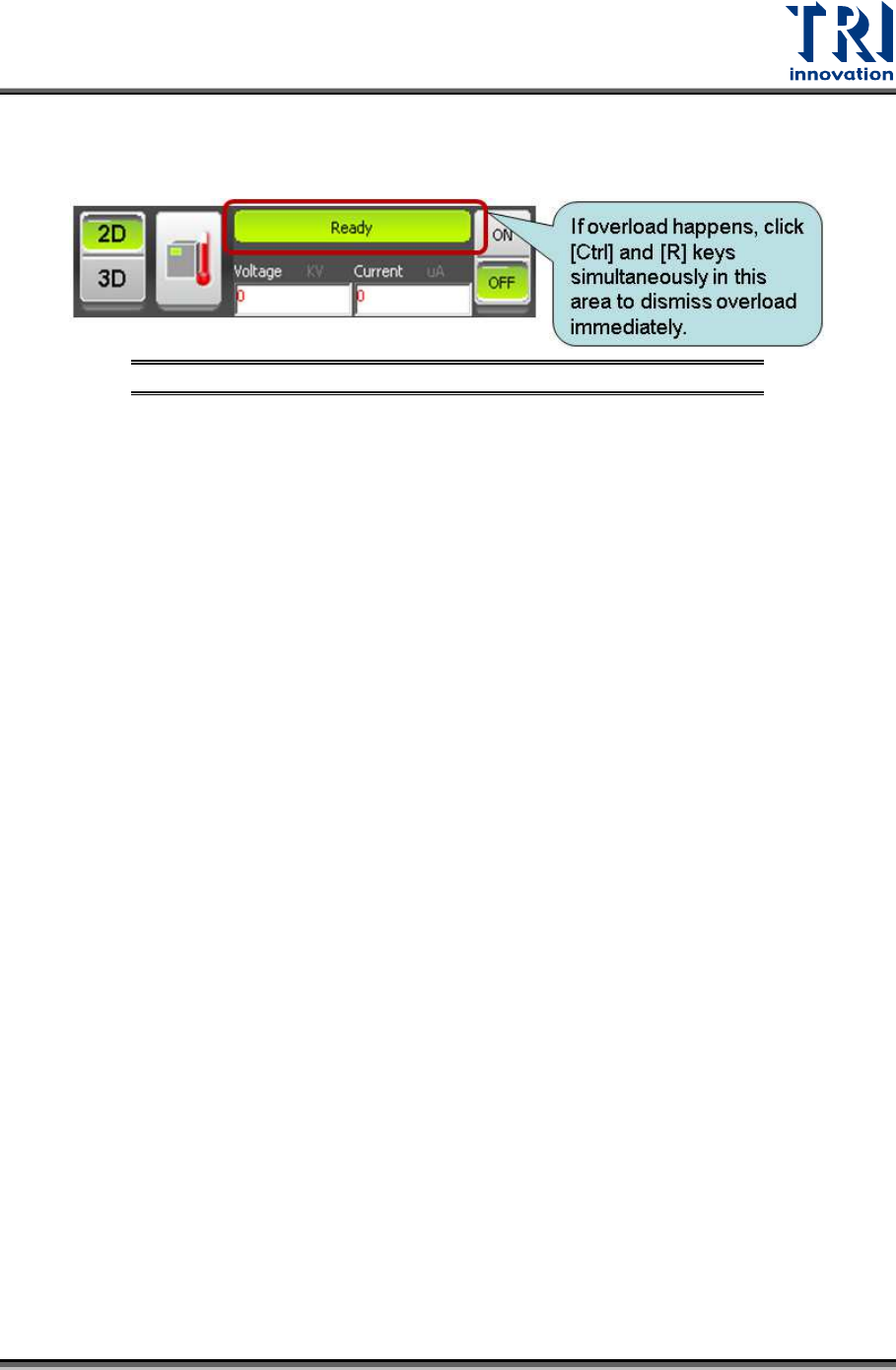
V. If overload happens, Left-click the mouse on the confined area in the
figure below. Click [Ctrl] and [R] keys simultaneously to dismiss overload
immediately and then report the overload voltage to TRI.
Figure 28: Warm up button
VI. If overload does not happen, click [Off] to turn off X-ray tube. Repeat
steps I~IV to test different voltages and currents listed below in sequence
and then report the overload voltage to TRI.
Test condition 1 (Voltage, Current) = (90kV, 300μA)
Test condition 2 (Voltage, Current) = (100kV, 300μA)
Test condition 3 (Voltage, Current) = (110kV, 300μA)
Test condition 4 (Voltage, Current) = (120kV, 300μA)
Test condition 5 (Voltage, Current) = (130kV, 300μA)
To perform warm-up maintenance manually:
I. Perform warm-up maintenance manually once every day. Please check
whether overload frequency decreases based on the time interval of every
three days.
II. About one week later, if you find overload frequency decreases until
overload does not happen anymore, you can perform the warm-up
maintenance manually once every day.
III. About one week later, if you find overload frequency does not decrease,
please do manual warm-up three times every day until overload does not
happen anymore, and then do manual warm-up once every day.
IV. If you have not used X-ray tube for several days, please repeat above
steps I~III.
Test Research, Inc.
18 TR7600 SIII Series User Guide – Maintenance
c) For machines with frequent overload, please follow the instructions mentioned above
to test different voltages and currents and then report the overload voltage to TRI.
Besides, please follow the suggestions below to do warm-up maintenance.
I. Please warm up machines three times every day. You can warm up
machines during lunch break or work shift time.
II. About one week later, if you find overload frequency decreases until
overload does not happen anymore, you can do warm-up maintenance
manually once every day.
III. After a period of time, if overload often happens again, please test
different voltages and currents listed below in sequence and report
overload voltage to TRI.
Test condition 1 (Voltage, Current) = (90kV, 300μA)
Test condition 2 (Voltage, Current) = (100kV, 300μA)
Test condition 3 (Voltage, Current) = (110kV, 300μA)
IV. Start to do warm-up maintenance manually more than three times every
day.
V. If overload frequency does not decrease obviously, please increase the
manual warm-up frequency every day.
VI. If overload frequency has decreased obviously for more than three days,
please do warm-up maintenance manually once every day.
VII. If you have not used X-ray tube for several days, please repeat the above
steps I~II.
Immediate Solution For X-ray Source Overload
1) In busy assembly lines, if machines have overload and you need to do inspection
urgently, you can execute the following steps, instead of manual warm-up.
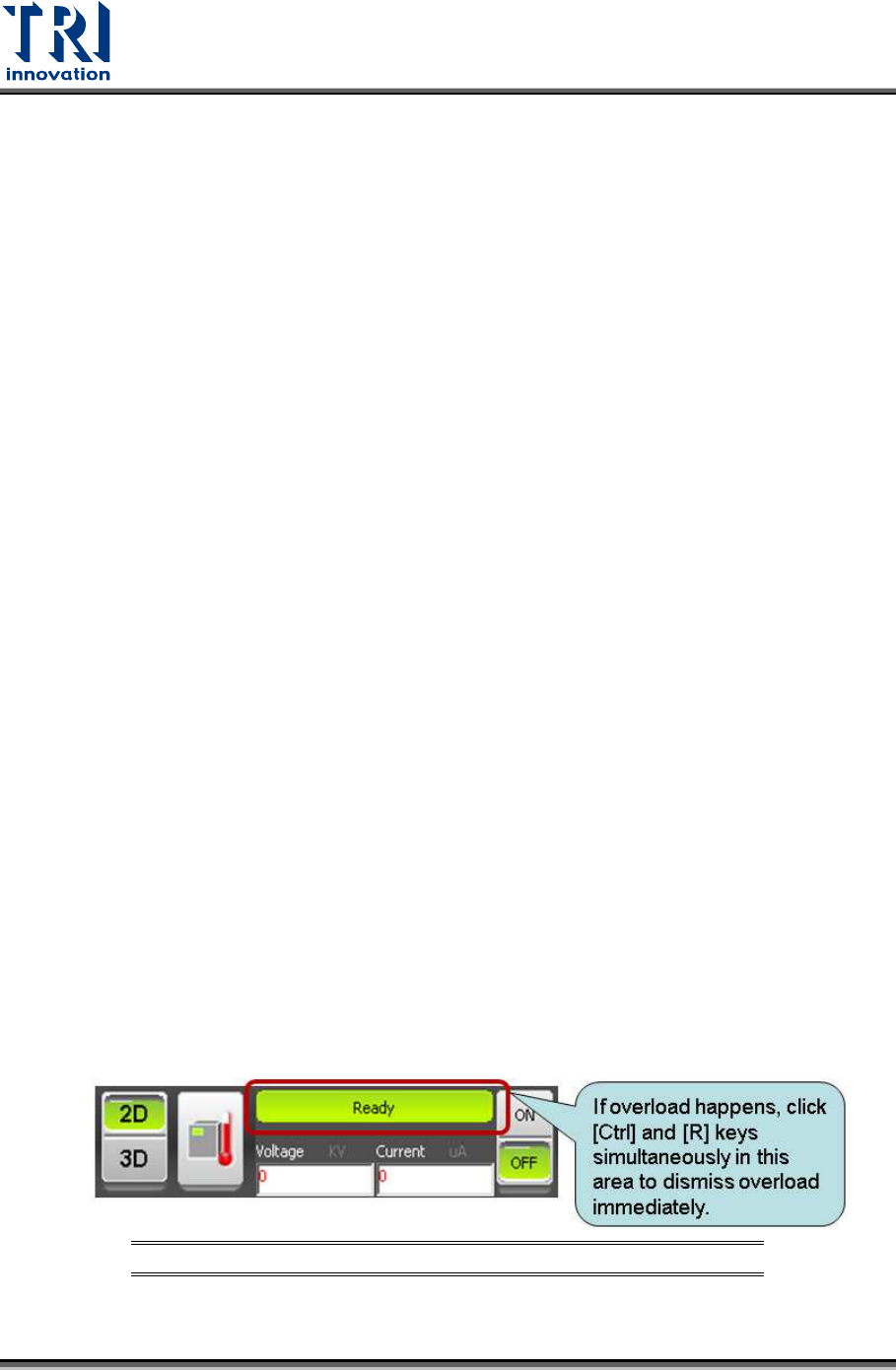
I. Left-click the mouse on the confined area in the figure below. Click [Ctrl] and
[R] keys simultaneously to dismiss overload immediately.
Figure 29: Click to dismiss Overload
Test Research, Inc.
TR7600 SIII Series User Guide – Maintenance 19
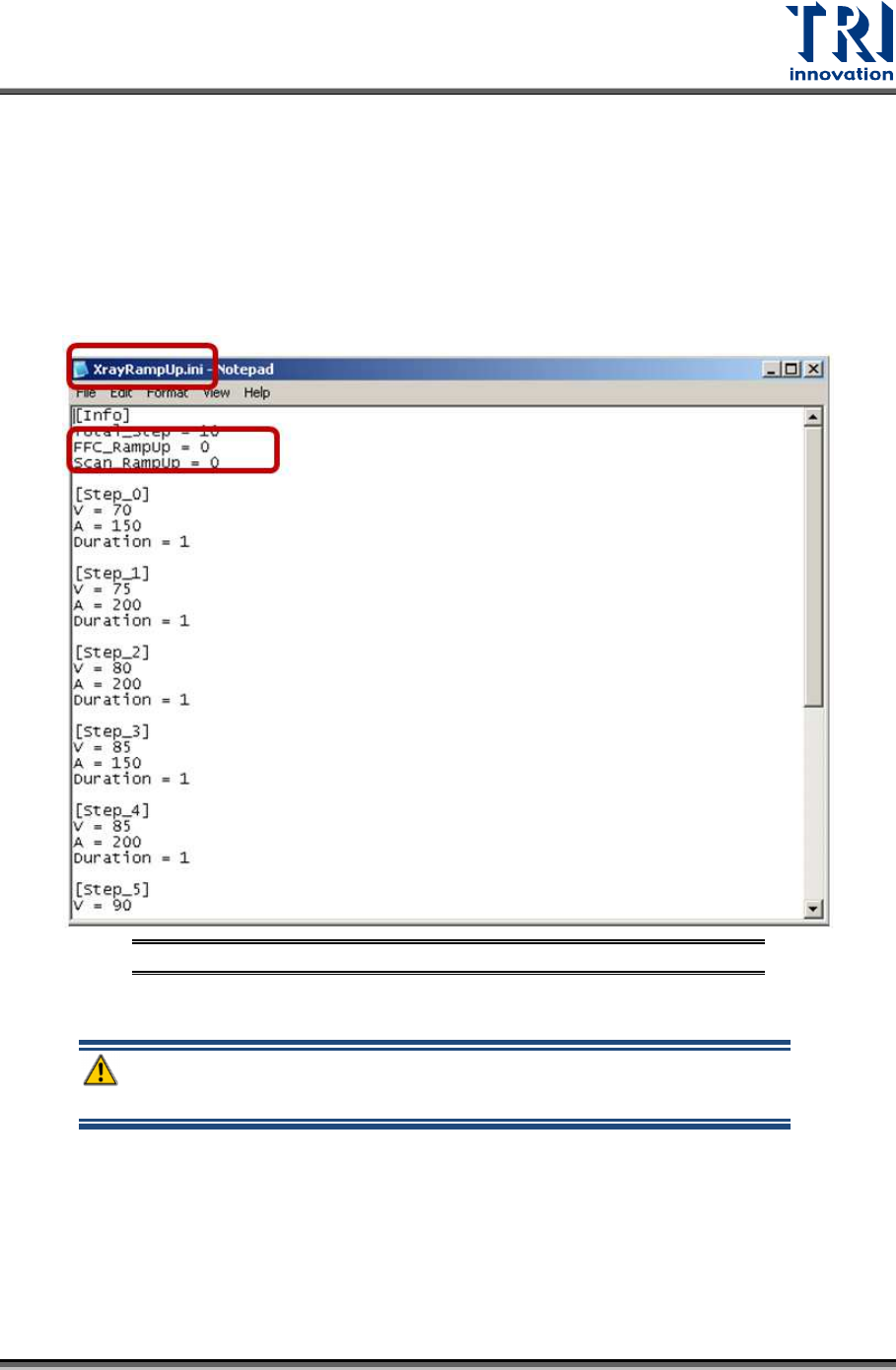
II. Open XrayRampUp.ini file in the main program folder.
III. Change the setup as FFC_RampUp = 1 and Scan_RampUp = 1, and then
save the updated file.
IV. After you update the XrayRampUp.ini file, the main program will increase the
voltage slowly whenever you scan a board or do FFC calibration.
V. After the inspection is done, you can do manual warm-up.
Figure 30: XrayRampUp.ini
Warning: If customers failed to do weekly manual warm-up, X-ray
tube warranty would be void.