00193891-0702_AI_LP_Barcode_DE+EN.pdf - 第160页
2 PCB barcode scanner assembly instructions SIPLACE 2.7 Installing the PCB barcode scanner 10/2009 Edition 160 : Set the distan ces between the 1D barcode scanner and the PCB so th at the barcodes are read reliably . Thi…
SIPLACE 2 PCB barcode scanner assembly instructions
10/2009 Edition 2.7 Installing the PCB barcode scanner
159
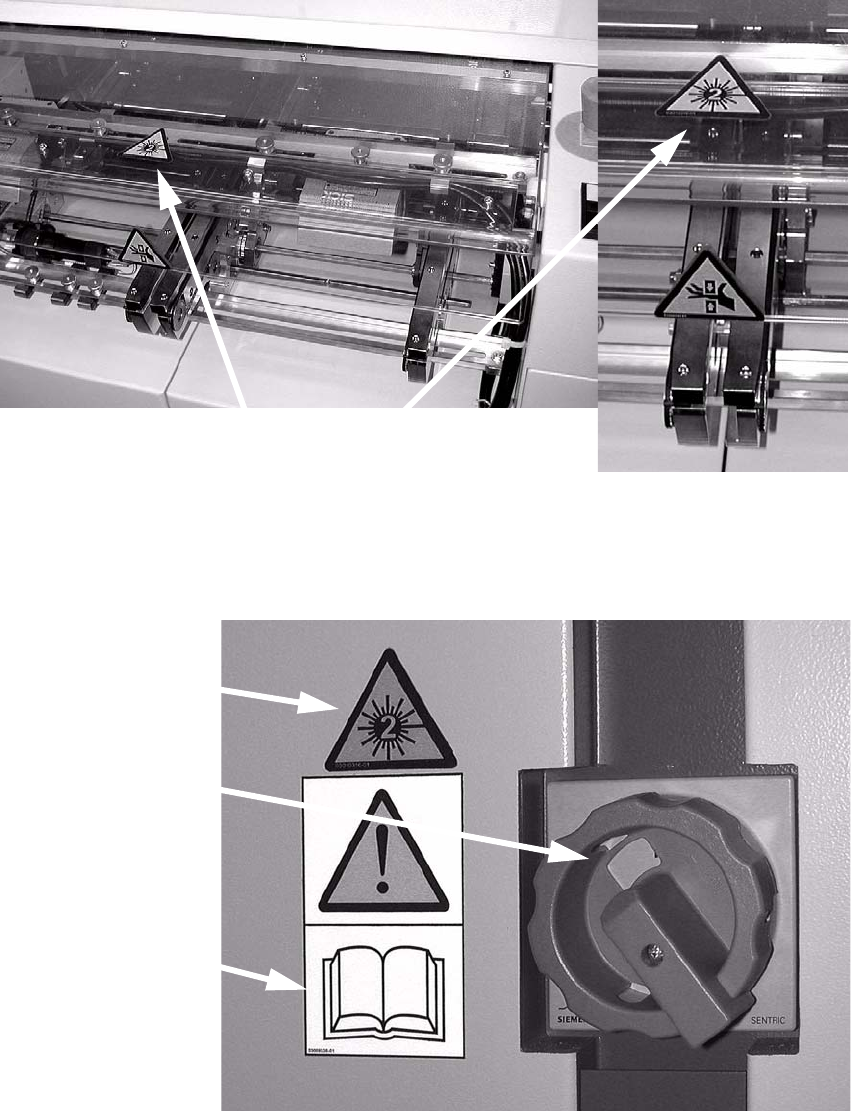
Attach the warning labels 2
: Attach the laser warning label to the Makrolon window on the input belt.
Th
e label is needed because a laser class 2 sensor
beam that is directed upwards while the
machine is in use could be directed outside.
Position of the label
2
: Stick the warning label W216 (item no. 03010316-xx) onto the cover, beside the main switch
and above the warning label concerning following the safety instructions in the operating in-
structions.
Main power switch
Warning label W216
Warning label
for safety
instructions
2

2 PCB barcode scanner assembly instructions SIPLACE
2.7 Installing the PCB barcode scanner 10/2009 Edition
160
: Set the distances between the 1D barcode scanner and the PCB so that the barcodes are read
reliably. This is achieved by moving the cross-rails up or down in the slots (see scanning field
diagram in
Chapter 2.11.4).
: Fo
r the 2D barcode scanner, set the distance to exactly 60 ± 1 mm.
Use the adjusting gauge provided
(see photograph on page 177).
The 2D scanner only works in this focus range.
2
The SICK software (version > 4.1) can be used to check the setting. 2
2
: Switch the placement machine on at the main switch.

SIPLACE 2 PCB barcode scanner assembly instructions
10/2009 Edition 2.7 Installing the PCB barcode scanner
161
2.7.2 SIPLACE HS-50 / HS-60 / D4 / D1 / D2
2.7.2.1 Preparatory work
: Switch the placement machine off at the main power switch.
2
HS-50 / HS-60 only: 2
: Check whether the fixing holes have been drilled for the PC
B barcode. If not, carry out the pre-
paratory work described in
Section 2.7.3.
2
For older HS-50 machines (version number < 800), the entire drilling pattern must be applied (see
Section 2.8). 2
For more recent HS-50 and older HS-60 machines, a thread must also be tapped (see drawing in
Section 2.8).
Do not use the HS-50 drilling gauge to do this. 2
: If drilling work is required, see the nex
t section, otherwise skip to the next section but one: Me-
chanical installation.