00193891-0702_AI_LP_Barcode_DE+EN.pdf - 第263页
SIPLACE 2 PCB barcode scanner assembly instructions 10/2009 Edition 2.12 Tips & tricks for the barcode scanner 263 – The “CL V Wizard“ button is used to check or set the focus height of the barcode reade r and automa…
2 PCB barcode scanner assembly instructions SIPLACE
2.12 Tips & tricks for the barcode scanner 10/2009 Edition
262
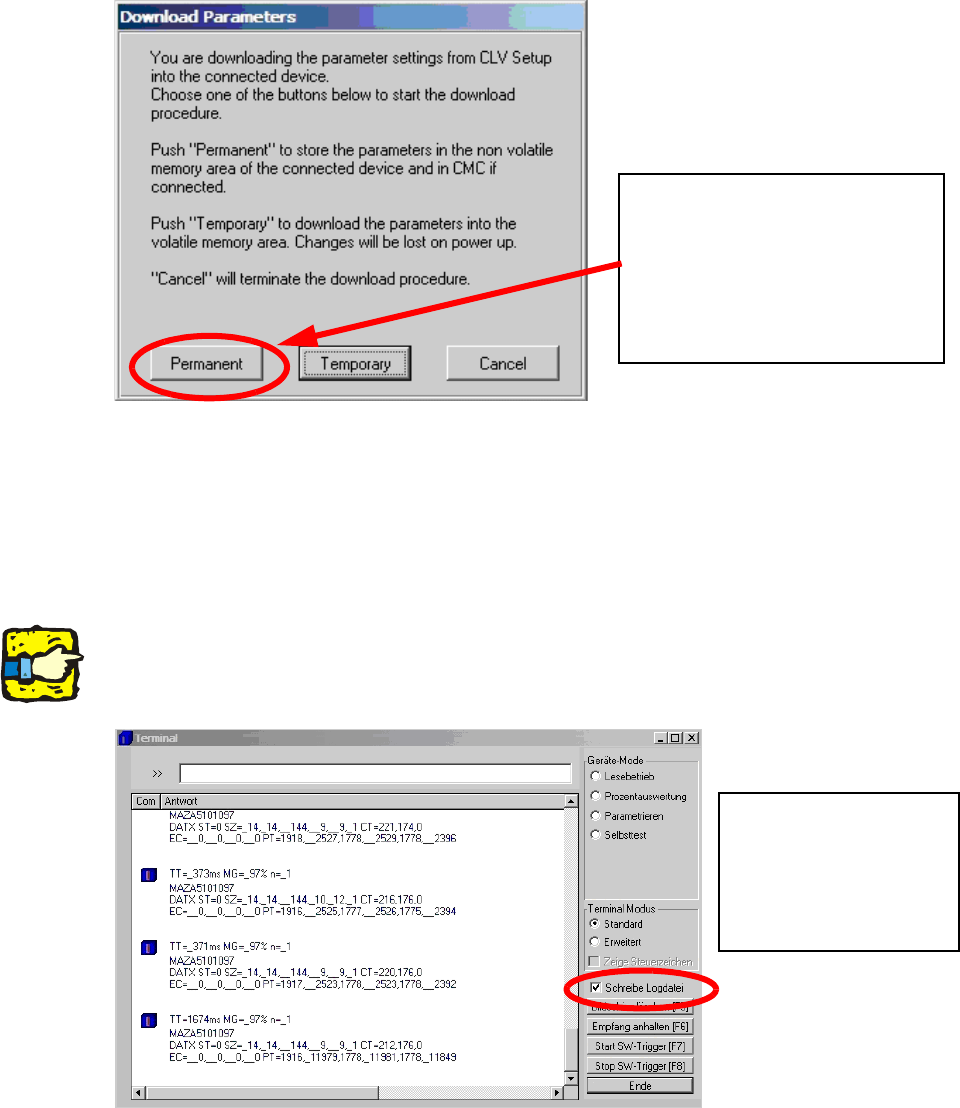
– Always select the download with the status “Permanent“.
Only the permanent download will
ensure that the settings are perma-
nently saved on the scanner.
With a temporary download, the set-
tings will be lost after a restart.
2
2
– Use the “Upload from device“ to send the settings from the scanner to the computer.
– Use the "Operating data" button to read the firmware on the connected scanner.
– Use the “Terminal“ button to displa
y the
data strings read by the scanner, write them to a log
file and save them on the computer.
2
Further information can be found in section 5 / Analyzing the data string in the terminal monitor.2
To save the data, high-
light the “Write log file"
box and select the cor-
responding path or file
name.
2
2
2
2
SIPLACE 2 PCB barcode scanner assembly instructions
10/2009 Edition 2.12 Tips & tricks for the barcode scanner
263
– The “CLV Wizard“ button is used to check or set the focus height of the barcode reader and
automatically configure it for a certain barcode type.
2
For further information, see section 6 / Changes in the CLV Wizard. 2
2
2
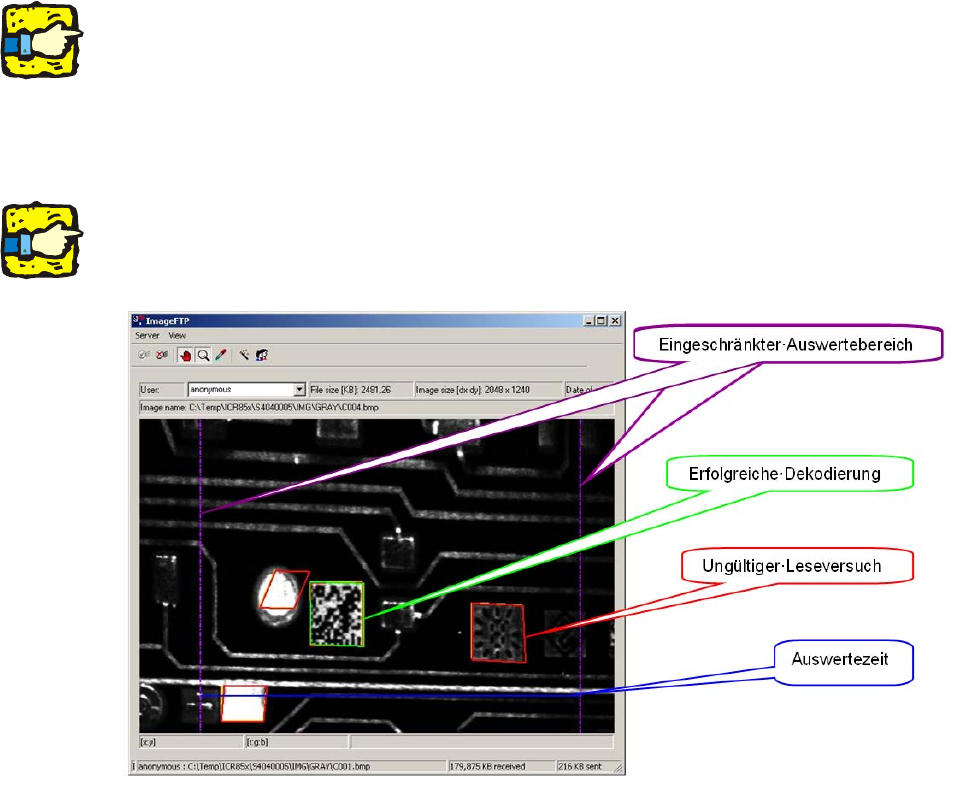
– The “FTP image output" button is used to display the image read by the scanner on the com-
puter.
2
The diagnostic data must have been activated in the “Image request“ menu in order to show the
guiding lines. 2
2
2
2.12.6.1 How the ICR850 works
When it is switched on, the scanner looks for possible barcode structures. 2
When it detects a possible structure, it places a barcode grid over it. 2
If the grid does not conform to the specifications, th
en the
structure is given a red border to indi-
cate an invalid scan attempt
. 2
If it does conform to the specifications, the bar
code is decoded, given a green border and output
to at the station. 2
The violet dashed lines restrict the area that the scan
ner analyzes when searching for the bar-
code. 2
2 PCB barcode scanner assembly instructions SIPLACE
2.12 Tips & tricks for the barcode scanner 10/2009 Edition
264
The analysis time is the time from when the scanner is switched on until the barcode is success-
fully decoded. The closer the blue line is to the su
ccessfully-decoded barcode, the better the pre-
set values. 2
2.12.7 Analyzing the data string in the terminal monitor
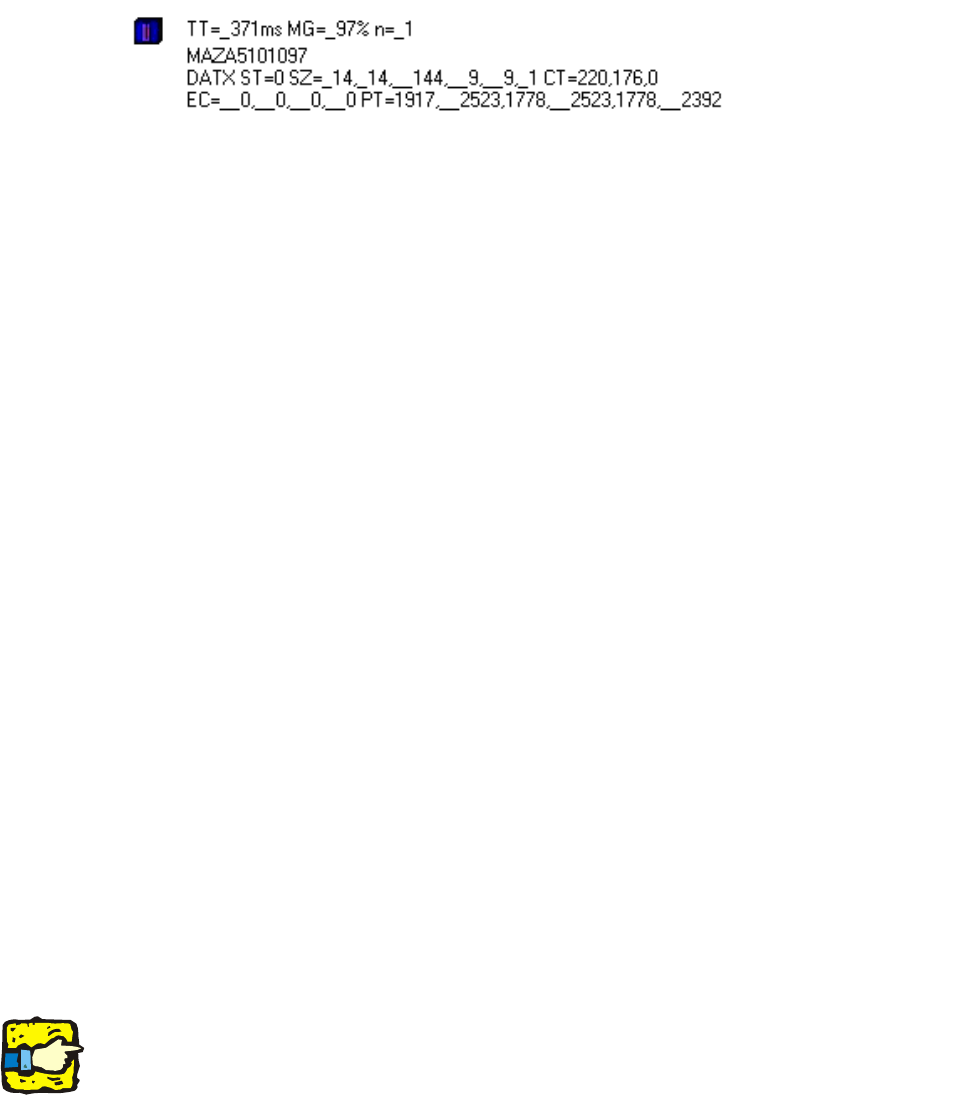
TT
The analysis time depends entirely on the application and is the time from the start of
the scan window to the end of the scan window, so it can extend over the entire length
of the PCB.
The result must be output in SIPLACE either immed
iately or after a time set with a timer,
and must thus be shorter than the external scan window.
MG
This value is not very informative and it comes from the linear codes.
n
Scanner status (0 = no code scanned)
2
2
The second line is the entire data content of the data matrix code. 2
DATX
Data matrix code detection
ST
Scan status (0 = Code detected as correct)
SZ
Shows the symbol size and the number of working bits. The last two values are the
number of pixels or the scans per cell. If the two values are identical on average, the
speed has been set correctly.
CT
Two values are output as a contrast; the first value shows the grayscale difference in
the data matrix symbol. A value in excess of 200 is good and the maximum possible
value is 255. This is not desirable, however, since the amplifiers are saturated at 255.
EC
For these values, the second digit is actually the important one as it shows the
percentage usage of the redundant data bytes. 100% is critical here and shows that the
NOREAD limit has been reached. It can be tolerated in individual cases, however, but
it should not exceed 50% on average.
PT
For PT, the coordinates of the three corner points of the L pattern of the data matrix
symbol are output. This is of less relevance in the SIPLACE application, but it can be
important in applications in which there are several codes to be scanned in the scanning
window in order to determine which codes were read. The first value is the pixel position
on the line, while the second value is the number of scans since the start of the scanning
window.
2
2
2
The two most important criteria are EC (percentage) and CT (contrast). 2