YSP10_Mainte_E.pdf - 第29页
2. Preparing for maintenance works 1-2 Chapter 1 Maintenance 1.2 Importance of periodic inspections and cleaning P eriodic inspections and cleaning are extremely important maintenance tasks. F ailure to perform inspectio…

1. Maintaining machine performance
1-1
Chapter 1 Maintenance
1. Maintaining machine performance
The most important condition essential for maintaining the performance of the machine you purchased
is using it under good environmental conditions. Performing daily maintenance and periodic inspections
is also absolutely essential.
1.1 Essential conditions and working environment
►
Air
• Supply air pressure : Always 0.45MPa or more
• Air hose with inner diameter of 8mm or more should be used.
• Clean air passed through air dryer and air filter should be used.
►
Power
Item Description
Power supply Single phase 200, 208, 220, and 230V +/-20V
Frequency 50Hz or 60Hz
Maximum power supply capacity 6.9kVA (except for optional temperature control unit)
Average power consumption 1.2kW
Power supply connection Power cable conductor cross-section area: 6 mm2 or larger
c
CAUTION
When the current leakage breaker is equipped at upstream position, select of which capacity is 30mA or more.
►
Environment
Item Description
Humidity
Functions guaranteed within 20 to 80% (no condensation), optimal range: 50 to
60%
Temperature
Functions guaranteed within 15 to 30°C. Machine precision guaranteed within
23 to 28°C. Recommended temperature: within 23 to 26°C
Environment
No dust or dirt etc. No organic solvent mist, sulfur dioxide gas, chlorine gas,
flammable gas and so.
Noise 78dB or less
Overvoltage category* category II
Pollution degree* degree 2
Altitude 1000m or less above sea level
Installation
Flat level location sturdy enough so no vibration occurs during operation.
Concrete or concrete equivalent strength level needed.
Wooden floors, office floors, or grating in particular are unsuitable.
Floor load-bearing strength Approx. 500 kg/m2 or more
Ambient noise
Make sure to prevent significant noise. Operating noise of the machine or
alarm are to be listened with no incident.
Ambient lighting Make sure to prevent strong light such as sunlight into vision system.
*Complying with IEC60664-1
n
NOTE
When using an industrial humidifier as static electricity prevention measures, be sure to refer "1.3 Importance of
appropriate humidity management", and comply it.

2. Preparing for maintenance works
1-2
Chapter 1 Maintenance
1.2 Importance of periodic inspections and cleaning
Periodic inspections and cleaning are extremely important maintenance tasks. Failure to perform inspections
and cleaning will prevent the machine from delivering full performance and may lead to component
mounting problems or equipment breakdowns.
Problem examples:
Dirty optical system (camera, lighting, etc.) may cause recognition errors.
Poor greasing of axes may cause abnormal noises.
Inadequate inspection of valve etc may cause failure in clamping and transferring a board.
As these examples show, failure to make inspections may lead to equipment problems. It is strongly
recommended to perform periodic inspections and cleaning to ensure the machine is used under optimal
conditions.
1.3 Importance of appropriate humidity management
The inappropriate humidity management of the machine installed floor, it triggers dew drops and may
damage the control circuit inside of machine.
Perform the following items to secure machine endurance.
█
Check the temperature and humidity of your site before turning on machines
• Actuate the air conditioner, humidifier or dehumidifier to adjust the temperature and humidity
matched to the environmental condition described in "1.1 Essential conditions and working
environment", confirm the temperature and humidity of your site settle and the turn on machines.
█
Use the humidifier adequetly
• Use the water without much impurity for humidifier.
• The spray type humidifier should be installed at high place enough from machines. Adjust the
amount of mist to prevent the dew drops on machine surface.
• Adjust the humidifier operation as necessary. Especially the using of humidifier in humid seasons, the
humidity may excess 80%.
n
NOTE
The water without much impurity refers to that is filtered by the dedicated equipment.
The impurity amount of filtered water can be perceived by the electrical conductivity of water (S/cm);
General tap water in Japan : 100 - 400µS/cm
Filtered tap water : approx. 1 - 2µS/cm
c
CAUTION
For your humidifier, DO NOT use tap water or well water. Those water include small amount of elements as such Natrium
or Chlorine, may cause a decline of insulation, and it may damage the circuit inside of machine.
2. Preparing for maintenance works
1-3
Chapter 1 Maintenance
2. Preparing for maintenance works
Tasks described in this section focus mainly on replacing parts (consumable parts) that are used to
keep machine function and might deteriorate gradually during use. This section also describes how the
user can easily replace parts (replaceable parts) when a breakdown occurs.
2.1 Consumable parts
Choose the following parts when some parts need to be replaced after the periodic inspections.
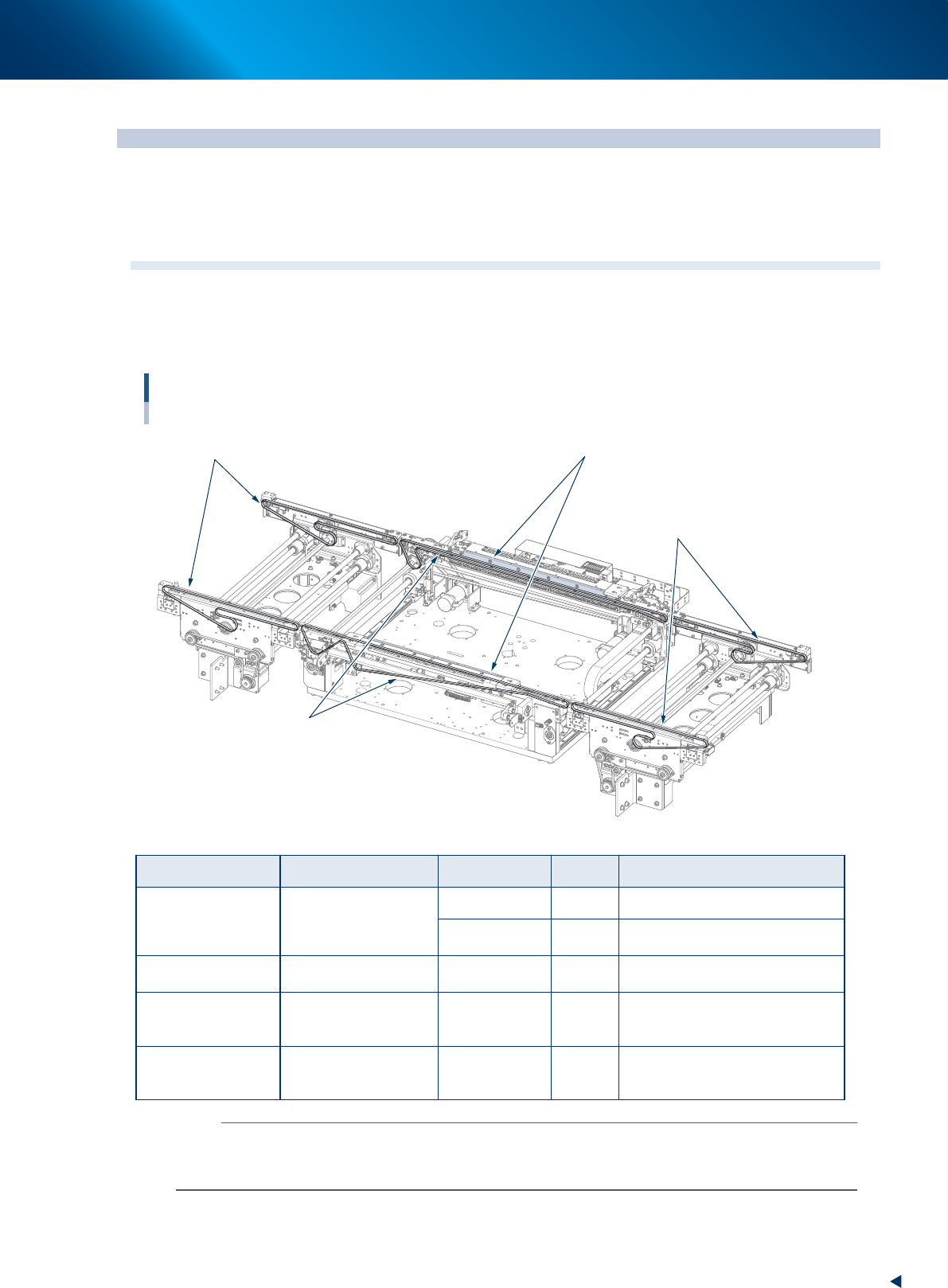
2.1.1 Conveyor related parts
Conveyor related consumable parts
Conveyor transfer belt and board clamp units
Edge clamp plates
Conveyor transfer belts (center)
Conveyor transfer belts (entrance/exit)
Conveyor transfer belts (entrance/exit)
53401-KMJ-00
Subject to replace Part name Part No. Quantity Note
Edge clamp plate PLATLE, EDGE CLAMP
KMJ-M9166-00X 2 Judge by the worn status of the parts.
KMJ-M9166-L0X 2
Judge by the worn status of the parts.
For L650 type only.
Conveyor transfer belt
(center)
BELT, CONV. KMJ-M9135-00X 2
Judge by the worn status of the parts.
Belt size: 1722mm
Conveyor transfer belt
(entrance/exit)
TRANSFER BELT W1 KHT-M9314-01X 4
Judge by the worn status of the parts.
Belt size: 1,000mm
Common to entrance and exit
Conveyor transfer belt
Extension of exit side
(option)
TRANSFER BELT W3L KMJ-M9346-00X 2
Judge by the worn status of the parts.
Belt size: 1,677mm
n
NOTE
The part Nos. given in this manual are the original part Nos. which were assigned to the parts when this manual was
issued. Because these part Nos. may be changed without prior notice, be sure to verify the latest part Nos. before ordering
parts.