5TROUBLESHOOTING_.pdf - 第141页
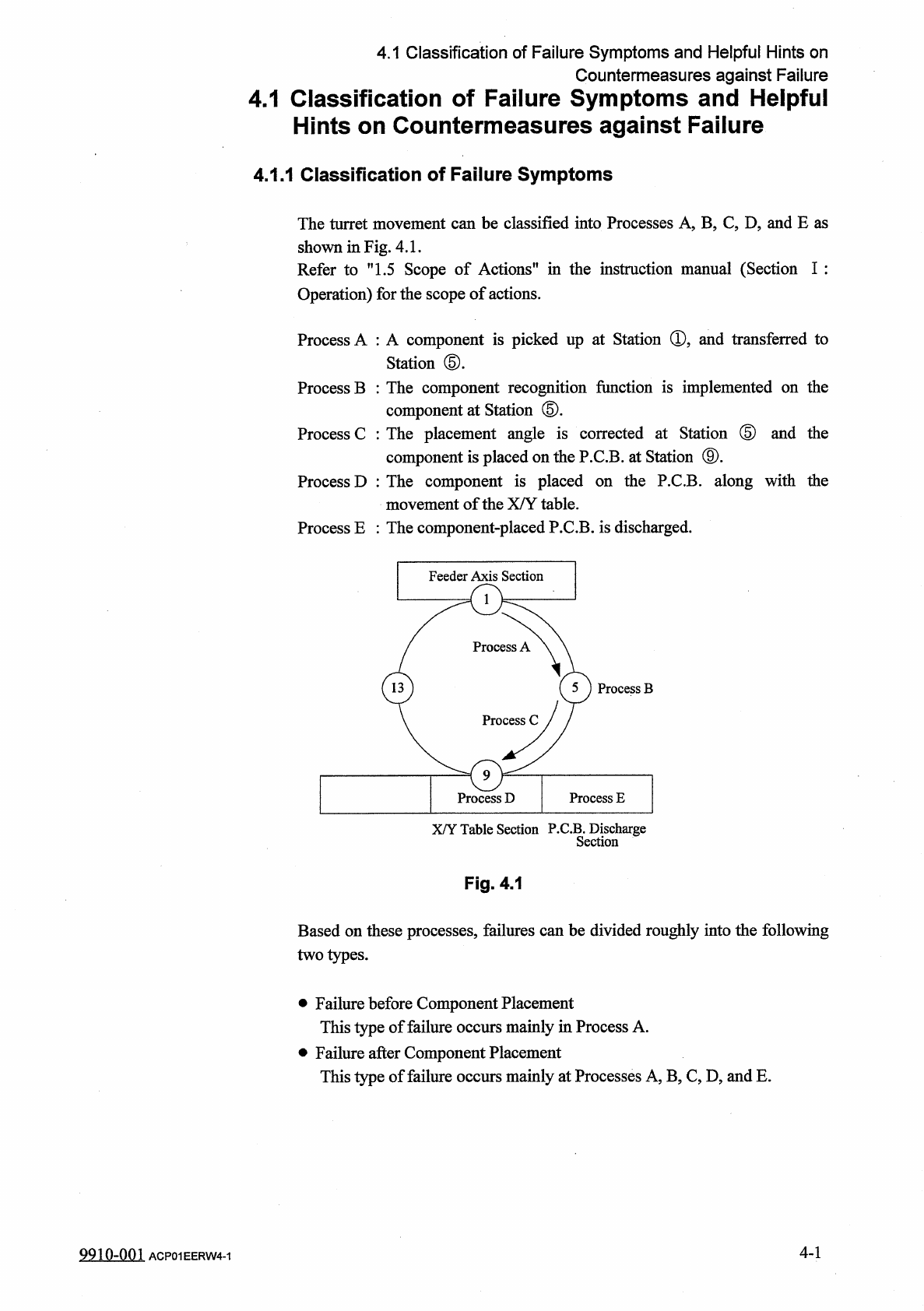
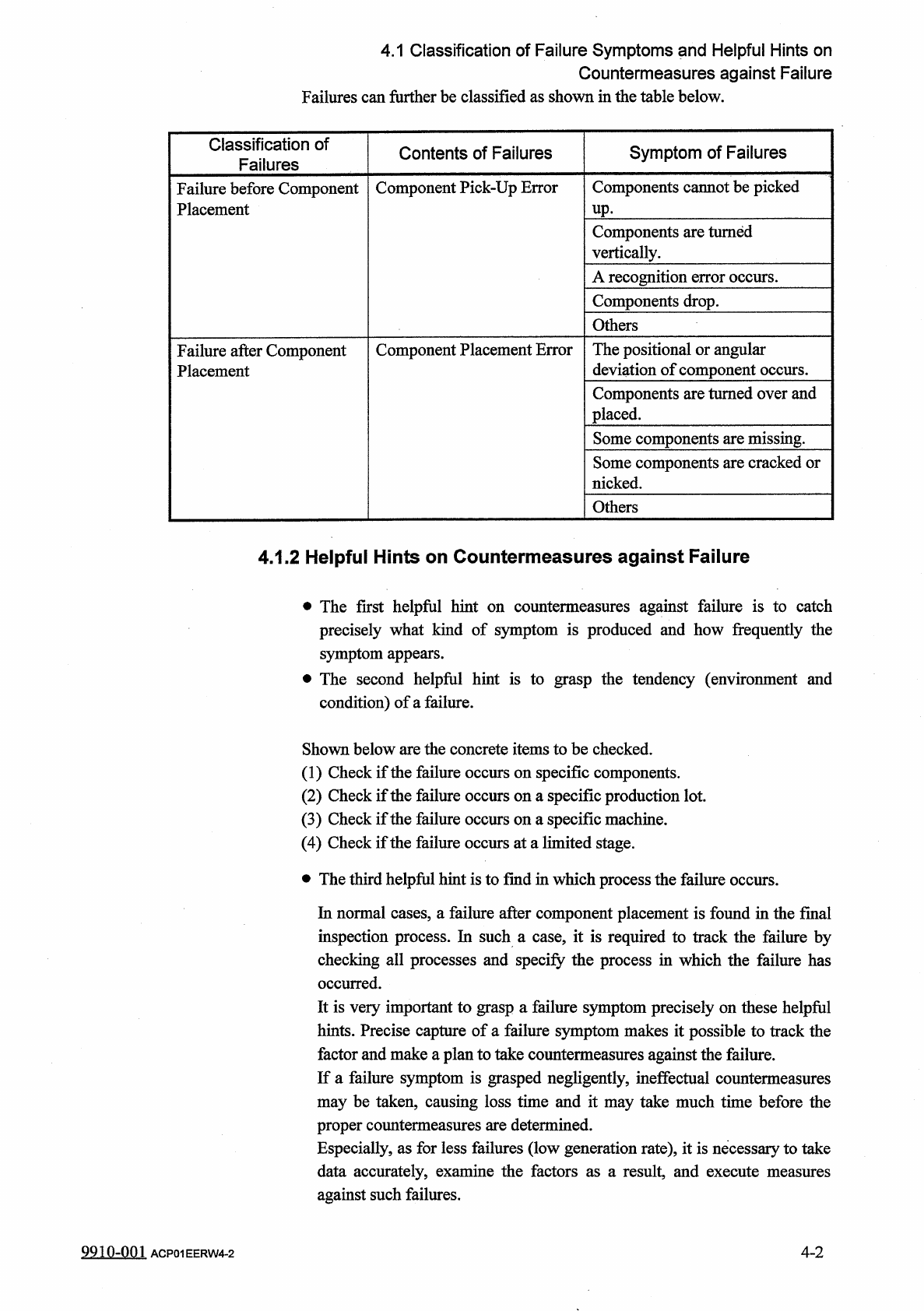
4.1 Classification of Failure Symptoms and Helpful Hints on Countermeasures against Failure 4.1 Classification of Failure Symptoms and Helpful Hints on Countermeasures against Failure 4.1 . 1 Classification of Failure Sy…
Page
4.3
.
2.3
Positional
and
Angular
Deviations
of
Component
Placement
4
-
17
4
-
18
4.3
.
3
Trouble
Cases
4.3
.
3.1
Generation
of
Angular
Deviation
(
Approx
.
10
°
)
during
Component
Placement
4.3
.
3.2
Generation
of
Angular
Deviation
(
Approx
.
90
°
)
during
Component
PJacement
4.3
.
3.3
Generation
of
Missing
Component
(
Component
Carried
Away
)
by
Specific
Head
4
-
18
4
-
19
4
-
20
0
-
001
ACP
01
EERCC
4
-
2
4.1
Classification
of
Failure
Symptoms
and
Helpful
Hints
on
Countermeasures
against
Failure
4.1
Classification
of
Failure
Symptoms
and
Helpful
Hints
on
Countermeasures
against
Failure
4.1
.
1
Classification
of
Failure
Symptoms
The
turret
movement
can
be
classified
into
Processes
A
,
B
,
C
,
D
?
and
E
as
Refer
to
"
1.5
Scope
of
Actions
"
in
the
instruction
manual
(
Section
I
:
Operation
)
for
the
scope
of
actions
.
Process
A
:
A
component
is
picked
up
at
Station
®
5
and
transferred
to
Station
⑤
.
Process
B
:
The
component
recognition
function
is
implemented
on
the
component
at
Station
⑤
.
Process
C
:
The
placement
angle
is
corrected
at
Station
(
5
)
and
the
component
is
placed
on
the
P
.
C
.
B
.
at
Station
⑨
.
Process
D
:
The
component
is
placed
on
the
P
.
C
.
B
.
along
with
the
movement
of
the
X
/
Y
table
.
Process
E
:
The
component
-
placed
P
.
C
.
B
.
is
discharged
.
P
.
C
.
B
.
Discharge
Section
X
/
Y
Table
Section
Fig
.
4
,
1
Based
on
these
processes
,
failures
can
be
divided
roughly
into
the
following
two
types
.
•
Failure
before
Component
Placement
This
type
of
failure
occurs
mainly
in
Process
A
.
•
Failure
after
Component
Placement
This
type
of
failure
occurs
mainly
at
Processes
A
,
B
,
C
,
D
,
and
E
.
4
-
1
9910
-
001
ACP
01
EERW
4
-
1
4.1
Classification
of
Failure
Symptoms
and
Helpful
Hints
on
Countermeasures
against
Failure
Failures
can
further
be
classified
as
shown
in
the
table
below
.
Classification
of
Failures
Symptom
of
Failures
Contents
of
Failures
Components
cannot
be
picked
Component
Pick
-
Up
Error
Failure
before
Component
Placement
up
-
Components
are
turned
vertically
.
A
recognition
error
occurs
.
Components
drop
.
Others
The
positional
or
angular
deviation
of
component
occurs
.
Component
Placement
Error
Failure
after
Component
Placement
Components
are
turned
over
and
placed
.
Some
components
are
missing
.
Some
components
are
cracked
or
nicked
.
Others
4.1
.
2
Helpful
Hints
on
Countermeasures
against
Failure
against
failure
is
to
catch
precisely
what
kind
of
symptom
is
produced
and
how
frequently
the
symptom
appears
.
•
The
second
helpful
hint
is
to
grasp
the
tendency
(
environment
and
condition
)
of
a
failure
.
•
The
first
helpful
hint
on
countermeasures
Shown
below
are
the
concrete
items
to
be
checked
.
(
1
)
Check
if
the
failure
occurs
on
specific
components
.
(
2
)
Check
if
the
failure
occurs
on
a
specific
production
lot
(
3
)
Check
if
the
failure
occurs
on
a
specific
machine
.
(
4
)
Check
if
the
failure
occurs
at
a
limited
stage
.
•
The
third
helpful
hint
is
to
find
in
which
process
the
failure
occurs
.
In
normal
cases
,
a
failure
after
component
placement
is
found
in
the
final
inspection
process
.
In
such
a
ease
,
it
is
required
to
track
the
failure
by
checking
all
processes
and
specify
the
process
in
which
the
failure
has
occurred
.
It
is
very
important
to
grasp
a
failure
symptom
precisely
on
these
helpful
hints
.
Precise
capture
of
a
failure
symptom
makes
it
possible
to
track
the
factor
and
make
a
plan
to
take
countermeasures
against
the
failure
.
If
a
failure
symptom
is
grasped
negligently
,
ineffectual
countermeasures
may
be
taken
,
causing
loss
time
and
it
may
take
much
time
before
the
proper
countermeasures
are
determined
.
Especially
,
as
for
less
failures
(
low
generation
rate
)
,
it
is
necessary
to
take
data
accurately
,
examine
the
factors
as
a
result
,
and
execute
measures
against
such
failures
.
9910
-
001
ACP
01
EERW
4
-
2
4
-
2