2500_Users_Manual-.pdf - 第109页
1958-2 Run Kit Perform all Tasks in Kit Number of Kits to Build Session I.D. Device Process • • • • • Specify Task 1 Task 2 Task 3 Task 4 M e s s a g e ~ 0 0 0 1 M e s s a g e ~ 0 0 0 2 M es s ag e ~ 00 0 3 Tasks and Kit…
↵
↵
Tasks
and
Kits
Introduction
to
Kits
Kits
are
Tasks
that
have
been
daisy-chained
together
so
several
can
be
run
as
one
large
job.
The
most
common
use
for
Kits
is
to
string
together
the
separate
Tasks
used
to
program
all
the
devices
for
a
single
board.
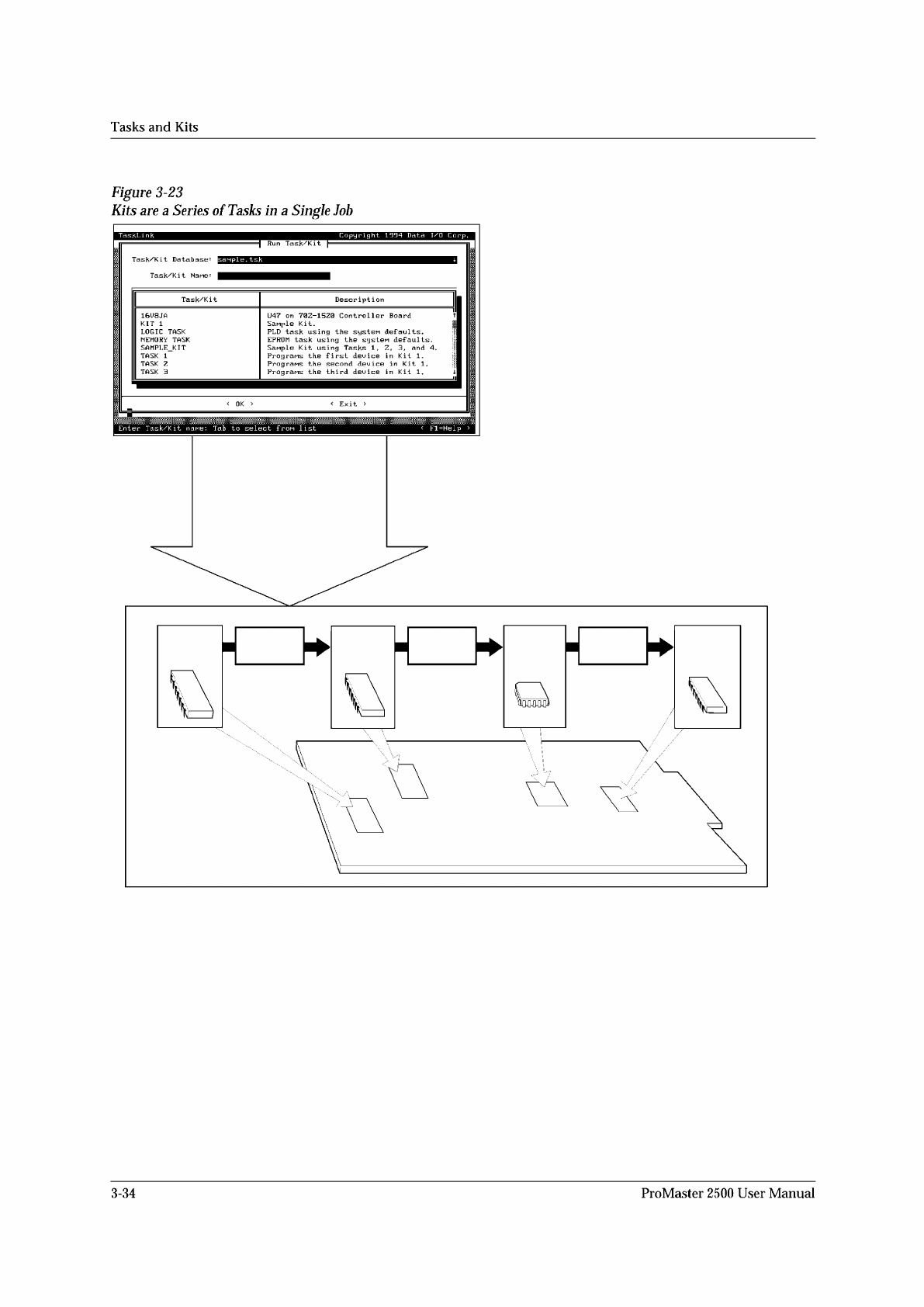
In
Figure
3-23
there
are
four
devices
that
must
be
programmed
and
labeled
for
the
sample
board.
Each
device
has
one
Task
that
controls
the
process
for
producing
that
device.
The
Kit
acts
like
a
super-Task.
To
illustrate
this
point,
assume
that
60
boards
need
to
be
built.
When
the
Kit
fbr
this
board
is
run,
the
Task
1
pass
limit
is
set
to
60
devices.
When
that
count
is
reached,
TaskLink
displays
a
message
prompting
the
system
operator
to
change
over
for
the
second
Task.
When
ready
for
Task
2,
the
operator
presses
.
TaskLink
starts
Task
2,
and
60
devices
for
that
Task
are
programmed.
This
process
continues
for
Task
3
and
Task
4.
The
messages
screens
are
typically
used
when
the
Tasks
define
devices
using
different
package
types
(Task
1
uses
DIPs
and
Task
2
uses
PLCCs).
In
this
case,
a
message
screen
might
remind
the
operator
about
the
steps
required
to
change
over
from
one
package
type
to
another.
A
Kit
can
include
a
maximum
of
20
Tasks.
All
the
Tasks
for
a
Kit
must
be
in
the
same
database
file
(called
the
Source
Database
in
the
Kit
dialog
box),
but
the
Kit
can
be
stored
in
the
Source
Database
or
a
different
database
file.
When
the
Kit
is
run,
the
system
operator
specifies
the
number
of
Kits
(equal
to
the
number
of
complete
boards)
to
be
built.
Selecting
Kit
Parameters
The
process
for
creating
a
Kit
is
similar
to
creating
a
Task.
From
TaskLink
s
main
screen,
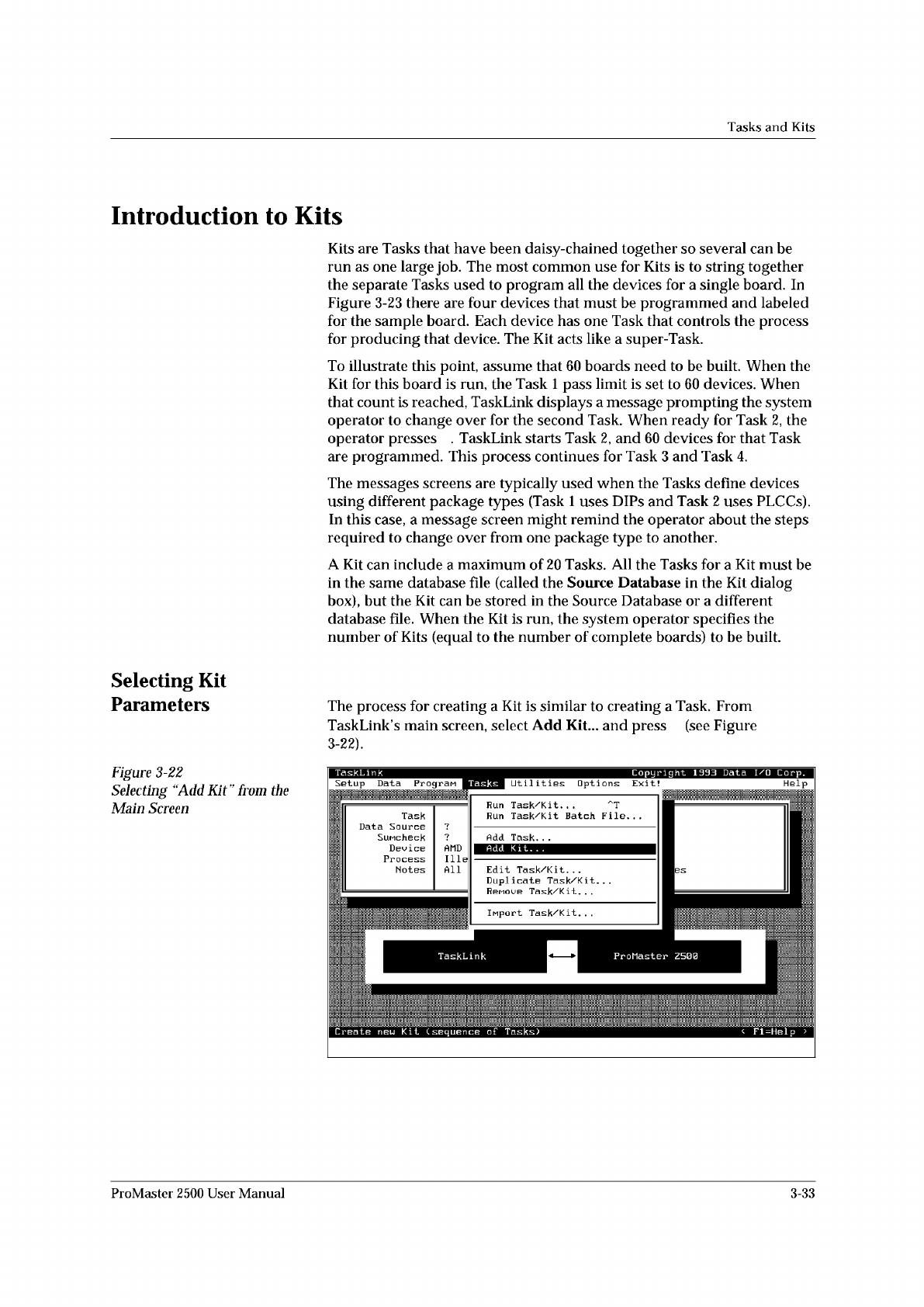
select
Add
Kit...
and
press
(see
Figure
3-22).
Figure
3-22
Selecting
“Add
Kit”
from
t
加
Main
Screen
ProMaster
2500
User
Manual
3-33
1958-2
Run Kit
Perform all Tasks in Kit
Number of Kits to Build
Session I.D.
Device
Process
•
•
•
•
•
Specify
Task 1
Task 2
Task 3
Task 4
Message
~0001
Message
~0002
Message
~0003
Tasks
and
Kits
Figure
3-23
Kits
are
a
Series
of
Tasks
in
a
Single
Job
TaskLi
nk
Copyright
1994
Data
I/O
Corp.
Run
Task/Kit
Enter
Task/Kit
Tab
to
select
frou
list
<
Fl=Help
3-34
ProMaster
2500
User
Manual
↵
↵
↵
Tasks
and
Kits
Description
:
Source
Database
:
Task/Quant
Ta$kL
ink
]
Copyright
1993
Data
I/O
Corp.
=|
Add
Kit
|=
Edit
Kit
"KIT
1"
TaskLink
Copyright
1934
Data
I/O
Corp.
==|
Add
Kit
|
Edit
Kit
"KIT
1"
p
ISanple
Kit.
Source
Database:
|c;
\tl\sanpl
巳.
twk
<
Message
Editor
〉
<
Cance
1
>
Press
Enter
to
accept
dialog;
Tab
for
next
item
<
Fl=Help
〉
<
Message
Editor
> <
Save
> <
Cancel
>
Enter
text;
Tab
f
or
next
<
Fl=Help
>
Describing
a
Kit
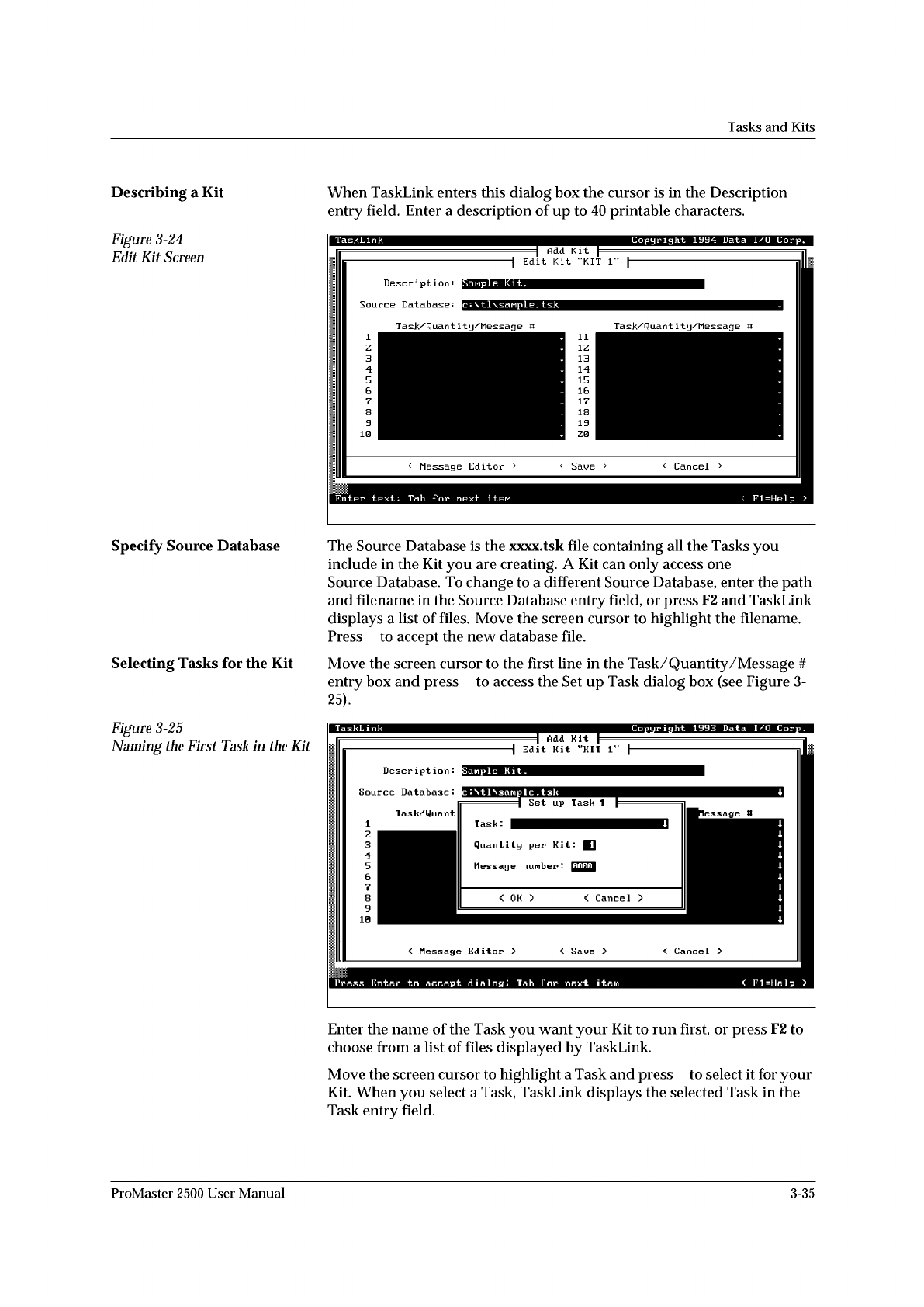
Figure
3-24
Edit
Kit
Screen
When
TaskLink
enters
this
dialog
box
the
cursor
is
in
the
Description
entry
field.
Enter
a
description
of
up
to
40
printable
characters.
Specify
Source
Database
Selecting
Tasks
for
the
Kit
The
Source
Database
is
the
xxxx.tsk
file
containing
all
the
Tasks
you
include
in
the
Kit
you
are
creating.
A
Kit
can
only
access
one
Source
Database.
To
change
to
a
different
Source
Database,
enter
the
path
and
filename
in
the
Source
Database
entry
field,
or
press
F2
and
TaskLink
displays
a
list
of
files.
Move
the
screen
cursor
to
highlight
the
filename.
Press
to
accept
the
new
database
file.
Move
the
screen
cursor
to
the
first
line
in
the
Task/Quantity
/Message
#
entry
box
and
press
to
access
the
Set
up
Task
dialog
box
(see
Figure
3-
25).
Figure
3-25
Naming
the
First
TasA
in
the
Kit
Enter
the
name
of
the
Task
you
want
your
Kit
to
run
first,
or
press
F2
to
choose
from
a
list
of
files
displayed
by
TaskLink.
Move
the
screen
cursor
to
highlight
a
Task
and
press
to
select
it
for
your
Kit.
When
you
select
a
Task,
TaskLink
displays
the
selected
Task
in
the
Task
entry
field.
1234567890
1
ProMaster
2500
User
Manual
3-35