2500_Users_Manual-.pdf - 第123页
Part Prog rammer Pa ckage Prod. Mfr. Number Menu N ame Pins Type Footno tes Base Vers . XXX 22V10-10/- 15 22V10- 10-PLC C 28 P LCC 3 PLCC-2 8-2 1.1 XXX CE26V12H CE2 6V12H-PL 28 P LCC 53 PLCC-2 8-4 1.1 A B C D E F G H 168…
1649-1
CONFIGURATION BLOCK
CONFIGURATION CONNECTOR
CONTACT SET
(1 of 4)
2
0
A
1
X
4
X
Operation
•
Is
a
new
label
type
needed?
•
If
you
changed
label
type,
did
you
calibrate
the
labels?
•
Have
you
inserted
the
input
tubes
with
the
correct
orientation
for
device
pin
1?
Descriptions
for
each
of
these
adjustments
are
presented
in
the
same
order
in
the
following
sections.
Configuring
the
Programming
Module
To
support
the
widest
variety
of
devices,
the
2500's
programming
modules
are
jumper
configurable
so
they
can
support
faster,
higher
density
devices.
With
higher
speed,
some
devices
are
more
sensitive
to
electronic
noise
levels
on
signal
and
programming
pins.
The
programming
modules
have
configuration
blocks
that
hold
the
decoupling
capacitors
required
to
take
care
of
possible
noise
on
the
device
pins.
To
program
most
devices,
you
use
the
module
configuration
that
supports
power
and
ground
pins
at
their
traditional
locations.
You
may
occasionally
need
to
reconfigure
the
programming
module
to
program
devices
that
have
additional
power
and
ground
pins
or
power
and
ground
in
different
locations.
When
you
reconfigure
a
module,
you
place
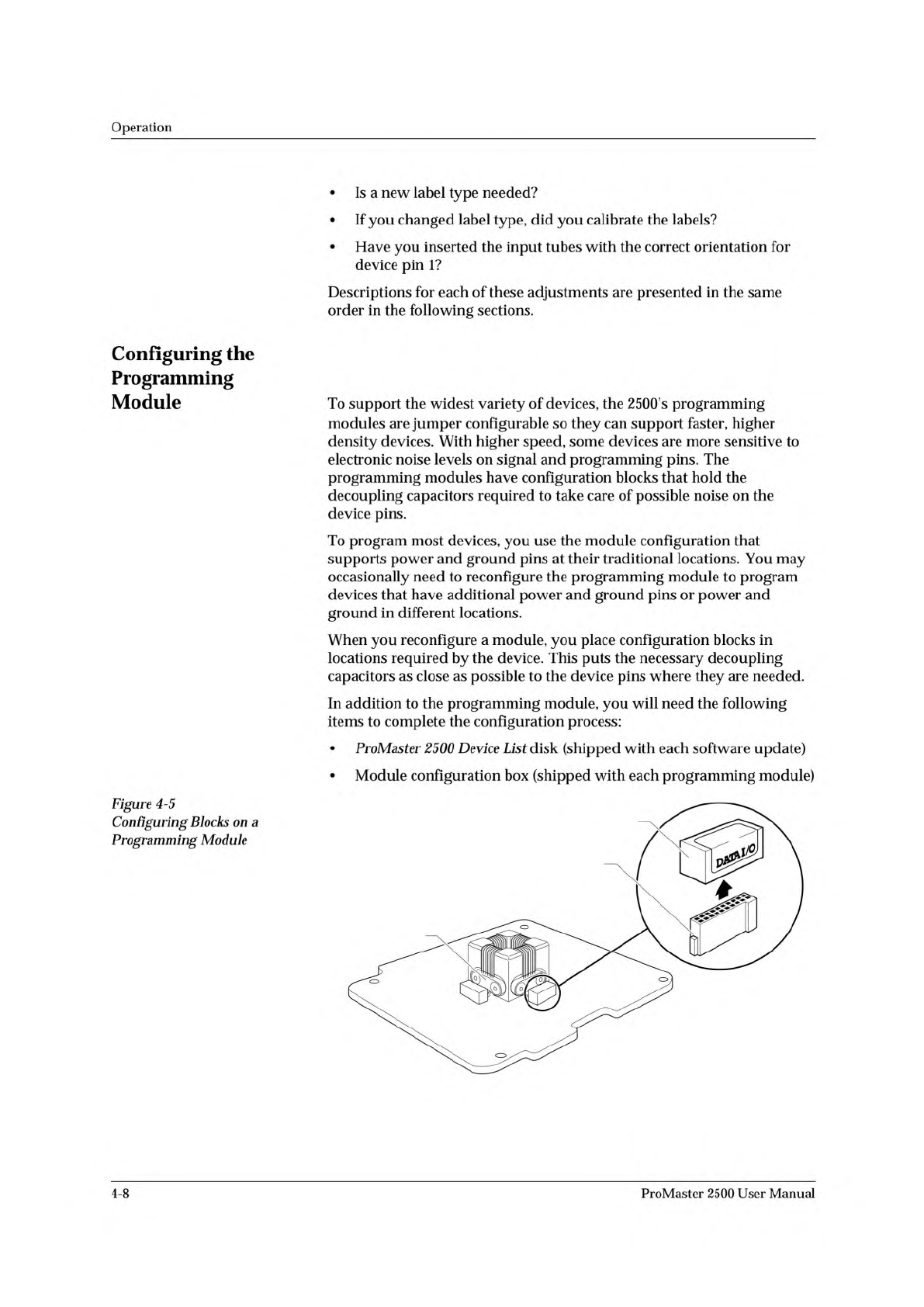
configuration
blocks
in
locations
required
by
the
device.
This
puts
the
necessary
decoupling
capacitors
as
close
as
possible
to
the
device
pins
where
they
are
needed.
In
addition
to
the
programming
module,
you
will
need
the
following
items
to
complete
the
configuration
process:
•
ProMaster
2500
Device
List
disk
(shipped
with
each
software
update)
•
Module
configuration
box
(shipped
with
each
programming
module)
Figure
4-5
Configuring
Blocks
on
a
Programming
Module
4-8
ProMaster
2500
User
Manual
Part Programmer Package Prod.
Mfr. Number Menu Name Pins Type Footnotes Base Vers.
XXX 22V10-10/-15 22V10-10-PLCC 28 PLCC 3 PLCC-28-2 1.1
XXX CE26V12H CE26V12H-PL 28 PLCC 53 PLCC-28-4 1.1
A B C D
E
F G H
1680-1
Operation
Removing
Modules
or
Moving
Configuration
Blocks
This
section
describes
the
typical
steps
involved
in
checking
and
changing
the
configuration
of
your
module.
1.
Select
the
device
—
On
the
Device
List
disk,
find
the
device
you
want
to
program
in
the
left-hand
columns.
The
module
configuration
for
that
device
is
listed
in
the
column
labeled
“Base.”
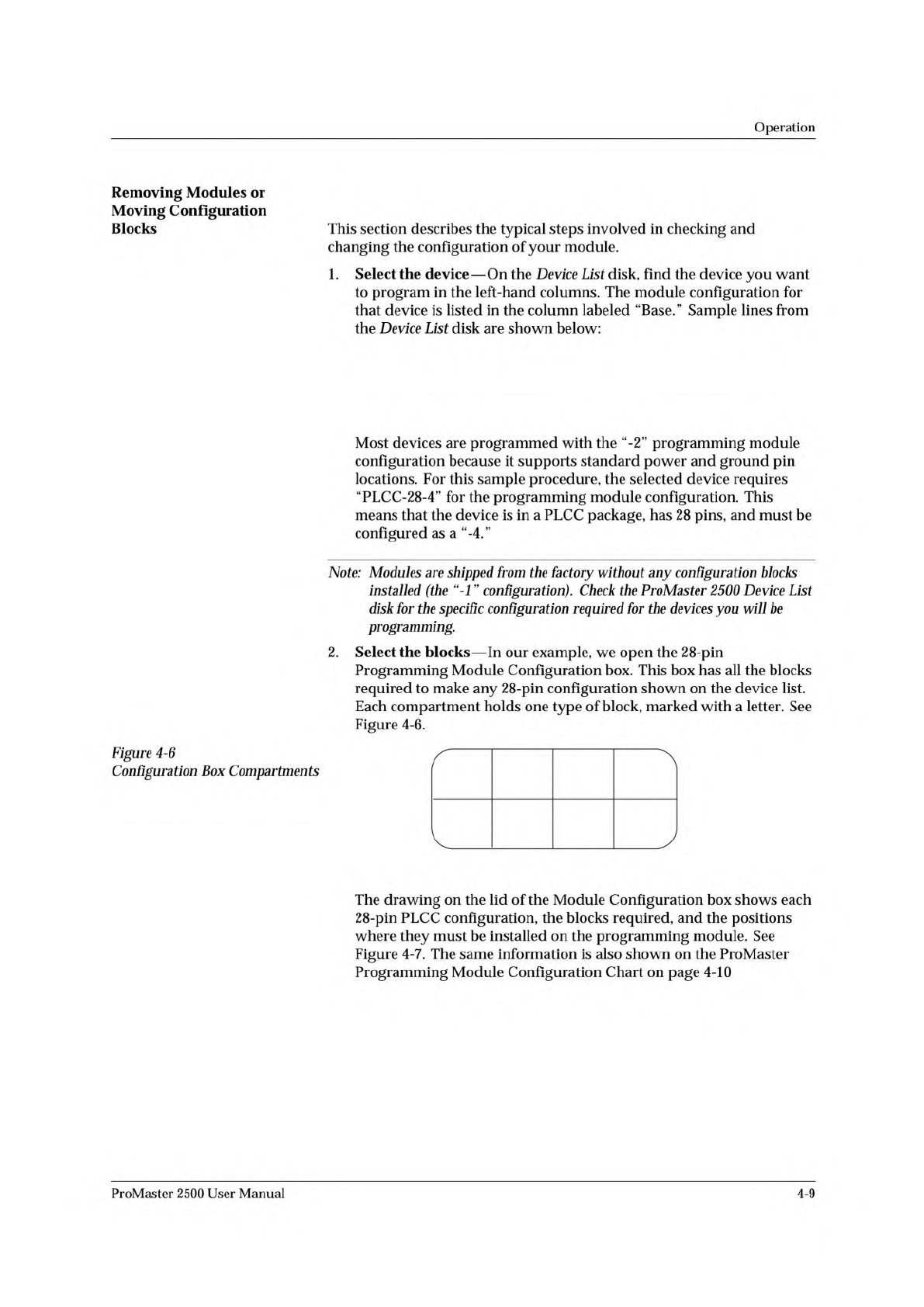
Sample
lines
from
the
Device
List
disk
are
shown
below:
Most
devices
are
programmed
with
the
“-2”
programming
module
configuration
because
it
supports
standard
power
and
ground
pin
locations.
For
this
sample
procedure,
the
selected
device
requires
“PLCC-28-4”
for
the
programming
module
configuration.
This
means
that
the
device
is
in
a
PLCC
package,
has
28
pins,
and
must
be
configured
as
a
“-4.”
Note:
Modules
are
shipped
from
the
factory
without
any
configuration
blocks
installed
(the
configuration).
Check
the
ProMaster
2500
Device
List
disk
for
the
specific
configuration
required
for
the
devices
you
will
be
programming.
2.
Select
the
blocks
—
In
our
example,
we
open
the
28-pin
Programming
Module
Configuration
box.
This
box
has
all
the
blocks
required
to
make
any
28-pin
configuration
shown
on
the
device
list.
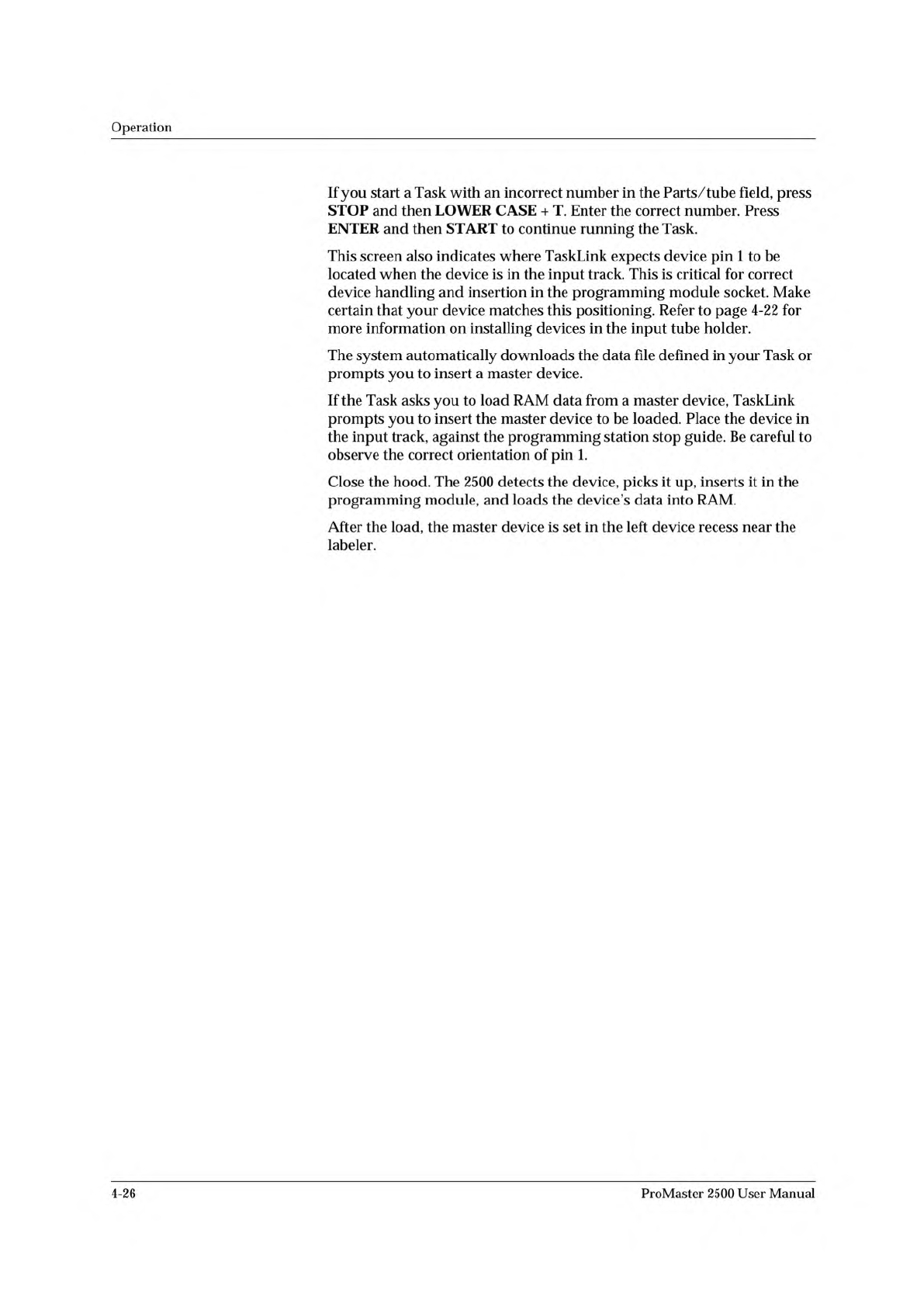
Each
compartment
holds
one
type
of
block,
marked
with
a
letter.
See
Figure
4-6.
Figure
4-6
Configuration
Box
Compartments
The
drawing
on
the
lid
of
the
Module
Configuration
box
shows
each
28-pin
PLCC
configuration,
the
blocks
required,
and
the
positions
where
they
must
be
installed
on
the
programming
module.
See
Figure
4-7.
The
same
information
is
also
shown
on
the
ProMaster
Programming
Module
Configuration
Chart
on
page
4-10
ProMaster
2500
User
Manual
4-9
Operation
If
you
start
a
Task
with
an
incorrect
number
in
the
Parts
/tube
field,
press
STOP
and
then
LOWER
CASE
+
T.
Enter
the
correct
number.
Press
ENTER
and
then
START
to
continue
running
the
Task.
This
screen
also
indicates
where
TaskLink
expects
device
pin
1
to
be
located
when
the
device
is
in
the
input
track.
This
is
critical
for
correct
device
handling
and
insertion
in
the
programming
module
socket.
Make
certain
that
your
device
matches
this
positioning.
Refer
to
page
4-22
for
more
information
on
installing
devices
in
the
input
tube
holder.
The
system
automatically
downloads
the
data
file
defined
in
your
Task
or
prompts
you
to
insert
a
master
device.
If
the
Task
asks
you
to
load
RAM
data
from
a
master
device,
TaskLink
prompts
you
to
insert
the
master
device
to
be
loaded.
Place
the
device
in
the
input
track,
against
the
programming
station
stop
guide.
Be
careful
to
observe
the
correct
orientation
of
pin
1.
Close
the
hood.
The
2500
detects
the
device,
picks
it
up,
inserts
it
in
the
programming
module,
and
loads
the
device's
data
into
RAM.
After
the
load,
the
master
device
is
set
in
the
left
device
recess
near
the
labeler.
4-26
ProMaster
2500
User
Manual