2500_Users_Manual-.pdf - 第133页
1851-2 D PRESS BEARINGS PLATEN APPLICATION PLATE E LABEL REEL COVER F B C A G Operation Figure 4-15 Threading New Labels in the Dot Matrix Printer Calibrating Labels in the Dot Matrix Printer 6. Unroll approximately two …
↑
↓
In
Progress
Waiting For Devices
Operation
3.
If
the
device
was
too
close
to
the
front
of
the
programming
module,
press
on
the
2500's
keyboard
once
or
twice.
If
the
device
was
too
close
to
the
back
of
the
programming
module,
press
once
or
twice.
4.
Press
START.
The
beam
moves
the
device
over
the
programming
module
and
stops.
5.
Press
and
hold
D
on
the
2500
keyboard
to
make
certain
that
the
device
is
equidistant
between
the
front
and
back
contact
sets.
Repeat
steps
1
through
5
until
the
device
moves
into
the
center
of
the
programming
module
and
is
not
closer
to
one
side
of
the
contacts
than
the
other.
6.
When
the
alignment
is
correct,
press
START
to
continue
running
the
Task.
System
Status
Box
The
System
Status
box
is
displayed
on
the
PC
screen
when
the
2500
is
processing
devices.
It
continually
updates
the
Counts
status
line
with
two
number
fields:
Pass
and
Total.
Specific
error
messages
are
momentarily
displayed
in
a
red
box
in
the
Last
Device
status
area.
All
the
programming
results
are
being
recorded
by
TaskLink
and
will
be
displayed
in
the
summary
screen
when
the
Task
is
completed.
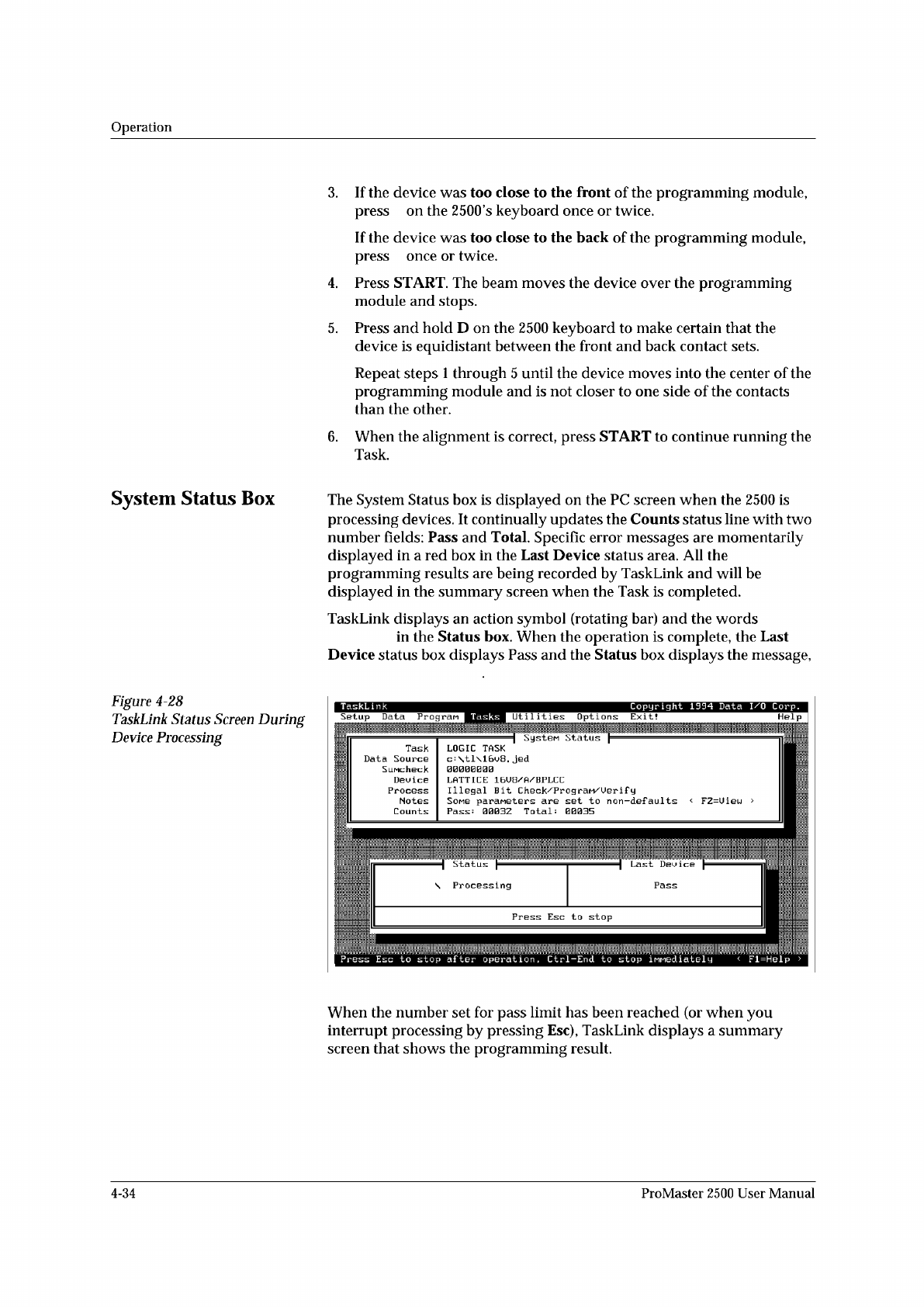
TaskLink
displays
an
action
symbol
(rotating
bar)
and
the
words
in
the
Status
box.
When
the
operation
is
complete,
the
Last
Device
status
box
displays
Pass
and
the
Status
box
displays
the
message,
Figure
4-28
TaskLink
Status
Screen
During
Device
Processing
Help
I
Status
、
Processing
TaskLink
Copyright
1994
Data
I/O
Corp.
Tasks
Util
it
les
Options
Exit!
Setup
Data
Progran
Task
Data
Source
SiiMcheck
Dau
i
ca
Process
Notes
Counts
SysteM
Status
LOGIC
TASK
c=
\tl\16u8.
jed
I.ATTI[:K
Illegal
Bit
Check/PrograM/Uerif
y
Somg
paraneters
are
set
to
non-defaults
<
FZ=Uiau
>
Total:
00035
Pass
:
0003Z
Press
Esc
to
stop
after
operation
,
Ctrl-End
to
stop
iMMediately
<
Fl=Help
>
When
the
number
set
for
pass
limit
has
been
reached
(or
when
you
interrupt
processing
by
pressing
Esc),
TaskLink
displays
a
summary
screen
that
shows
the
programming
result.
4-34
ProMaster
2500
User
Manual
1851-2
D
PRESS BEARINGS
PLATEN
APPLICATION PLATE
E
LABEL REEL COVER
F
B
C
A
G
Operation
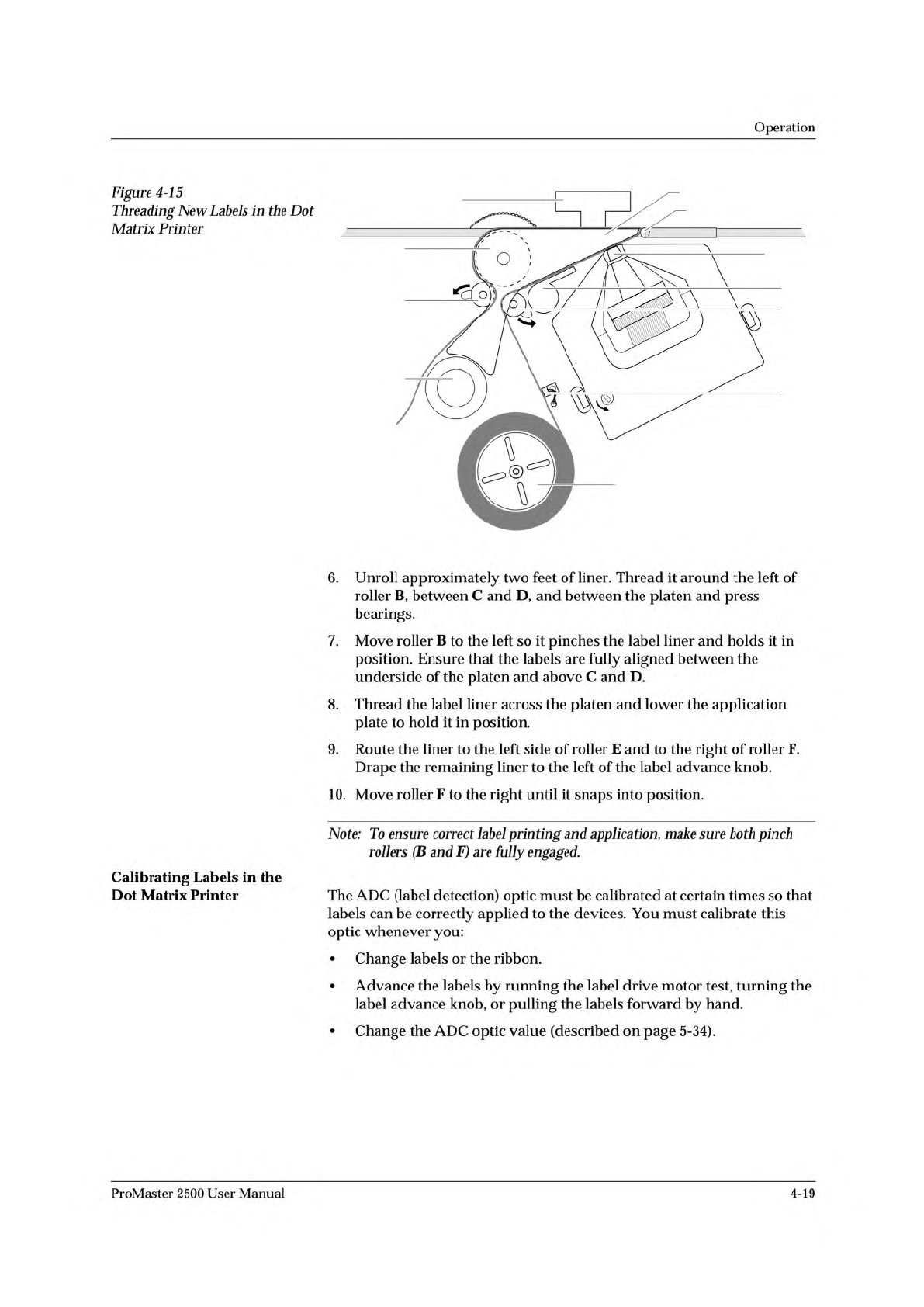
Figure
4-15
Threading
New
Labels
in
the
Dot
Matrix
Printer
Calibrating
Labels
in
the
Dot
Matrix
Printer
6.
Unroll
approximately
two
feet
of
liner.
Thread
it
around
the
left
of
roller
B,
between
C
and
D,
and
between
the
platen
and
press
bearings.
7.
Move
roller
B
to
the
left
so
it
pinches
the
label
liner
and
holds
it
in
position.
Ensure
that
the
labels
are
fully
aligned
between
the
underside
of
the
platen
and
above
C
and
D.
8.
Thread
the
label
liner
across
the
platen
and
lower
the
application
plate
to
hold
it
in
position.
9.
Route
the
liner
to
the
left
side
of
roller
E
and
to
the
right
of
roller
F.
Drape
the
remaining
liner
to
the
left
of
the
label
advance
knob.
10.
Move
roller
F
to
the
right
until
it
snaps
into
position.
Note:
To
ensure
correct
label
printing
and
application,
make
sure
both
pinch
rollers
(B
and
F)
are
fully
engaged.
The
ADC
(label
detection)
optic
must
be
calibrated
at
certain
times
so
that
labels
can
be
correctly
applied
to
the
devices.
You
must
calibrate
this
optic
whenever
you:
•
Change
labels
or
the
ribbon.
•
Advance
the
labels
by
running
the
label
drive
motor
test,
turning
the
label
advance
knob,
or
pulling
the
labels
forward
by
hand.
•
Change
the
ADC
optic
value
(described
on
page
5-34).
ProMaster
2500
User
Manual
4-19
Operation
To
calibrate
labels,
do
the
following:
1.
Place
your
finger
next
to
the
press
bearings
to
“catch”
the
two
or
three
labels
that
are
advanced
during
the
calibration
process.
2.
Press
CAL
on
the
2500's
keyboard.
3.
When
the
labels
stop
advancing,
calibration
is
complete.
Loading
Labels
in
the
Thermal
Printer
Threading
labels
on
the
thermal
printer/labeler
is
similar
to
threading
labels
on
the
dot
matrix
printer/labeler
(see
Figure
4-16).
The
major
differences
on
the
thermal
printer/labeler
are:
•
The
ADC
label
optic
is
stationary.
•
The
retractable
rollers
(platen
pinch
and
label
pinch
rollers)
snap
back
into
position
if
you
release
them.
On
the
dot
matrix
labeler,
the
rollers
remain
in
the
open
position.
Note:
Do
not
tighten
the
label
roll
on
its
core.
The
ro〃
is
intentionally
loose
so
the
combination
of
high
temperature
and
humidity
do
not
cause
the
labels
to
peel
incorrectly.
Follow
the
procedure
below
to
load
a
new
roll
of
labels
into
the
thermal
printer.
WARNING:
A
hinged
cover
protects
operators
from
injury
while
the
labeler
is
operating.
Be
sure
that
this
cover
is
in
place
over
the
labeler
before
you
start
a
printing
or
labeling
operation.
1.
Lower
the
labeler
cover.
2.
Push
the
label
pinch
roller
and
the
platen
pinch
rollers
into
their
retracted
positions
away
from
the
platen.
3.
Remove
the
magnetic
cover
from
the
label
roll.
4.
Install
the
new
label
roll
on
the
label
supply
hub
so
that
the
leader
comes
off
from
the
right
side
of
the
hub
(see
Figure
4-16).
5.
Replace
the
magnetic
cover
over
the
label
roll
to
hold
the
labels
in
place.
6.
Prepare
the
label
path
by
raising
the
application
plate
and
retracting
the
platen
pinch
and
label
pinch
rollers.
7.
Thread
about
2
feet
(60
cm)
of
label
liner
around
the
left
side
of
the
label
alignment
roller
and
through
the
gap
between
the
application
plate
and
the
output
track.
Lay
the
liner
along
the
output
track
for
the
time
being.
8.
Position
the
label
liner
on
the
underside
of
the
platen
and
guide
the
platen
pinch
roller
back
into
its
operating
position
against
the
platen
to
hold
the
liner
in
place.
9.
Thread
the
liner
between
the
ADC
optic
and
the
platen,
and
then
between
the
print
head
and
the
platen.
4-20
ProMaster
2500
User
Manual