2500_Users_Manual-.pdf - 第159页
SECURITY FUSE VIOLATI ON ELECTRONIC ID ERROR NON-BLANK ILLEGAL BIT PROGRAM FAIL Preventive Maintenance • Security fuse check — Some devices have a security fuse feature that, when programmed, prevents the reading of the …
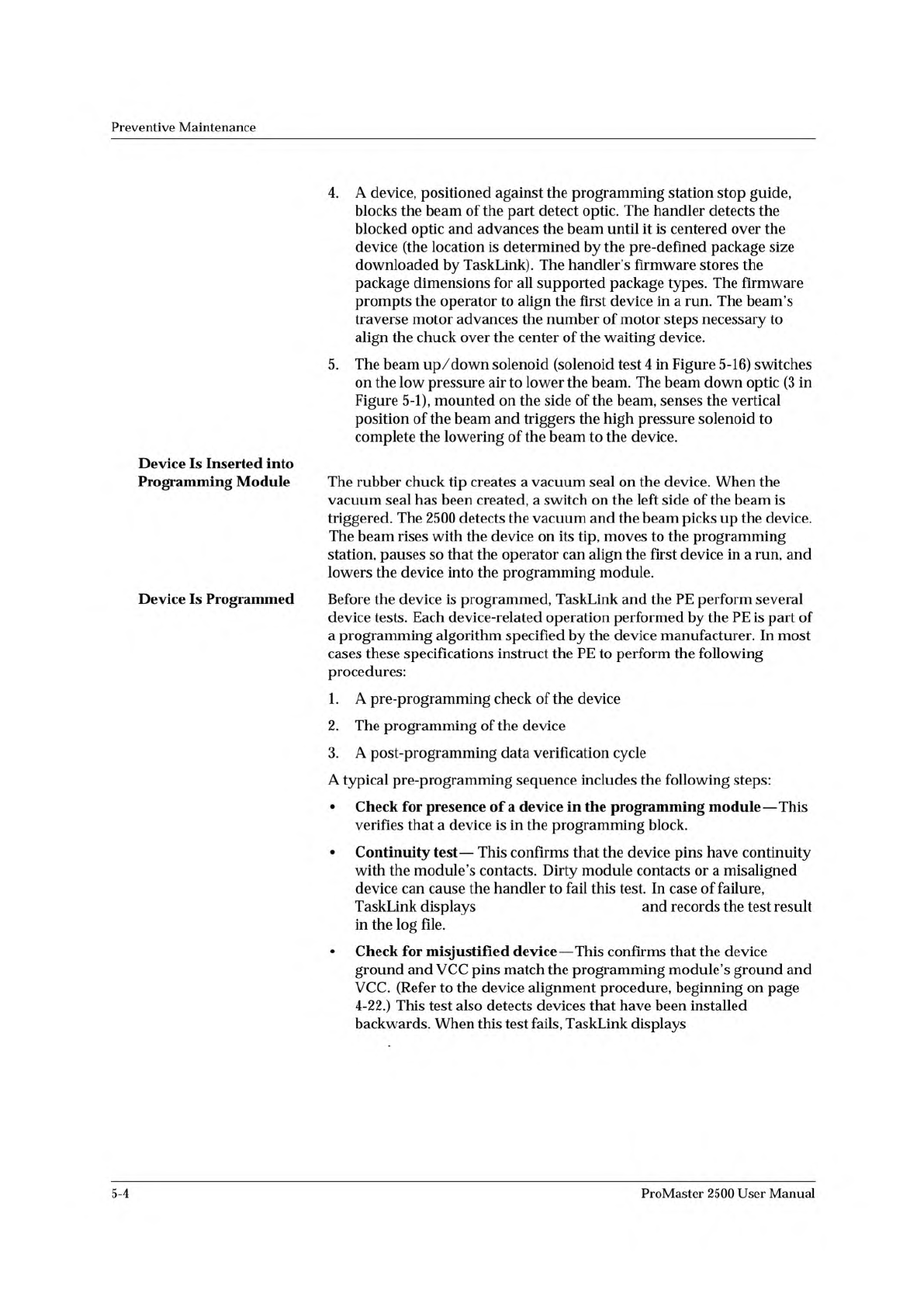
CONTINUITY TEST FAIL
CONTINUITY TEST
FAIL
Preventive
Maintenance
Device
Is
Inserted
into
Programming
Module
Device
Is
Programmed
4.
A
device,
positioned
against
the
programming
station
stop
guide,
blocks
the
beam
of
the
part
detect
optic.
The
handler
detects
the
blocked
optic
and
advances
the
beam
until
it
is
centered
over
the
device
(the
location
is
determined
by
the
pre-defined
package
size
downloaded
by
TaskLink).
The
handler's
firmware
stores
the
package
dimensions
for
all
supported
package
types.
The
firmware
prompts
the
operator
to
align
the
first
device
in
a
run.
The
beam's
traverse
motor
advances
the
number
of
motor
steps
necessary
to
align
the
chuck
over
the
center
of
the
waiting
device.
5.
The
beam
up/down
solenoid
(solenoid
test
4
in
Figure
5-16)
switches
on
the
low
pressure
air
to
lower
the
beam.
The
beam
down
optic
(3
in
Figure
5-1),
mounted
on
the
side
of
the
beam,
senses
the
vertical
position
of
the
beam
and
triggers
the
high
pressure
solenoid
to
complete
the
lowering
of
the
beam
to
the
device.
The
rubber
chuck
tip
creates
a
vacuum
seal
on
the
device.
When
the
vacuum
seal
has
been
created,
a
switch
on
the
left
side
of
the
beam
is
triggered.
The
2500
detects
the
vacuum
and
the
beam
picks
up
the
device.
The
beam
rises
with
the
device
on
its
tip,
moves
to
the
programming
station,
pauses
so
that
the
operator
can
align
the
first
device
in
a
run,
and
lowers
the
device
into
the
programming
module.
Before
the
device
is
programmed,
TaskLink
and
the
PE
perform
several
device
tests.
Each
device-related
operation
performed
by
the
PE
is
part
of
a
programming
algorithm
specified
by
the
device
manufacturer.
In
most
cases
these
specifications
instruct
the
PE
to
perform
the
following
procedures:
1.
A
pre-programming
check
of
the
device
2.
The
programming
of
the
device
3.
A
post-programming
data
verification
cycle
A
typical
pre-programming
sequence
includes
the
following
steps:
•
Check
for
presence
of
a
device
in
the
programming
module
—
This
verifies
that
a
device
is
in
the
programming
block.
•
Continuity
test
—
This
confirms
that
the
device
pins
have
continuity
with
the
module's
contacts.
Dirty
module
contacts
or
a
misaligned
device
can
cause
the
handler
to
fail
this
test.
In
case
of
failure,
TaskLink
displays
and
records
the
test
result
in
the
log
file.
•
Check
for
misjustified
device
—
This
confirms
that
the
device
ground
and
VCC
pins
match
the
programming
module's
ground
and
VCC.
(Refer
to
the
device
alignment
procedure,
beginning
on
page
4-22.)
This
test
also
detects
devices
that
have
been
installed
backwards.
When
this
test
fails,
TaskLink
displays
5-4
ProMaster
2500
User
Manual
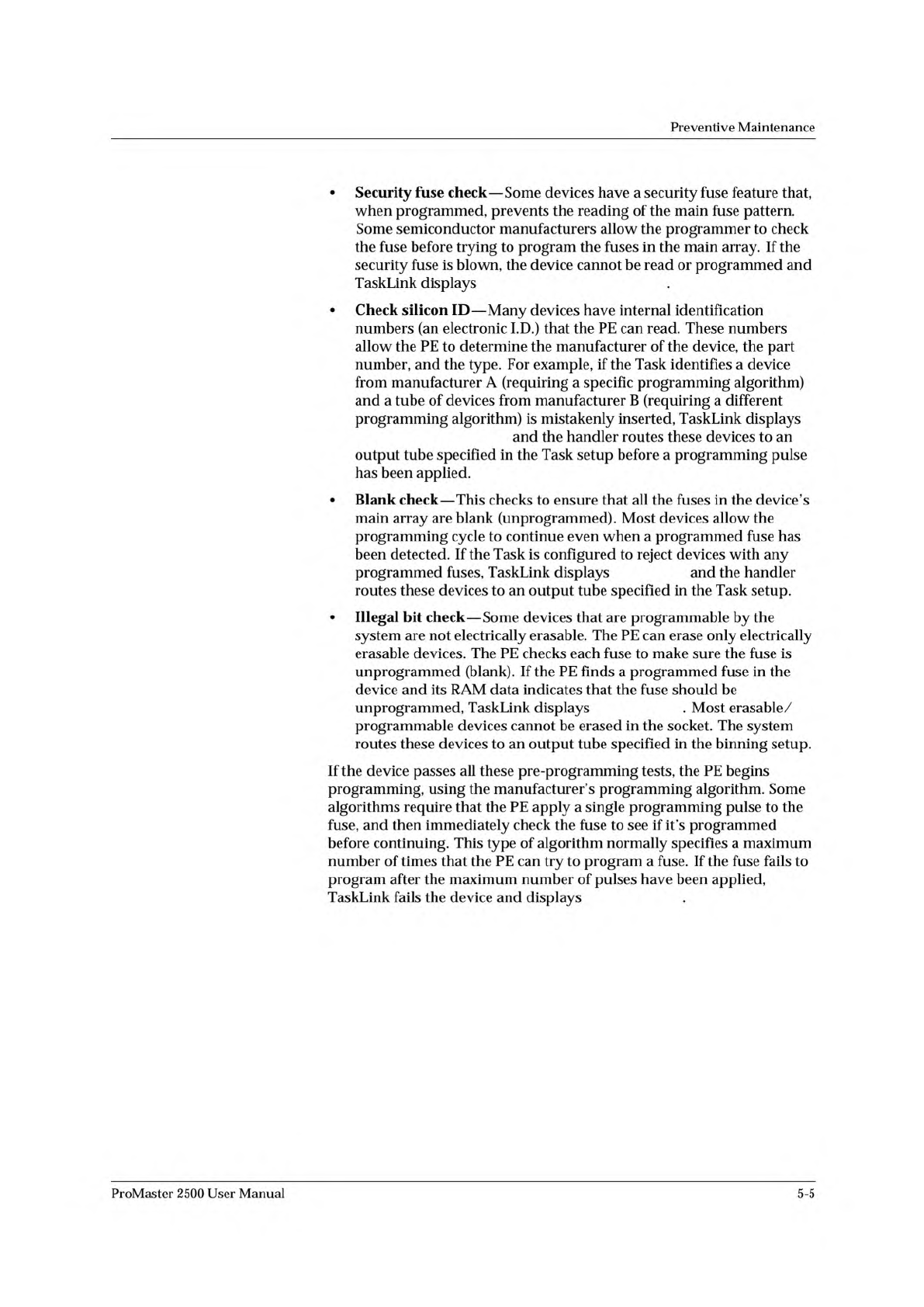
SECURITY FUSE VIOLATION
ELECTRONIC ID ERROR
NON-BLANK
ILLEGAL BIT
PROGRAM FAIL
Preventive
Maintenance
•
Security
fuse
check
—
Some
devices
have
a
security
fuse
feature
that,
when
programmed,
prevents
the
reading
of
the
main
fuse
pattern.
Some
semiconductor
manufacturers
allow
the
programmer
to
check
the
fuse
before
trying
to
program
the
fuses
in
the
main
array.
If
the
security
fuse
is
blown,
the
device
cannot
be
read
or
programmed
and
TaskLink
displays
.
•
Check
silicon
ID
—
Many
devices
have
internal
identification
numbers
(an
electronic
I.D.)
that
the
PE
can
read.
These
numbers
allow
the
PE
to
determine
the
manufacturer
of
the
device,
the
part
number,
and
the
type.
For
example,
if
the
Task
identifies
a
device
from
manufacturer
A
(requiring
a
specific
programming
algorithm)
and
a
tube
of
devices
from
manufacturer
B
(requiring
a
different
programming
algorithm)
is
mistakenly
inserted,
TaskLink
displays
and
the
handler
routes
these
devices
to
an
output
tube
specified
in
the
Task
setup
before
a
programming
pulse
has
been
applied.
•
Blank
check
—
This
checks
to
ensure
that
all
the
fuses
in
the
device's
main
array
are
blank
(unprogrammed)
.
Most
devices
allow
the
programming
cycle
to
continue
even
when
a
programmed
fuse
has
been
detected.
If
the
Task
is
configured
to
reject
devices
with
any
programmed
fuses,
TaskLink
displays
and
the
handler
routes
these
devices
to
an
output
tube
specified
in
the
Task
setup.
•
Illegal
bit
check
—
Some
devices
that
are
programmable
by
the
system
are
not
electrically
erasable.
The
PE
can
erase
only
electrically
erasable
devices.
The
PE
checks
each
fuse
to
make
sure
the
fuse
is
unprogrammed
(blank).
If
the
PE
finds
a
programmed
fuse
in
the
device
and
its
RAM
data
indicates
that
the
fuse
should
be
unprogrammed,
TaskLink
displays
.
Most
erasable/
programmable
devices
cannot
be
erased
in
the
socket.
The
system
routes
these
devices
to
an
output
tube
specified
in
the
binning
setup.
If
the
device
passes
all
these
pre-programming
tests,
the
PE
begins
programming,
using
the
manufacturer's
programming
algorithm.
Some
algorithms
require
that
the
PE
apply
a
single
programming
pulse
to
the
fuse,
and
then
immediately
check
the
fuse
to
see
if
it's
programmed
before
continuing.
This
type
of
algorithm
normally
specifies
a
maximum
number
of
times
that
the
PE
can
try
to
program
a
fuse.
If
the
fuse
fails
to
program
after
the
maximum
number
of
pulses
have
been
applied,
TaskLink
fails
the
device
and
displays
.
ProMaster
2500
User
Manual
5-5
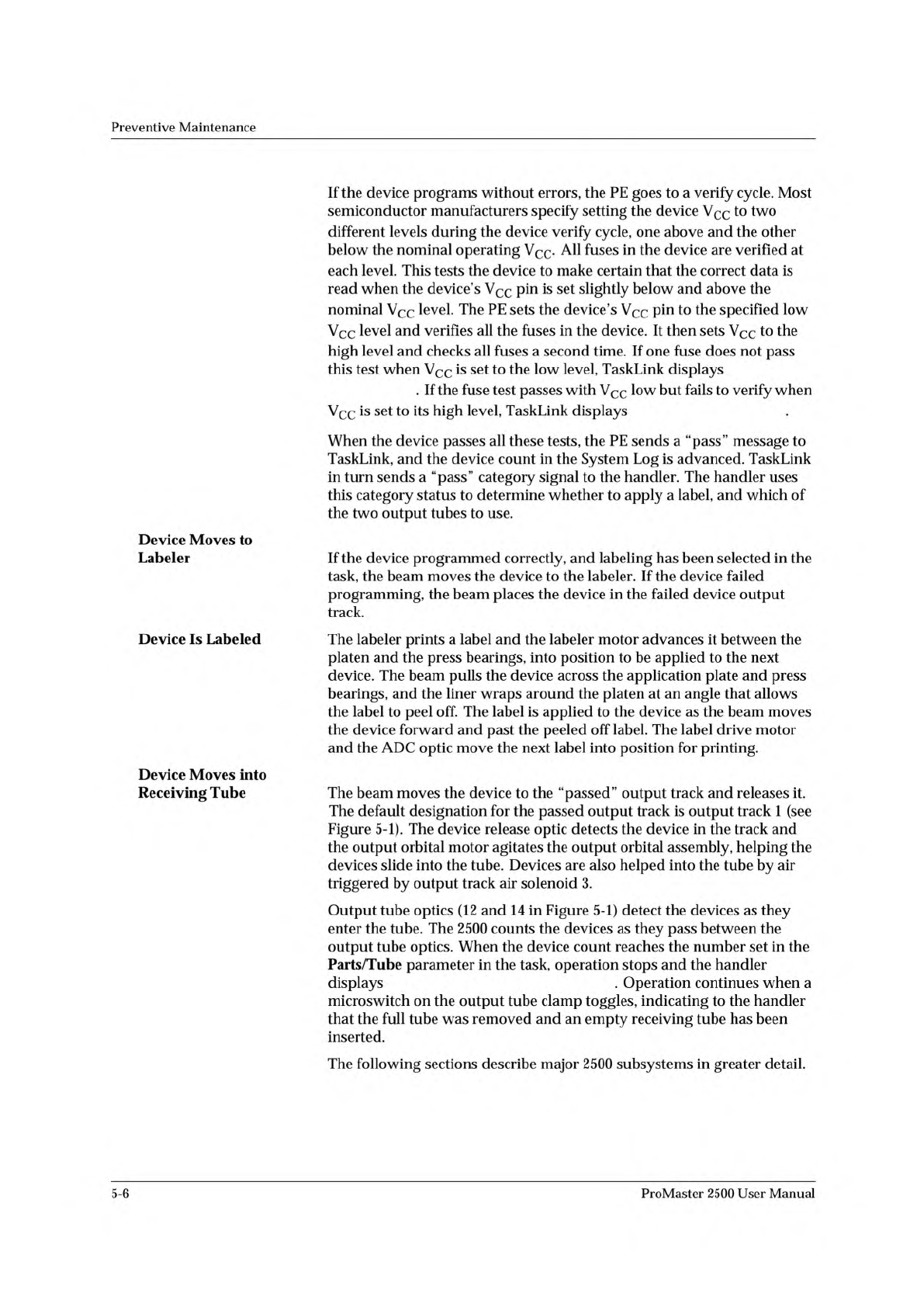
VERIFY
FAIL, PASS1
VERIFY FAIL, PASS 2
CATEGORY X BIN NOT AVAILABLE
Preventive
Maintenance
If
the
device
programs
without
errors,
the
PE
goes
to
a
verify
cycle.
Most
semiconductor
manufacturers
specify
setting
the
device
Vcc
to
two
different
levels
during
the
device
verify
cycle,
one
above
and
the
other
below
the
nominal
operating
V^c-
All
fuses
in
the
device
are
verified
at
each
level.
This
tests
the
device
to
make
certain
that
the
correct
data
is
read
when
the
device's
Vcc
pin
is
set
slightly
below
and
above
the
nominal
Vcc
level.
The
PE
sets
the
device's
Vcc
Pin
to
the
specified
low
Vcc
level
and
verifies
all
the
fuses
in
the
device.
It
then
sets
Vcc
to
the
high
level
and
checks
all
fuses
a
second
time.
If
one
fuse
does
not
pass
this
test
when
Vcc
is
set
to
the
low
level,
TaskLink
displays
.
If
the
fuse
test
passes
with
Vcc
low
but
fails
to
verify
when
Vcc
is
set
to
its
high
level,
TaskLink
displays
.
When
the
device
passes
all
these
tests,
the
PE
sends
a
“pass”
message
to
TaskLink,
and
the
device
count
in
the
System
Log
is
advanced.
TaskLink
in
turn
sends
a
“pass”
category
signal
to
the
handler.
The
handler
uses
this
category
status
to
determine
whether
to
apply
a
label,
and
which
of
the
two
output
tubes
to
use.
Device
Moves
to
Labeler
If
the
device
programmed
correctly,
and
labeling
has
been
selected
in
the
task,
the
beam
moves
the
device
to
the
labeler.
If
the
device
failed
programming,
the
beam
places
the
device
in
the
failed
device
output
track.
Device
Is
Labeled
The
labeler
prints
a
label
and
the
labeler
motor
advances
it
between
the
platen
and
the
press
bearings,
into
position
to
be
applied
to
the
next
device.
The
beam
pulls
the
device
across
the
application
plate
and
press
bearings,
and
the
liner
wraps
around
the
platen
at
an
angle
that
allows
the
label
to
peel
off.
The
label
is
applied
to
the
device
as
the
beam
moves
the
device
forward
and
past
the
peeled
off
label.
The
label
drive
motor
and
the
ADC
optic
move
the
next
label
into
position
for
printing.
Device
Moves
into
Receiving
Tube
The
beam
moves
the
device
to
the
“passed”
output
track
and
releases
it.
The
default
designation
for
the
passed
output
track
is
output
track
1
(see
Figure
5-1).
The
device
release
optic
detects
the
device
in
the
track
and
the
output
orbital
motor
agitates
the
output
orbital
assembly,
helping
the
devices
slide
into
the
tube.
Devices
are
also
helped
into
the
tube
by
air
triggered
by
output
track
air
solenoid
3.
Output
tube
optics
(12
and
14
in
Figure
5-1)
detect
the
devices
as
they
enter
the
tube.
The
2500
counts
the
devices
as
they
pass
between
the
output
tube
optics.
When
the
device
count
reaches
the
number
set
in
the
Parts/Tube
parameter
in
the
task,
operation
stops
and
the
handler
displays
.
Operation
continues
when
a
microswitch
on
the
output
tube
clamp
toggles,
indicating
to
the
handler
that
the
full
tube
was
removed
and
an
empty
receiving
tube
has
been
inserted.
The
following
sections
describe
major
2500
subsystems
in
greater
detail.
5-6
ProMaster
2500
User
Manual