2500_Users_Manual-.pdf - 第260页
2280-2 PIN INSULATION BLOCK PROGRAMMING BLOCK CIRCUIT BOARD FRONT OF HANDLER DEVICE Repair and Replacement Procedures The pin insulation block is symmetrical so no specific polarity orientation is required; it may be ins…
1930-1
PRINTED
CIRCUIT
BOARD
Repair
and
Replacement
Procedures
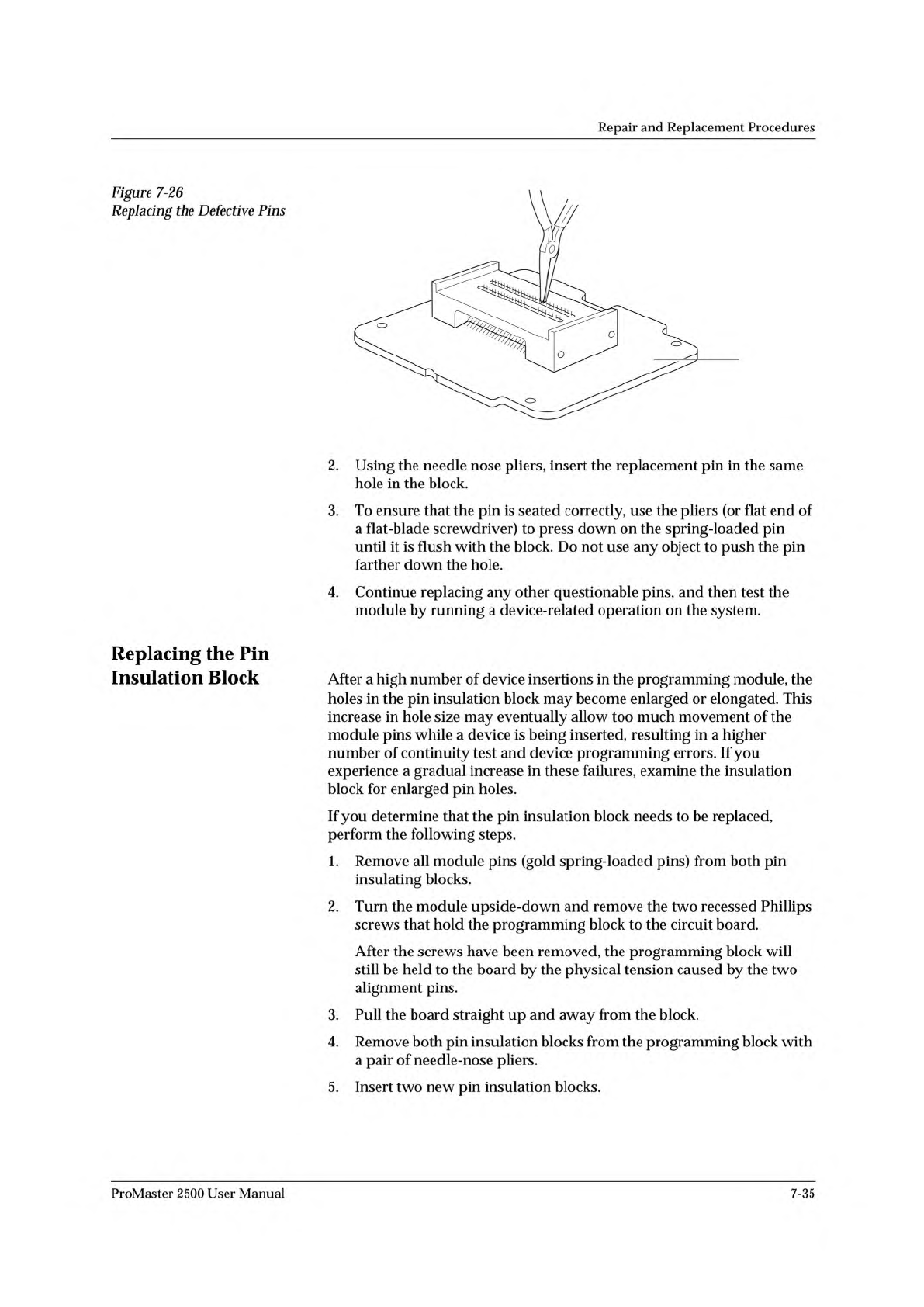
Figure
7-26
Replacing
the
Defective
Pins
2.
Using
the
needle
nose
pliers,
insert
the
replacement
pin
in
the
same
hole
in
the
block.
3.
To
ensure
that
the
pin
is
seated
correctly,
use
the
pliers
(or
flat
end
of
a
flat-blade
screwdriver)
to
press
down
on
the
spring-loaded
pin
until
it
is
flush
with
the
block.
Do
not
use
any
object
to
push
the
pin
farther
down
the
hole.
4.
Continue
replacing
any
other
questionable
pins,
and
then
test
the
module
by
running
a
device-related
operation
on
the
system.
Replacing
the
Pin
Insulation
Block
After
a
high
number
of
device
insertions
in
the
programming
module,
the
holes
in
the
pin
insulation
block
may
become
enlarged
or
elongated.
This
increase
in
hole
size
may
eventually
allow
too
much
movement
of
the
module
pins
while
a
device
is
being
inserted,
resulting
in
a
higher
number
of
continuity
test
and
device
programming
errors.
If
you
experience
a
gradual
increase
in
these
failures,
examine
the
insulation
block
for
enlarged
pin
holes.
If
you
determine
that
the
pin
insulation
block
needs
to
be
replaced,
perform
the
following
steps.
1.
Remove
all
module
pins
(gold
spring-loaded
pins)
from
both
pin
insulating
blocks.
2.
Turn
the
module
upside-down
and
remove
the
two
recessed
Phillips
screws
that
hold
the
programming
block
to
the
circuit
board.
After
the
screws
have
been
removed,
the
programming
block
will
still
be
held
to
the
board
by
the
physical
tension
caused
by
the
two
alignment
pins.
3.
Pull
the
board
straight
up
and
away
from
the
block.
4.
Remove
both
pin
insulation
blocks
from
the
programming
block
with
a
pair
of
needle-nose
pliers.
5.
Insert
two
new
pin
insulation
blocks.
ProMaster
2500
User
Manual
7-35
2280-2
PIN INSULATION
BLOCK
PROGRAMMING
BLOCK
CIRCUIT BOARD
FRONT
OF
HANDLER
DEVICE
Repair
and
Replacement
Procedures
The
pin
insulation
block
is
symmetrical
so
no
specific
polarity
orientation
is
required;
it
may
be
inserted
into
the
programming
block
either
way.
6.
Carefully
plug
the
programming
block
onto
the
circuit
board
using
the
block's
alignment
pins
as
guides.
The
programming
block
is
symmetrical
so
no
specific
polarity
orientation
is
required;
the
block
may
be
inserted
on
the
circuit
board
either
way.
The
block
is
seated
on
the
board
correctly
when
rests
against
the
board
on
all
sides
without
a
gap.
If
a
gap
exists,
remove
and
reseat
the
block.
7.
Turn
the
module
upside
down
and
reinsert
the
two
Phillips
screws
on
the
bottom
of
the
circuit
board.
8.
Reinsert
the
spring-loaded
module
pins
in
the
insulation
block.
Note:
One
end
of
the
module's
gold
contact
pin
is
spring-loaded
a/id
telescopes
when
pressed.
Reinsert
the
module
pin
into
the
new
insulation
block
with
the
telescoping
end
up
so
that
end
contacts
the
device
lead
during
programming.
Most
SOIC
programming
modules
ship
without
some
pins
in
the
pin
insulation
block
at
the
narrow
end
of
the
module
board.
Start
reinserting
pins
in
the
block
holes
nearest
the
wide
end
of
the
circuit
board
and
work
toward
the
narrow
end.
Fill
both
insulation
blocks
with
an
equal
number
of
module
contact
pins.
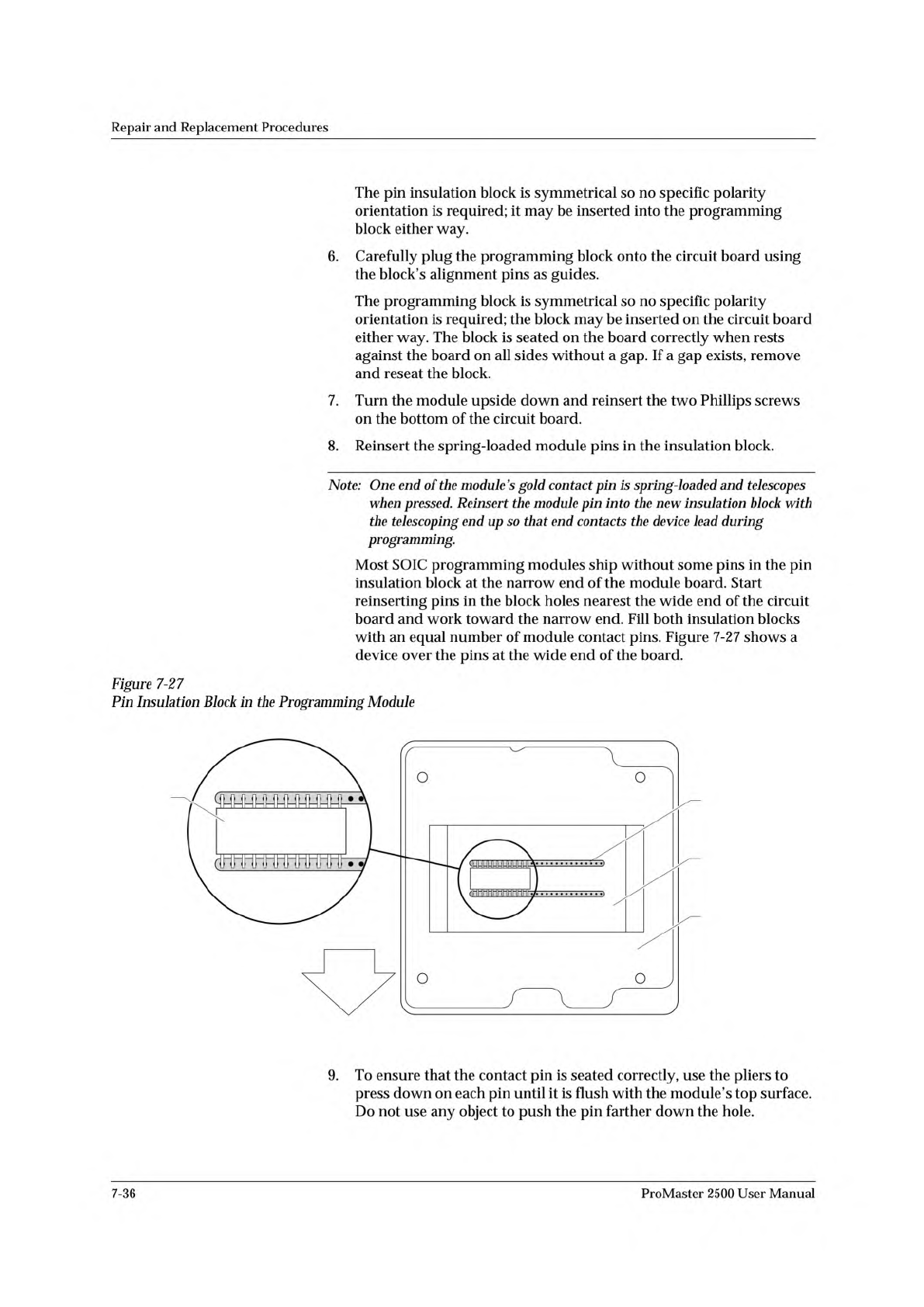
Figure
7-27
shows
a
device
over
the
pins
at
the
wide
end
of
the
board.
Figure
7-27
Pin
Insulation
Block
in
the
Programming
Module
)
,
°
J
J
9.
To
ensure
that
the
contact
pin
is
seated
correctly,
use
the
pliers
to
press
down
on
each
pin
until
it
is
flush
with
the
module's
top
surface.
Do
not
use
any
object
to
push
the
pin
farther
down
the
hole.
7-36
ProMaster
2500
User
Manual
Repair
and
Replacement
Procedures
10.
Test
the
module
by
running
a
device-related
operation
using
the
module.
Replacing
the
Programming
Block
on
a
PLCC
Module
After
a
period
of
time,
the
protective
coating
on
the
programming
block
(see
Figure
7-28)
may
wear
to
the
point
that
you
begin
to
see
a
higher
number
of
device-related
errors.
If
you
have
a
second
module
of
the
same
pin
count,
you
can
confirm
that
wear
is
the
source
of
these
problems
by
programming
the
same
type
of
device
on
the
second
module
and
comparing
the
yields.
CAUTION:
To
avoid
possible
damage
to
the
system
components,
this
procedure
should
be
performed
only
by
a
qualified
service
technician.
ProMaster
2500
User
Manual
7-37