2500_Users_Manual-.pdf - 第295页
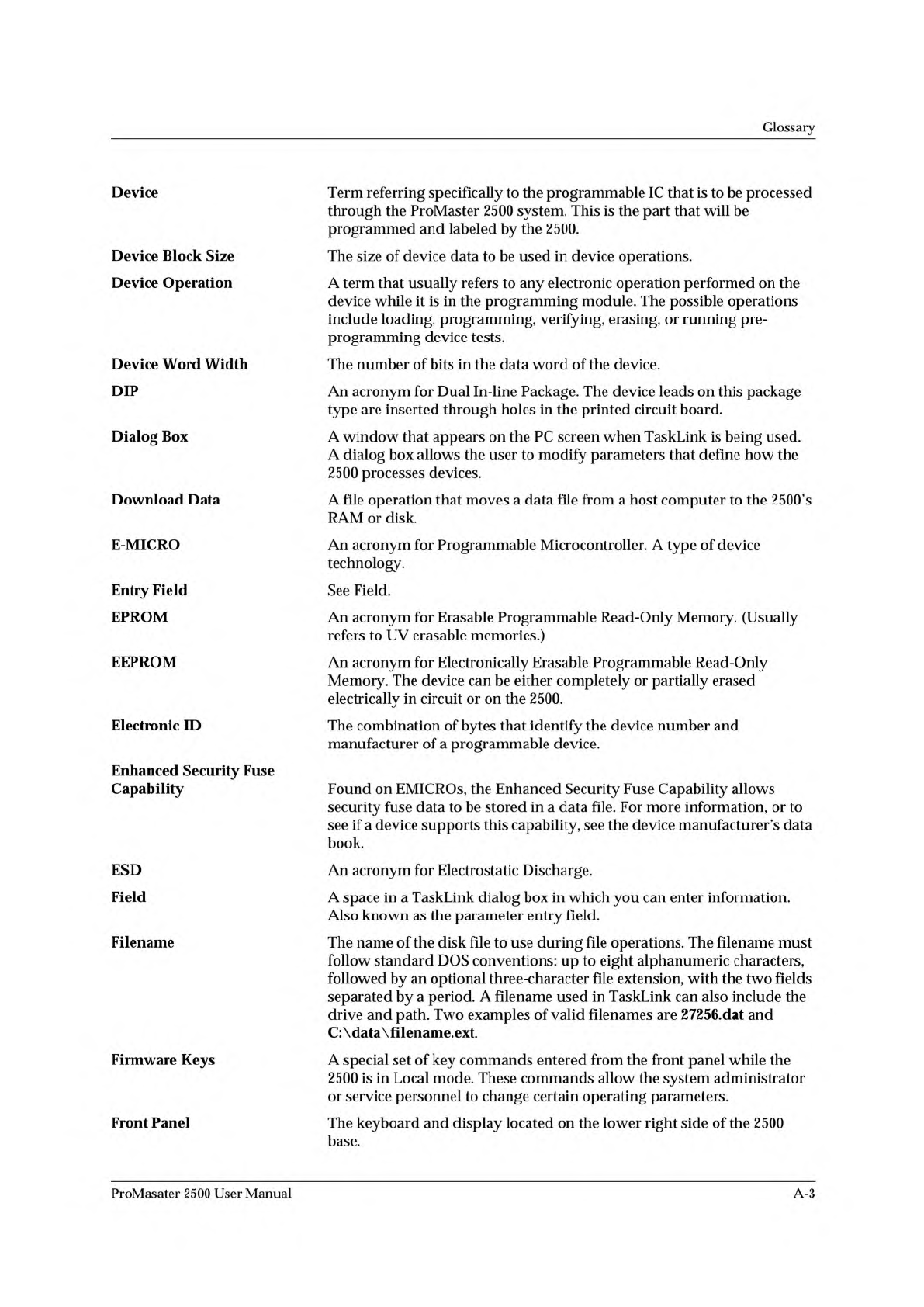
Glossary Device Term referring specifically to the programmable IC that is to be processed through the ProMaster 2500 system. This is the part that will be programmed and labeled by the 2500. Device Block Size Device Ope…
Glossary
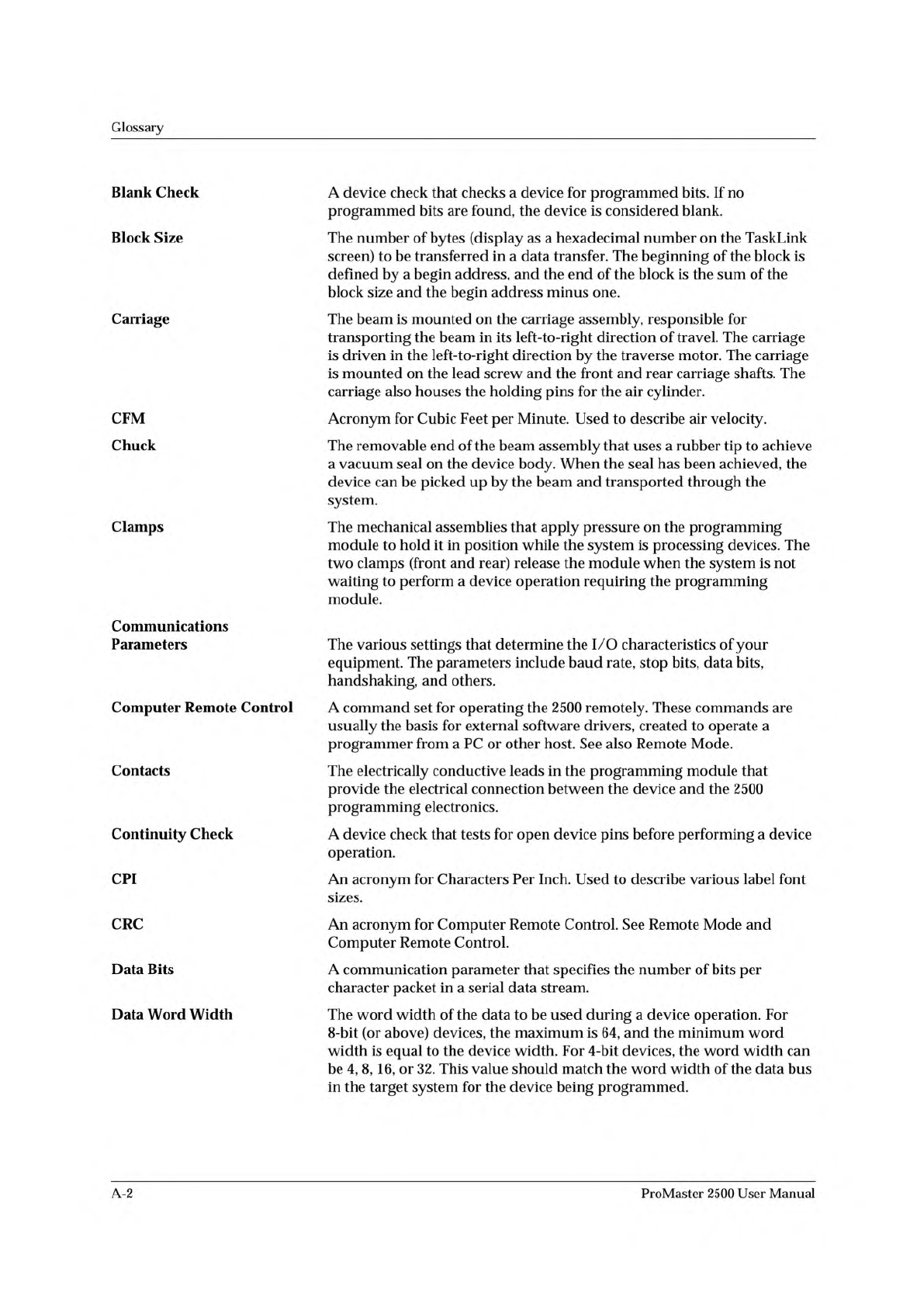
Blank
Check
A
device
check
that
checks
a
device
for
programmed
bits.
If
no
programmed
bits
are
found,
the
device
is
considered
blank.
Block
Size
The
number
of
bytes
(display
as
a
hexadecimal
number
on
the
TaskLink
screen)
to
be
transferred
in
a
data
transfer.
The
beginning
of
the
block
is
defined
by
a
begin
address,
and
the
end
of
the
block
is
the
sum
of
the
block
size
and
the
begin
address
minus
one.
Carriage
The
beam
is
mounted
on
the
carriage
assembly,
responsible
for
transporting
the
beam
in
its
left-to-right
direction
of
travel.
The
carriage
is
driven
in
the
left-to-right
direction
by
the
traverse
motor.
The
carriage
is
mounted
on
the
lead
screw
and
the
front
and
rear
carriage
shafts.
The
carriage
also
houses
the
holding
pins
for
the
air
cylinder.
CFM
Chuck
Acronym
for
Cubic
Feet
per
Minute.
Used
to
describe
air
velocity.
The
removable
end
of
the
beam
assembly
that
uses
a
rubber
tip
to
achieve
a
vacuum
seal
on
the
device
body.
When
the
seal
has
been
achieved,
the
device
can
be
picked
up
by
the
beam
and
transported
through
the
system.
Clamps
The
mechanical
assemblies
that
apply
pressure
on
the
programming
module
to
hold
it
in
position
while
the
system
is
processing
devices.
The
two
clamps
(front
and
rear)
release
the
module
when
the
system
is
not
waiting
to
perform
a
device
operation
requiring
the
programming
module.
Communications
Parameters
The
various
settings
that
determine
the
I/O
characteristics
of
your
equipment.
The
parameters
include
baud
rate,
stop
bits,
data
bits,
handshaking,
and
others.
Computer
Remote
Control
A
command
set
for
operating
the
2500
remotely.
These
commands
are
usually
the
basis
for
external
software
drivers,
created
to
operate
a
programmer
from
a
PC
or
other
host.
See
also
Remote
Mode.
Contacts
The
electrically
conductive
leads
in
the
programming
module
that
provide
the
electrical
connection
between
the
device
and
the
2500
programming
electronics.
Continuity
Check
A
device
check
that
tests
for
open
device
pins
before
performing
a
device
operation.
CPI
An
acronym
for
Characters
Per
Inch.
Used
to
describe
various
label
font
sizes.
CRC
An
acronym
for
Computer
Remote
Control.
See
Remote
Mode
and
Computer
Remote
Control.
Data
Bits
A
communication
parameter
that
specifies
the
number
of
bits
per
character
packet
in
a
serial
data
stream.
Data
Word
Width
The
word
width
of
the
data
to
be
used
during
a
device
operation.
For
8-bit
(or
above)
devices,
the
maximum
is
64,
and
the
minimum
word
width
is
equal
to
the
device
width.
For
4-bit
devices,
the
word
width
can
be
4,
8,
16,
or
32.
This
value
should
match
the
word
width
of
the
data
bus
in
the
target
system
for
the
device
being
programmed.
A-2
ProMaster
2500
User
Manual
Glossary
Device
Term
referring
specifically
to
the
programmable
IC
that
is
to
be
processed
through
the
ProMaster
2500
system.
This
is
the
part
that
will
be
programmed
and
labeled
by
the
2500.
Device
Block
Size
Device
Operation
The
size
of
device
data
to
be
used
in
device
operations.
A
term
that
usually
refers
to
any
electronic
operation
performed
on
the
device
while
it
is
in
the
programming
module.
The
possible
operations
include
loading,
programming,
verifying,
erasing,
or
running
pre¬
programming
device
tests.
Device
Word
Width
DIP
The
number
of
bits
in
the
data
word
of
the
device.
An
acronym
for
Dual
In-line
Package.
The
device
leads
on
this
package
type
are
inserted
through
holes
in
the
printed
circuit
board.
Dialog
Box
A
window
that
appears
on
the
PC
screen
when
TaskLink
is
being
used.
A
dialog
box
allows
the
user
to
modify
parameters
that
define
how
the
2500
processes
devices.
Download
Data
A
file
operation
that
moves
a
data
file
from
a
host
computer
to
the
2500's
RAM
or
disk.
E-MICRO
An
acronym
for
Programmable
Microcontroller.
A
type
of
device
technology.
Entry
Field
EPROM
See
Field.
An
acronym
for
Erasable
Programmable
Read-Only
Memory.
(Usually
refers
to
UV
erasable
memories.)
EEPROM
An
acronym
for
Electronically
Erasable
Programmable
Read-Only
Memory.
The
device
can
be
either
completely
or
partially
erased
electrically
in
circuit
or
on
the
2500.
Electronic
ID
The
combination
of
bytes
that
identify
the
device
number
and
manufacturer
of
a
programmable
device.
Enhanced
Security
Fuse
Capability
Found
on
EMICROs,
the
Enhanced
Security
Fuse
Capability
allows
security
fuse
data
to
be
stored
in
a
data
file.
For
more
information,
or
to
see
if
a
device
supports
this
capability,
see
the
device
manufacturer's
data
book.
ESD
Field
An
acronym
for
Electrostatic
Discharge.
A
space
in
a
TaskLink
dialog
box
in
which
you
can
enter
information.
Also
known
as
the
parameter
entry
field.
Filename
The
name
of
the
disk
file
to
use
during
file
operations.
The
filename
must
follow
standard
DOS
conventions:
up
to
eight
alphanumeric
characters,
followed
by
an
optional
three-character
file
extension,
with
the
two
fields
separated
by
a
period.
A
filename
used
in
TaskLink
can
also
include
the
drive
and
path.
Two
examples
of
valid
filenames
are
27256.dat
and
C:\data\filename.ext.
Firmware
Keys
A
special
set
of
key
commands
entered
from
the
front
panel
while
the
2500
is
in
Local
mode.
These
commands
allow
the
system
administrator
or
service
personnel
to
change
certain
operating
parameters.
Front
Panel
The
keyboard
and
display
located
on
the
lower
right
side
of
the
2500
base.
ProMasater
2500
User
Manual
A-3
Glossary
Fuse
Verification
A
type
of
post-programming
device
check
that
checks
the
fuse
pattern
programmed
into
a
logic
device
against
the
pattern
in
user
memory.
Fusemap
The
fuse-level
description
portion
of
a
programmable
integrated
circuit.
Fusemaps
are
typically
flies
in
JEDEC
Standard
#3A
format
and
are
downloaded
to
PLD
programmers
for
programming
or
verifying
a
device.
High-speed
Logic
Drivers
A
logic
device
test
that
increases
the
speed
of
the
logic
transitions
between
0
to
1
and
1
to
0
of
the
test
vector
input
states.
This
test
is
a
diagnostic
tool
designed
to
help
debug
and
classify
test
vector
failures.
Specifically,
this
test
is
designed
to
help
identify
vector
transitions
that
are
speed
dependent.
I/O
Address
Offset
This
value
influences
the
beginning
address
where
data
is
stored
during
a
file
transfer
operation.
For
uploads
from
the
2500,
the
I/O
Offset
is
an
address
value
add
to
the
RAM
address
for
each
transferred
data
byte.
For
downloads,
the
I/O
Offset
is
subtracted
from
the
beginning
address
in
the
formatted
data
file.
The
result
is
then
added
to
the
memory
begin
address
to
determine
where
the
block
of
data
is
loaded.
I/O
Timeout
The
amount
of
time
that
the
programming
electronics
will
wait
for
a
data
transfer
to
begin.
I/O
Translation
Format
Illegal
Bit
See
Data
Translation
Format.
An
illegal
bit
is
a
programmed
location
in
a
device
that
the
data
file
specifies
should
not
be
programmed.
Illegal
Bit
Check
A
test
that
determines
whether
or
not
a
socketed
device
contains
any
illegal
bits.
JEDEC
An
acronym
for
Joint
Electron
Design
Engineering
Committee,
which
is
a
committee
of
programmer
and
semiconductor
manufacturers
that
provide
common
standards
for
programmable
issues.
Examples
include:
acceptable
test
characters
for
PLDs
and
standard
data
transfer/
programming
formats
for
PLDs.
JEDEC
Standard
#3A
is
the
industry
standard
for
PLD
formats.
JEDEC
Standard
#3A
The
standard
PLD
data
translation
format
(as
defined
by
the
JEDEC)
for
PLD
design
software
to
communicate
with
PLD
programmers.
It
defines
the
states
of
all
fuses
in
the
device
(the
fusemap)
and
may
include
test
vectors
for
device
testing.
LED
An
acronym
for
Light
Emitting
Diode.
The
2500
has
one
external
LED
on
the
disk
drive
and
numerous
internal
LEDs
on
the
handler
controller
board
used
for
diagnostic
tests.
Liner
The
non-adhesive
backing
that
holds
the
blank
labels
on
a
label
roll.
Labels
are
removed
from
the
liner
by
the
2500
and
applied
to
the
device.
Load
Device
A
device
operation
that
copies
data
from
a
master
device
into
user
memory.
Local
Mode
One
of
two
system
operation
modes
for
the
ProMaster
2500.
When
placed
in
local
mode,
the
2500
responds
to
commands
sent
either
from
the
front
panel
or
its
internal
firmware.
In
this
mode,
the
2500
is
not
operating
with
TaskLink.
The
other
general
operating
mode
for
the
2500
is
Remote
mode.
A-4
ProMaster
2500
User
Manual