2500_Users_Manual-.pdf - 第324页
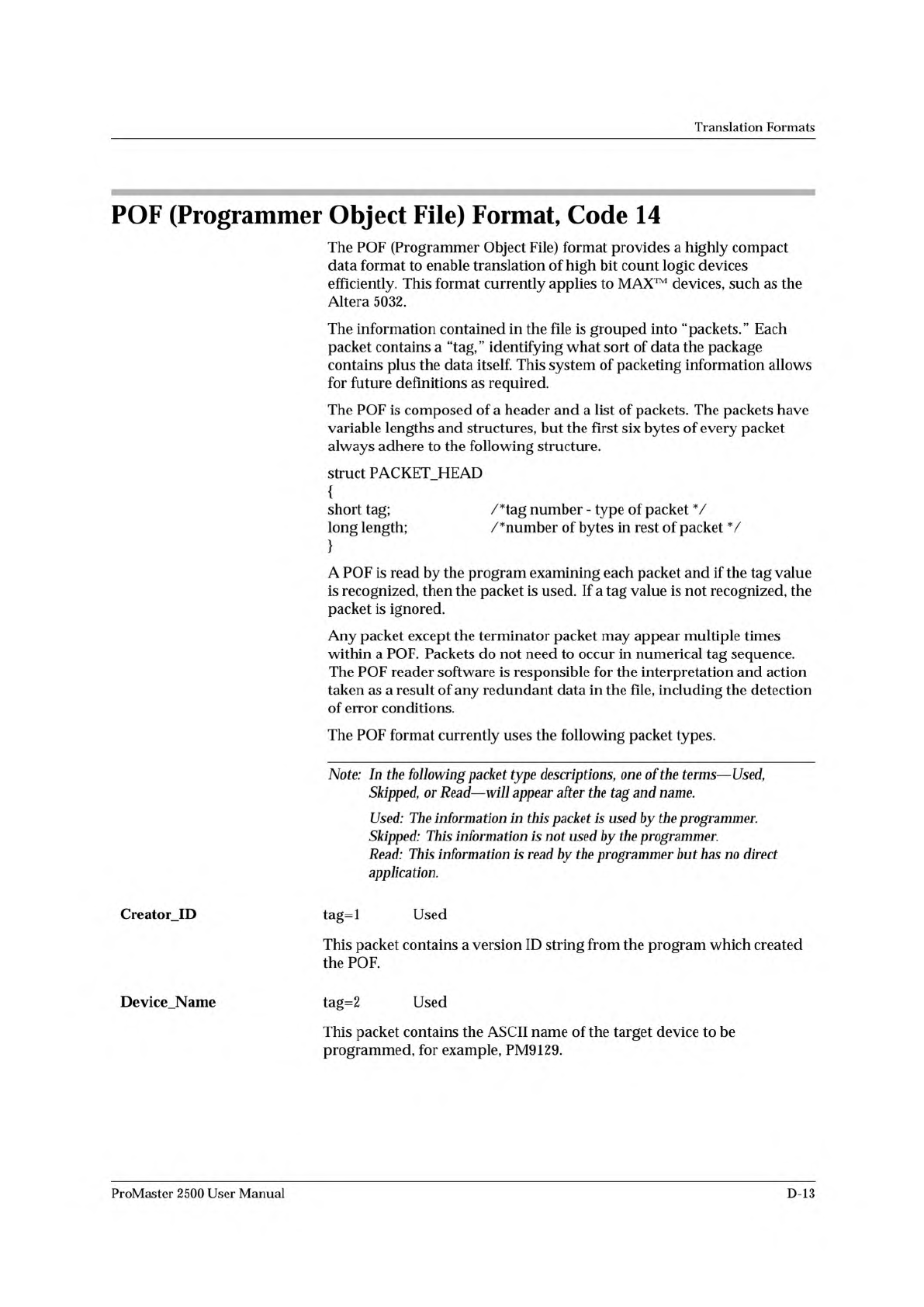
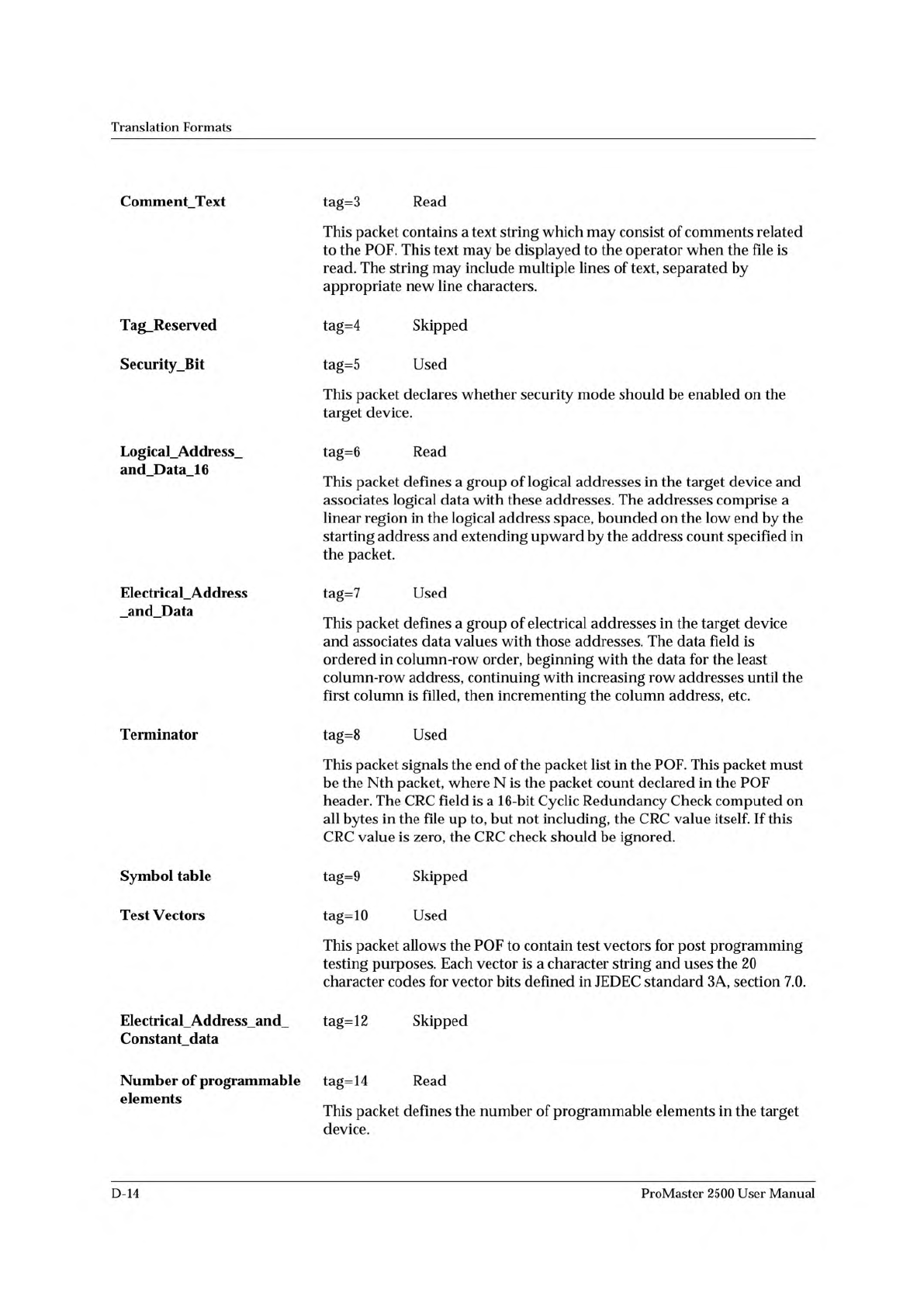
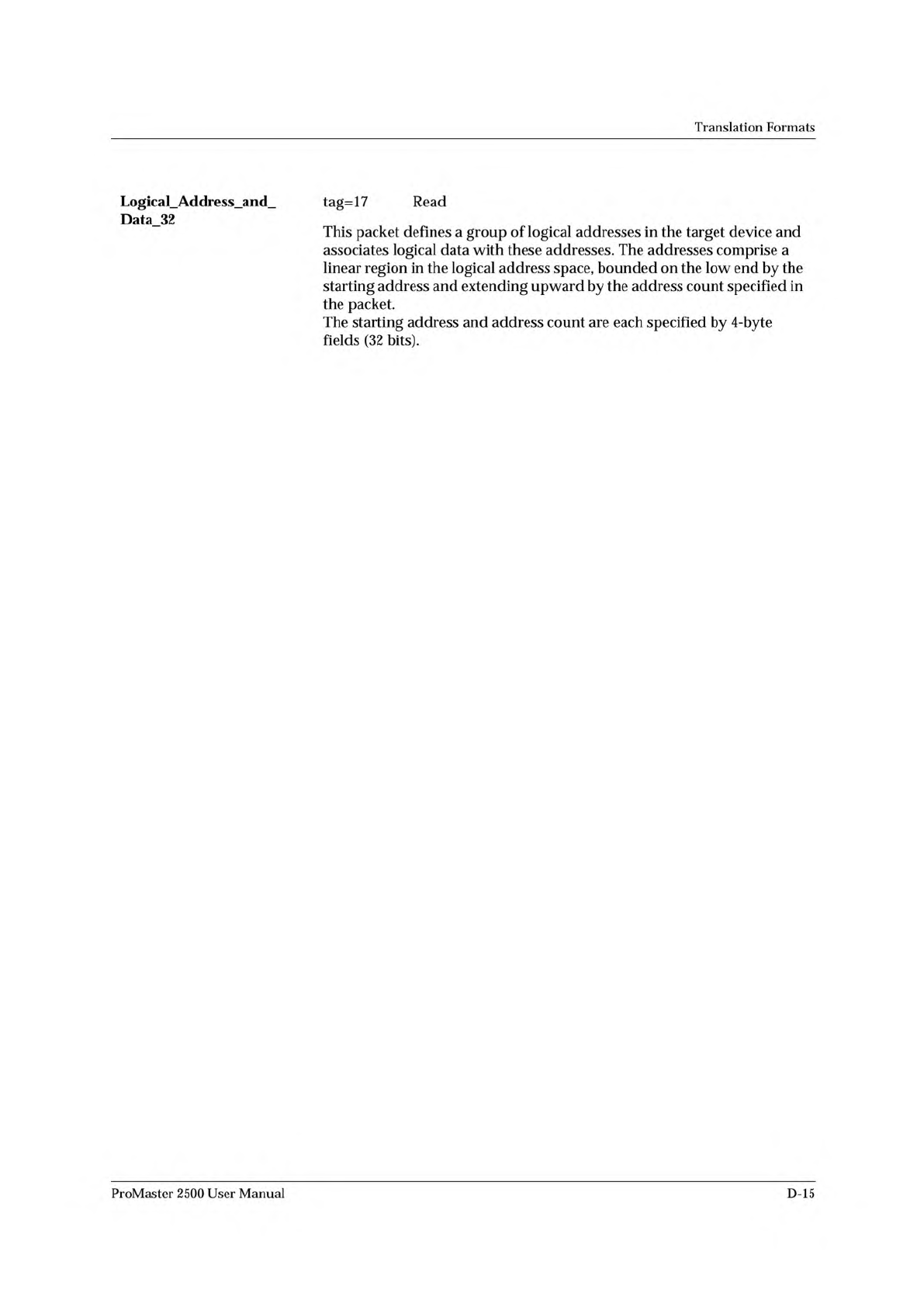
Translation Formats Comment_T ext tag=3 Read This packet contains a text string which may consist of comments related to the POF. This text may be displayed to the operator when the file is read. The string may include m…
Translation
Formats
POF
(Programmer
Object
File)
Format,
Code
14
The
POF
(Programmer
Object
File)
format
provides
a
highly
compact
data
format
to
enable
translation
of
high
bit
count
logic
devices
efficiently.
This
format
currently
applies
to
MAX™
devices,
such
as
the
Altera
5032.
The
information
contained
in
the
file
is
grouped
into
“packets.”
Each
packet
contains
a
“tag,”
identifying
what
sort
of
data
the
package
contains
plus
the
data
itself.
This
system
of
packeting
information
allows
for
future
definitions
as
required.
The
POF
is
composed
of
a
header
and
a
list
of
packets.
The
packets
have
variable
lengths
and
structures,
but
the
first
six
bytes
of
every
packet
always
adhere
to
the
following
structure.
struct
PACKET_HEAD
{
short
tag;
/*tag
number
-
type
of
packet
*/
long
length;
/*number
of
bytes
in
rest
of
packet
*/
}
A
POF
is
read
by
the
program
examining
each
packet
and
if
the
tag
value
is
recognized,
then
the
packet
is
used.
If
a
tag
value
is
not
recognized,
the
packet
is
ignored.
Any
packet
except
the
terminator
packet
may
appear
multiple
times
within
a
POF.
Packets
do
not
need
to
occur
in
numerical
tag
sequence.
The
POF
reader
software
is
responsible
for
the
interpretation
and
action
taken
as
a
result
of
any
redundant
data
in
the
file,
including
the
detection
of
error
conditions.
The
POF
format
currently
uses
the
following
packet
types.
Note:
In
the
following
packet
type
descriptions,
one
of
the
terms
—
Used,
Skipped,
or
Read
—
will
appear
after
the
tag
and
name.
Used:
The
information
in
this
packet
is
used
by
the
programmer.
Skipped:
This
information
is
not
used
by
the
programmer.
Read:
This
information
is
read
by
the
programmer
but
has
no
direct
application.
CreatorJD
tag=l
Used
This
packet
contains
a
version
ID
string
from
the
program
which
created
the
POF.
Device_Name
tag=2
Used
This
packet
contains
the
ASCII
name
of
the
target
device
to
be
programmed,
for
example,
PM9129.
ProMaster
2500
User
Manual
D-13
Translation
Formats
Comment_T
ext
tag=3
Read
This
packet
contains
a
text
string
which
may
consist
of
comments
related
to
the
POF.
This
text
may
be
displayed
to
the
operator
when
the
file
is
read.
The
string
may
include
multiple
lines
of
text,
separated
by
appropriate
new
line
characters.
Tag_Reserved
tag=4
Skipped
Security_Bit
tag=5
Used
This
packet
declares
whether
security
mode
should
be
enabled
on
the
target
device.
Logical_Address_
tag=6
Read
and_Data_16
This
packet
defines
a
group
of
logical
addresses
in
the
target
device
and
associates
logical
data
with
these
addresses.
The
addresses
comprise
a
linear
region
in
the
logical
address
space,
bounded
on
the
low
end
by
the
starting
address
and
extending
upward
by
the
address
count
specified
in
the
packet.
Electrical_Address
tag=7
Used
_and_Data
This
packet
defines
a
group
of
electrical
addresses
in
the
target
device
and
associates
data
values
with
those
addresses.
The
data
field
is
ordered
in
column-row
order,
beginning
with
the
data
for
the
least
column-row
address,
continuing
with
increasing
row
addresses
until
the
first
column
is
filled,
then
incrementing
the
column
address,
etc.
Terminator
tag=8
Used
This
packet
signals
the
end
of
the
packet
list
in
the
POF.
This
packet
must
be
the
Nth
packet,
where
N
is
the
packet
count
declared
in
the
POF
header.
The
CRC
field
is
a
16-bit
Cyclic
Redundancy
Check
computed
on
all
bytes
in
the
file
up
to,
but
not
including,
the
CRC
value
itself.
If
this
CRC
value
is
zero,
the
CRC
check
should
be
ignored.
Symbol
table
tag=9
Skipped
Test
Vectors
tag=10
Used
This
packet
allows
the
POF
to
contain
test
vectors
for
post
programming
testing
purposes.
Each
vector
is
a
character
string
and
uses
the
20
character
codes
for
vector
bits
defined
in
JEDEC
standard
3
A,
section
7.0.
Electrical_Address_and_
tag=12
Skipped
Constant_data
Number
of
programmable
elements
tag=14
Read
This
packet
defines
the
number
of
programmable
elements
in
the
target
device.
D-14
ProMaster
2500
User
Manual
Translation
Formats
Logical_Address_and_
Data_32
tag=17
Read
This
packet
defines
a
group
of
logical
addresses
in
the
target
device
and
associates
logical
data
with
these
addresses.
The
addresses
comprise
a
linear
region
in
the
logical
address
space,
bounded
on
the
low
end
by
the
starting
address
and
extending
upward
by
the
address
count
specified
in
the
packet.
The
starting
address
and
address
count
are
each
specified
by
4-byte
fields
(32
bits).
ProMaster
2500
User
Manual
D-15