2500_Users_Manual-.pdf - 第329页
$ A 0 0 0 0 0 0 , 3 7 7 3 7 7 3 7 7 3 7 7 3 7 7 3 77 3 7 7 3 7 7 3 7 7 3 7 7 3 7 7 3 7 7 3 7 7 3 7 7 3 7 7 3 7 7 $ S 0 0 7 7 6 0 , $ A 0 0 0 0 0 0 , 3 7 7 % 3 7 7 % 3 7 7% 3 7 7 % 37 7 %3 7 7 % 3 7 7 % 3 7 7 % 3 77 % 3 7…
Translation
Formats
LOF
Fields
The
following
fields
are
included
in
Data
I/O's
implementation
of
the
LOF
format:
<STX>
*
Start
of
Data
(ASCII
Ctrl-B,
0x02
hex)
C
*
Fuse
Checksum
K
Fuse
data,
followed
by
control
words
and
pulse
link
cycles
N
*
Notes
Field
QB
Number
of
bits
per
word
QC
Number
of
control
words
at
the
end
of
each
K
field
QF
Number
of
Fuses
in
Device
(#
of
K
fields)
QM
Number
of
macro
cells
in
the
data
file
QP
*
Number
of
Device
Package
Pins
QS
Number
of
Hex-ASCII
words
in
each
K
field
and
each
control
word
QV
*
Maximum
Number
of
Test
Vectors
R
Signature
Analysis
(reserved
for
future
use)
S
SpDE
Checksum
T
Signature
Analysis
(reserved
for
future
use)
V
*
Test
Vectors
(reserved
for
future
use)
X
*
Default
Test
Conditions
(reserved
for
future
use)
<ETX>
*
End
of
Data
(ASCII
Ctrl-C,
0x03
hex)
These
fields
are
already
defined
as
part
of
the
JEDEC
standard
and
not
be
defined
in
this
section.
D-18
ProMaster
2500
User
Manual
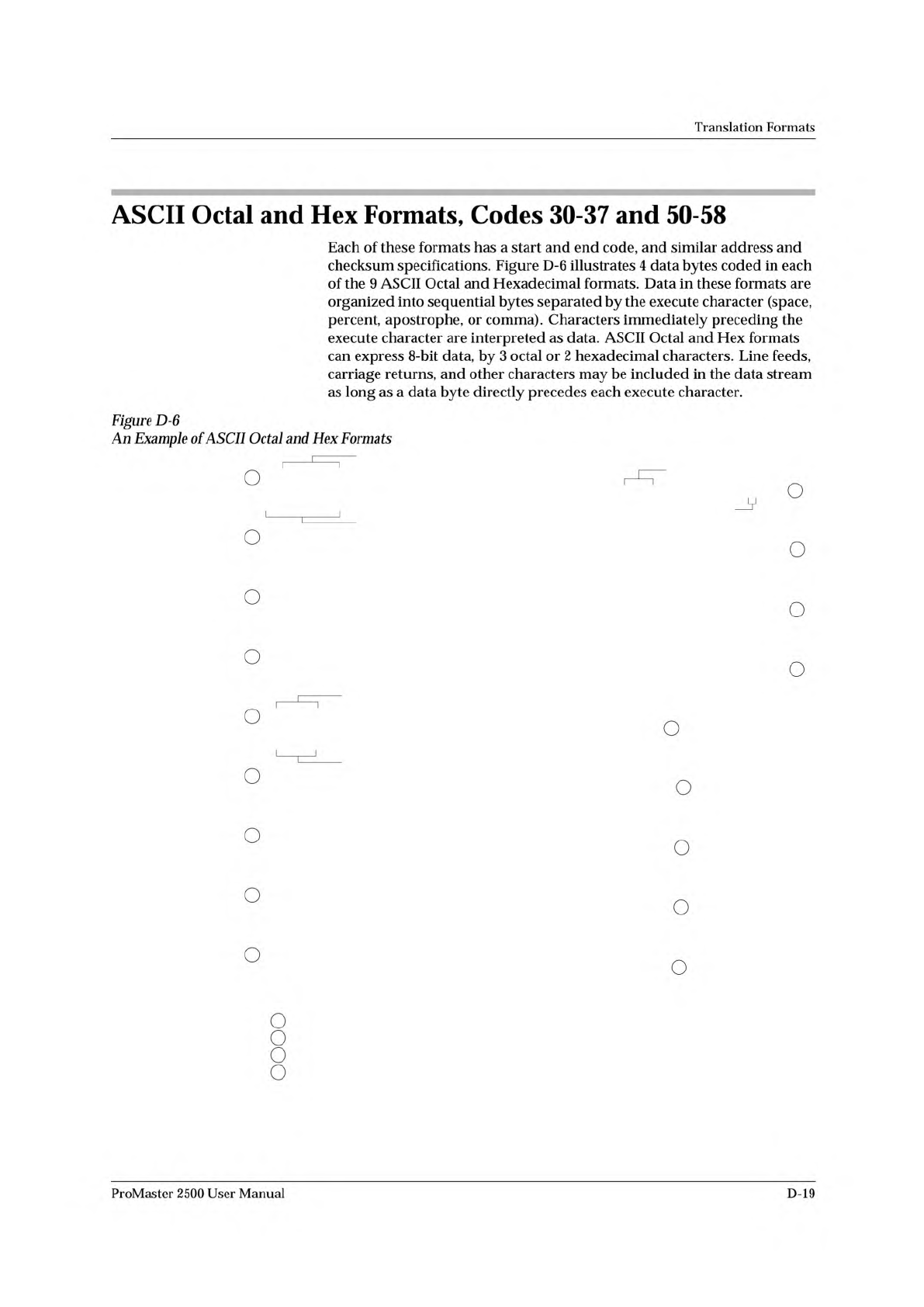
$A000000,
377 377 377 377 377 377 377 377 377 377 377 377 377 377 377 377
$S007760,
$A000000,
377%377%377%377%377%377%377%377%377%377%377%377%377%377%377%377%
$S007760,
$A000000,
377'377'377'377'377'377'377'377'377'377'377'377'377'377'377'377'
$S007760,
$A000000,
377'377'377'377'377'377'377'377'377'377'377'377'377'377'377'377'
$S007760,
$A0000,
FF%FF%FF%FF%FF%FF%FF%FF%FF%FF%FF%FF%FF%FF%FF%FF%
$S0FF0,
$A0000,
FF FF FF FF FF FF FF FF FF FF FF FF FF FF FF FF
$S0FF0,
$A0000,
FF'FF'FF'FF'FF'FF'FF'FF'FF'FF'FF'FF'FF'FF'FF'FF'
$S0FF0,
$A0000,
FF,FF,FF,FF,FF,FF,FF,FF,FF,FF,FF,FF,FF,FF,FF,FF,
$S0FF0,
$A0000,
FF'FF'FF'FF'FF'FF'FF'FF'FF'FF'FF'FF'FF'FF'FF'FF'
$S0FF0,
1
1
1
2
1
1
1
1
2
4
4
4
3
4
4
4
3
4
FORMAT 30 (OR 35)
FORMAT 31 (OR 36)
FORMAT 32
FORMAT 37
FORMAT 50 (OR 55)
FORMAT 51 (OR 56)
FORMAT 52
FORMAT 53 (OR 58)
FORMAT 57
Optional Octal Address Field (Typical)
Optional Octal Sumcheck Field (Typical)
Octal Data Byte (Typical)
Execute Character
Optional Hex Address Field
Optional Hex Sumcheck Field
LEGEND
Start Code is nonprintable STX - CTRL B (optionally SOH - CTRL A)
Start Code is nonprintable SOM - CTRL R
End Code is nonprintable EOM - CTRL T
End Code is nonprintable ETX - CTRL C
1
2
3
4
0078-2
Translation
Formats
Figure
D-6
An
Example
of
ASCII
Octal
and
Hex
Formats
ASCII
Octal
and
Hex
Formats,
Codes
30-37
and
50-58
Each
of
these
formats
has
a
start
and
end
code,
and
similar
address
and
checksum
specifications.
Figure
D-6
illustrates
4
data
bytes
coded
in
each
of
the
9
ASCII
Octal
and
Hexadecimal
formats.
Data
in
these
formats
are
organized
into
sequential
bytes
separated
by
the
execute
character
(space,
percent,
apostrophe,
or
comma).
Characters
immediately
preceding
the
execute
character
are
interpreted
as
data.
ASCII
Octal
and
Hex
formats
can
express
8-bit
data,
by
3
octal
or
2
hexadecimal
characters.
Line
feeds,
carriage
returns,
and
other
characters
may
be
included
in
the
data
stream
as
long
as
a
data
byte
directly
precedes
each
execute
character.
oooo
ProMaster
2500
User
Manual
D-19
Translation
Formats
Although
each
data
byte
has
an
address,
most
are
implied.
Data
bytes
are
addressed
sequentially
unless
an
explicit
address
is
included
in
the
data
stream.
This
address
is
preceded
by
a
$
and
an
A,
must
contain
2
to
8
hex
or
3
to
11
octal
characters,
and
must
be
followed
by
a
comma,
except
for
the
ASCII-Hex
(Comma)
format,
which
uses
a
period.
The
programmer
skips
to
the
new
address
to
store
the
next
data
byte;
succeeding
bytes
are
again
stored
sequentially.
Each
format
has
an
end
code,
which
terminates
input
operations.
However,
if
a
new
start
code
follows
within
16
characters
of
an
end
code,
input
will
continue
uninterrupted.
If
no
characters
come
within
2
seconds,
input
operation
is
terminated.
After
receiving
the
final
end
code
following
an
input
operation,
the
programmer
calculates
a
sumcheck
of
all
incoming
data.
Optionally,
a
sumcheck
can
also
be
entered
in
the
input
data
stream.
The
programmer
compares
this
sumcheck
with
its
own
calculated
sumcheck.
If
they
match,
the
programmer
will
display
the
sumcheck;
if
not,
a
sumcheck
error
will
be
displayed.
Note:
The
sumcheck
field
consists
of
either
2-4
hex
or
3-6
octal
characters,
sandwiched
between
the
$
and
comma
characters.
The
sumcheck
immediately
follows
end
code.
The
sumcheck
is
optional
in
the
input
mode
but
is
always
included
in
the
output
mode.
The
most
significant
digit
of
the
sumcheck
may
be
0
or
1
when
expressing
1
6
bits
as
6
octal
characters.
The
programmer
divides
the
output
data
into
8-line
blocks.
Data
transmission
is
begun
with
the
start
code,
a
nonprintable
STX
character,
or
optionally,
SOH.*
Data
blocks
follow,
each
one
prefaced
by
an
address
for
the
first
data
byte
in
the
block.
The
end
of
transmission
is
signaled
by
the
end
code,
a
nonprintable
ETX
character.
Directly
following
the
end
code
is
a
sumcheck
of
the
transferred
data.
*
ASCII-Octal
SMS
and
ASCII-Hex
SMS
use
SOM
(CTRL-R)
as
a
start
code
and
EOM
(CTRL-T)
as
an
end
code.
D-20
ProMaster
2500
User
Manual