2500_Users_Manual-.pdf - 第341页
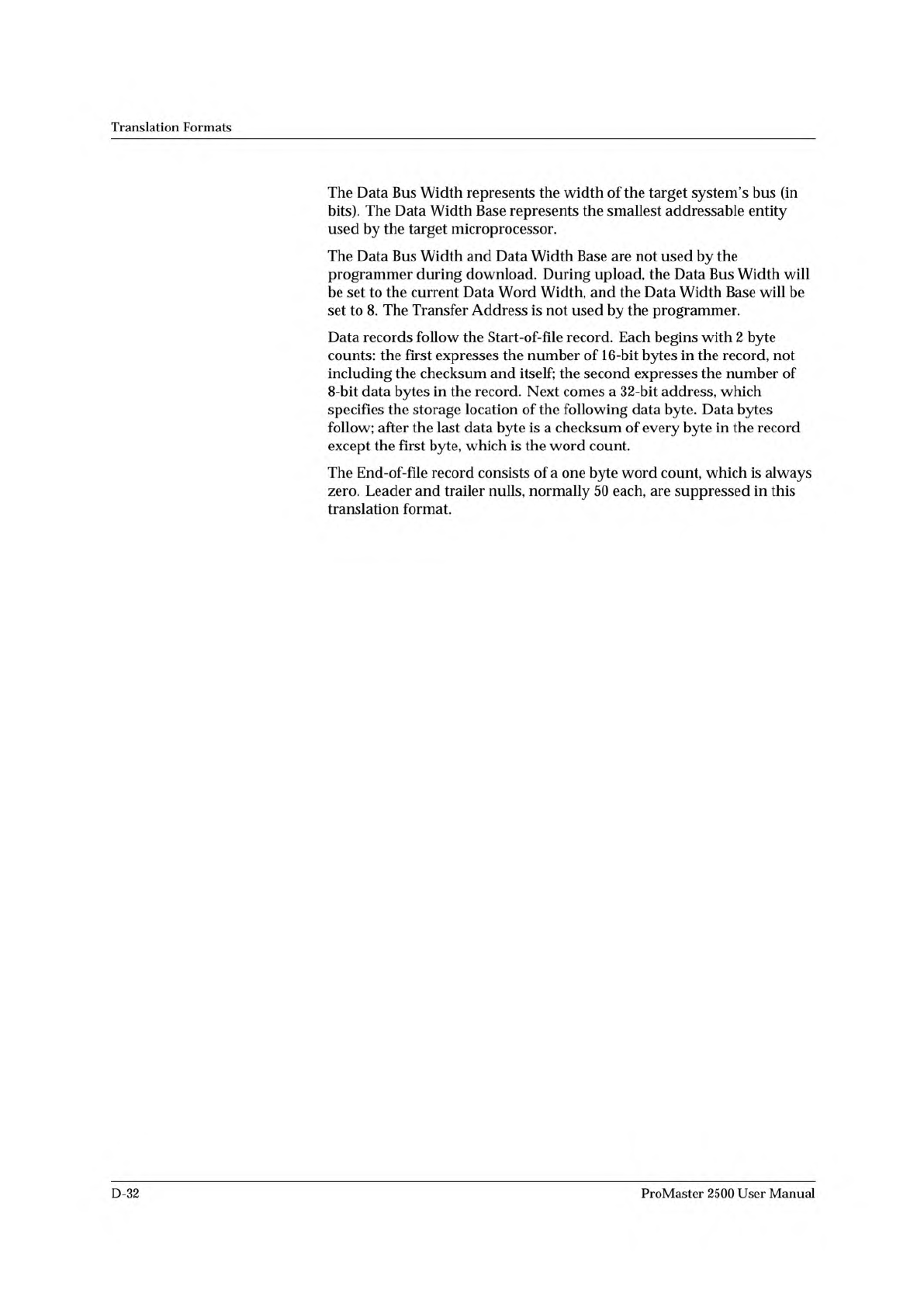
End-of-File record consists only of a word count of 0. Checksum Data bytes Address where following data byte is to be stored. BYTE COUNT — number of 8-bit data bytes. WORD COUNT — number of 16-bit words in record except …
:02 0000 02 1230 BA
:10 0045 00 55AA FF.....BC
1230
+ 0045
12345
Translation
Formats
03-Start
Record
Problem:
Find
the
address
for
the
first
data
byte
for
the
following
file.
Solution:
Step
1.
Find
the
record
address
for
the
byte.
The
first
data
byte
is
55.
Its
record
address
is
0045
from
above.
Step
2.
Find
the
offset
address.
The
offset
address
is
1230
from
above.
Step
3.
Shift
the
offset
address
one
place
left,
then
add
it
to
the
record
address,
like
this:
Offset
address
(upper
16
bits)
Record
address
(lower
16
bits)
20-bit
address
The
address
for
the
first
data
byte
is
12345.
Note:
Always
specify
the
address
offset
when
using
this
format,
even
when
the
offset
is
zero.
During
output
translation,
the
firmware
will
force
the
record
size
to
16
(decimal)
if
the
record
size
is
specified
greater
than
16.
There
is
no
such
limitation
for
record
sizes
specified
less
than
16.
This
record
type
is
not
sent
during
output
by
Data
I/O
translator
firmware.
D-30
ProMaster
2500
User
Manual
End-of-File record consists only of a word count of 0.
Checksum
Data bytes
Address where following data byte is to be stored.
BYTE COUNT — number of 8-bit data bytes.
WORD COUNT — number of 16-bit words in record except checksum and itself.
CHECKSUM — modulo 256 sum of all bytes in the record except the first byte.
TRANSFER ADDRESS — for microprocessor program counter.
DATA WIDTH BASE — see text.
DATA BUS WIDTH — see text.
WORD COUNT — number of 16-bit words in the record; always 04 in
Start-of-File record.
Note:
START-OF-FILE
RECORD
ONE DATA
RECORD
END-OF-FILE
RECORD
0088-2
HIGH
ORDER
LOW
ORDER
Third Byte
MSB
LSB
Second Byte
32-bit address
is sent in this
manner, in 4
groups of 8-bit
bytes.
This format is binary. Therefore, no ASCII control characters
or carriage returns and line feeds are allowed.
Translation
Formats
Hewlett-Packard
64000
Absolute
Format,
Code
89
Hewlett-Packard
Absolute
is
a
binary
format
with
control
and
data-checking
characters.
See
Figure
D-16.
Figure
D-16
Example
of
HP
64000
Absolute
Format
Data
files
begin
with
a
Start-of-file
record,
which
includes
the
Data
Bus
Width,
Data
Width
Base,
Transfer
Address,
and
a
checksum
of
the
bytes
in
the
record.
ProMaster
2500
User
Manual
D-31
Translation
Formats
The
Data
Bus
Width
represents
the
width
of
the
target
system's
bus
(in
bits).
The
Data
Width
Base
represents
the
smallest
addressable
entity
used
by
the
target
microprocessor.
The
Data
Bus
Width
and
Data
Width
Base
are
not
used
by
the
programmer
during
download.
During
upload,
the
Data
Bus
Width
will
be
set
to
the
current
Data
Word
Width,
and
the
Data
Width
Base
will
be
set
to
8.
The
Transfer
Address
is
not
used
by
the
programmer.
Data
records
follow
the
Start-of-file
record.
Each
begins
with
2
byte
counts:
the
first
expresses
the
number
of
16-bit
bytes
in
the
record,
not
including
the
checksum
and
itself;
the
second
expresses
the
number
of
8-bit
data
bytes
in
the
record.
Next
comes
a
32-bit
address,
which
specifies
the
storage
location
of
the
following
data
byte.
Data
bytes
follow;
after
the
last
data
byte
is
a
checksum
of
every
byte
in
the
record
except
the
first
byte,
which
is
the
word
count.
The
End-of-file
record
consists
of
a
one
byte
word
count,
which
is
always
zero.
Leader
and
trailer
nulls,
normally
50
each,
are
suppressed
in
this
translation
format.
D-32
ProMaster
2500
User
Manual