2500_Users_Manual-.pdf - 第371页
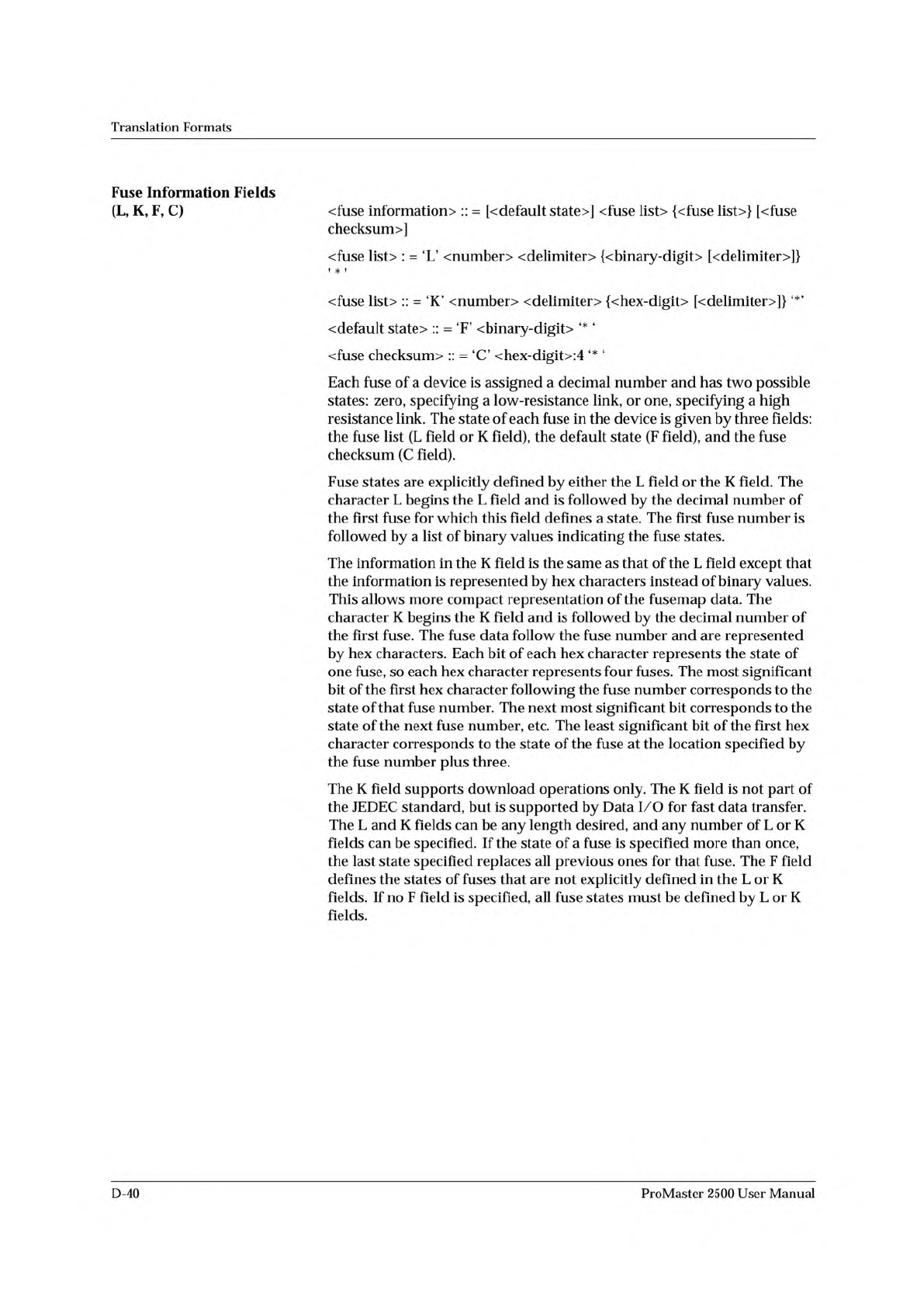
F0*L0 01010101* L0008 0 1010111* L1000 0101*C019E* F0*K0 55* K0008 57* K10 00 5* C019E* L0200 0110101010101 0101011 01011101011010001001001 0010* G1 Translation Formats The C field, the fuse information checksum field, i…
Translation
Formats
Fuse
Information
Fields
(L,
K,
F,
C)
<fuse
information〉
::
=
[<default
state>]
<fuse
list>
{<fuse
list>}
[<fuse
checksum
>]
<fuse
list〉
:
=
,L'
<number>
<delimiter>
{<binary-digit>
[<delimiter>]}
•
*
t
<fuse
list〉
::
=
,K'
<number>
<
delimiter
>
{<
hex-digit
>
[vdelimiter〉]}
'*,
<
default
state>
::
=
'F'
〈
binary-digit〉
'
vfuse
checksum〉
::
=
'C'
<hex-digit>:4
'*
'
Each
fuse
of
a
device
is
assigned
a
decimal
number
and
has
two
possible
states:
zero,
specifying
a
low-resistance
link,
or
one,
specifying
a
high
resistance
link.
The
state
of
each
fuse
in
the
device
is
given
by
three
fields:
the
fuse
list
(L
field
or
K
field),
the
default
state
(F
field),
and
the
fuse
checksum
(C
field).
Fuse
states
are
explicitly
defined
by
either
the
L
field
or
the
K
field.
The
character
L
begins
the
L
field
and
is
followed
by
the
decimal
number
of
the
first
fuse
for
which
this
field
defines
a
state.
The
first
fuse
number
is
followed
by
a
list
of
binary
values
indicating
the
fuse
states.
The
information
in
the
K
field
is
the
same
as
that
of
the
L
field
except
that
the
information
is
represented
by
hex
characters
instead
of
binary
values.
This
allows
more
compact
representation
of
the
fusemap
data.
The
character
K
begins
the
K
field
and
is
followed
by
the
decimal
number
of
the
first
fuse.
The
fuse
data
follow
the
fuse
number
and
are
represented
by
hex
characters.
Each
bit
of
each
hex
character
represents
the
state
of
one
fuse,
so
each
hex
character
represents
four
fuses.
The
most
significant
bit
of
the
first
hex
character
following
the
fuse
number
corresponds
to
the
state
of
that
fuse
number.
The
next
most
significant
bit
corresponds
to
the
state
of
the
next
fuse
number,
etc.
The
least
significant
bit
of
the
first
hex
character
corresponds
to
the
state
of
the
fuse
at
the
location
specified
by
the
fuse
number
plus
three.
The
K
field
supports
download
operations
only.
The
K
field
is
not
part
of
the
JEDEC
standard,
but
is
supported
by
Data
I/O
for
fast
data
transfer.
The
L
and
K
fields
can
be
any
length
desired,
and
any
number
of
L
or
K
fields
can
be
specified.
If
the
state
of
a
fuse
is
specified
more
than
once,
the
last
state
specified
replaces
all
previous
ones
for
that
fuse.
The
F
field
defines
the
states
of
fuses
that
are
not
explicitly
defined
in
the
L
or
K
fields.
If
no
F
field
is
specified,
all
fuse
states
must
be
defined
by
L
or
K
fields.
D-40
ProMaster
2500
User
Manual
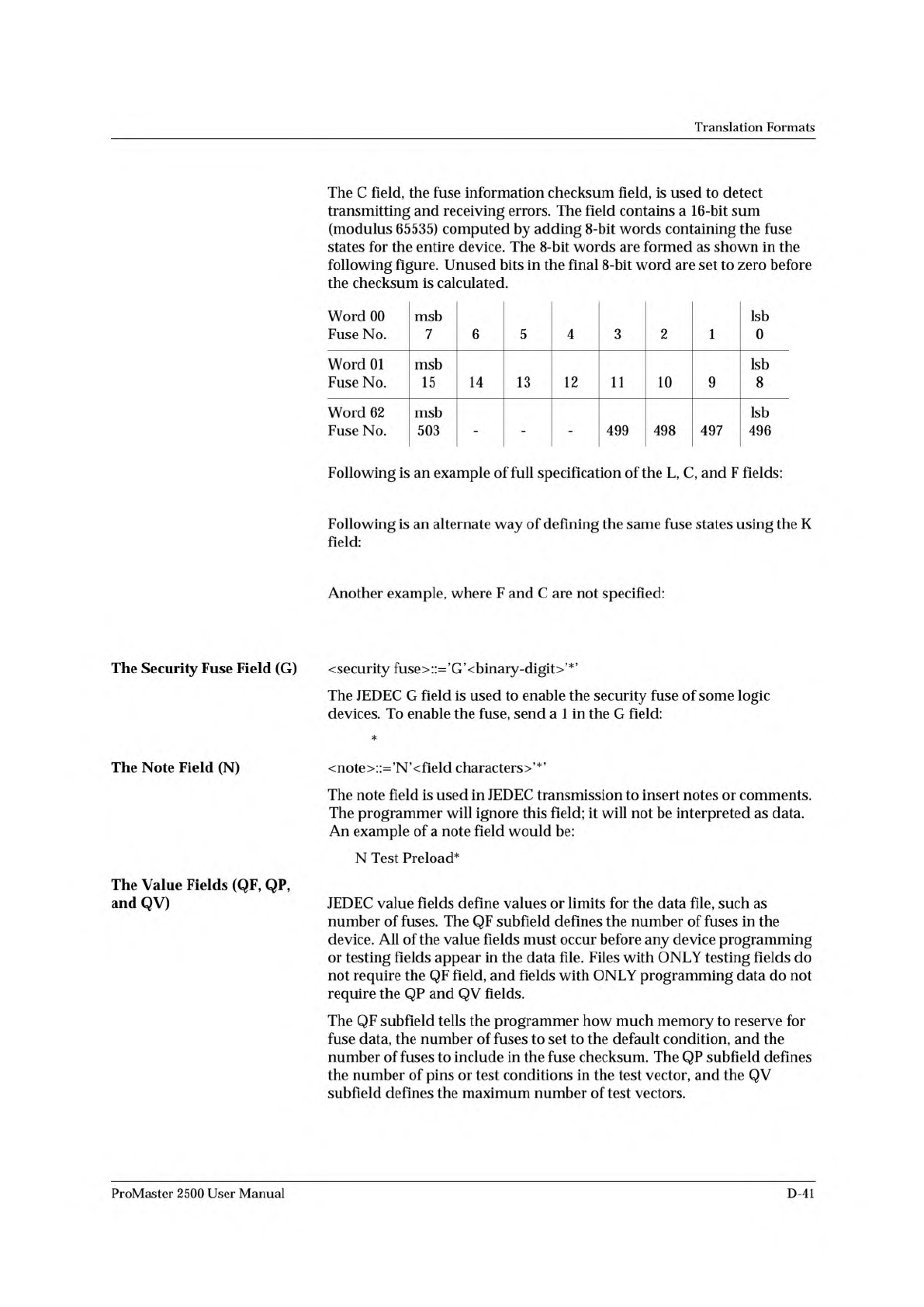
F0*L0 01010101* L0008 01010111* L1000 0101*C019E*
F0*K0 55* K0008 57* K1000 5* C019E*
L0200 01101010101010101011
010111010110100010010010010*
G1
Translation
Formats
The
C
field,
the
fuse
information
checksum
field,
is
used
to
detect
transmitting
and
receiving
errors.
The
field
contains
a
16-bit
sum
(modulus
65535)
computed
by
adding
8-bit
words
containing
the
fuse
states
for
the
entire
device.
The
8-bit
words
are
formed
as
shown
in
the
following
figure.
Unused
bits
in
the
final
8-bit
word
are
set
to
zero
before
the
checksum
is
calculated.
Word
00
Fuse
No.
msb
7
6
5
4
3
2
1
Isb
0
Word
01
Fuse
No.
msb
15
14
13
12
11
10
9
Isb
8
Word
62
Fuse
No.
msb
503
- - -
499
498
497
Isb
496
Following
is
an
example
of
full
specification
of
the
L,
C,
and
F
fields:
Following
is
an
alternate
way
of
defining
the
same
fuse
states
using
the
K
field:
Another
example,
where
F
and
C
are
not
specified:
The
Security
Fuse
Field
(G)
〈
security
fuse
>
'
G
'
v
binary-digit
>
'
*
'
The
JEDEC
G
field
is
used
to
enable
the
security
fuse
of
some
logic
devices.
To
enable
the
fuse,
send
a
1
in
the
G
field:
*
The
Note
Field
(N)
<note>::=,N,<field
characters〉'*'
The
note
field
is
used
in
JEDEC
transmission
to
insert
notes
or
comments.
The
programmer
will
ignore
this
field;
it
will
not
be
interpreted
as
data.
An
example
of
a
note
field
would
be:
N
Test
Preload*
The
Value
Fields
(QF,
QP,
and
QV)
JEDEC
value
fields
define
values
or
limits
for
the
data
file,
such
as
number
of
fuses.
The
QF
subfield
defines
the
number
of
fuses
in
the
device.
All
of
the
value
fields
must
occur
before
any
device
programming
or
testing
fields
appear
in
the
data
file.
Files
with
ONLY
testing
fields
do
not
require
the
QF
field,
and
fields
with
ONLY
programming
data
do
not
require
the
QP
and
QV
fields.
The
QF
subfield
tells
the
programmer
how
much
memory
to
reserve
for
fuse
data,
the
number
of
fuses
to
set
to
the
default
condition,
and
the
number
of
fuses
to
include
in
the
fuse
checksum.
The
QP
subfield
defines
the
number
of
pins
or
test
conditions
in
the
test
vector,
and
the
QV
subfield
defines
the
maximum
number
of
test
vectors.
ProMaster
2500
User
Manual
D-41
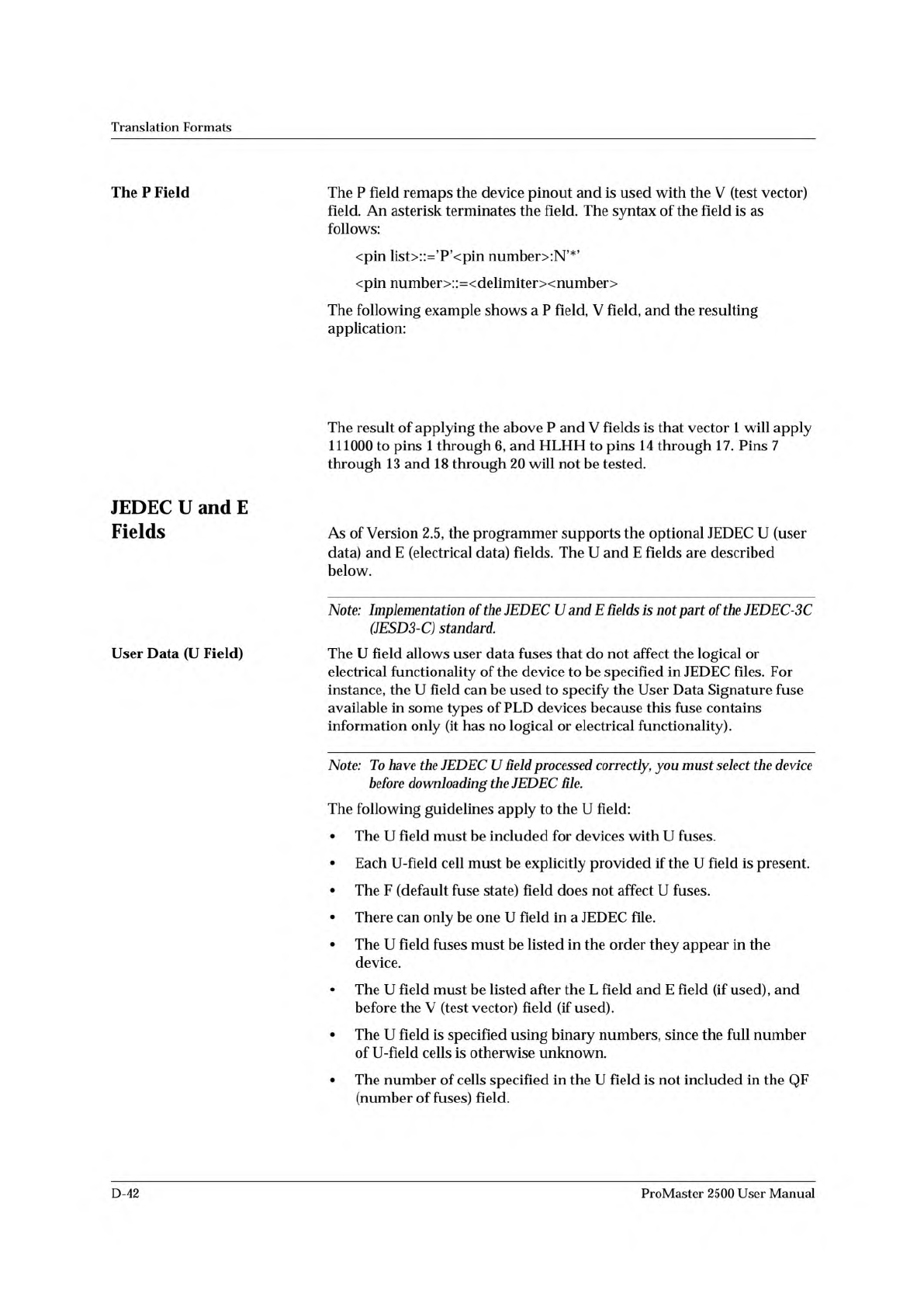
P 1 2 3 4 5 6 14 15 16 17 7 8 9 10 11 12 13 18 19 20 *
V0001 111000HLHHNNNNNNNNNN*
V0002 100000HHHLNNNNNNNNNN*
Translation
Formats
The
P
Field
The
P
field
remaps
the
device
pinout
and
is
used
with
the
V
(test
vector)
field.
An
asterisk
terminates
the
field.
The
syntax
of
the
field
is
as
follows:
<pin
Hst>::='P'vpin
number>:N^*^
<pin
number>::=<delimiterxnumber>
The
following
example
shows
a
P
field,
V
field,
and
the
resulting
application:
The
result
of
applying
the
above
P
and
V
fields
is
that
vector
1
will
apply
111000
to
pins
1
through
6,
and
HLHH
to
pins
14
through
17.
Pins
7
through
13
and
18
through
20
will
not
be
tested.
JEDEC
U
and
E
Fields
As
of
Version
2.5,
the
programmer
supports
the
optional
JEDEC
U
(user
data)
and
E
(electrical
data)
fields.
The
U
and
E
fields
are
described
below.
Note:
Implementation
of
the
JEDEC
U
and
E
fields
is
not
part
of
the
JEDEC-
3c
(JESD3-C)
standard.
User
Data
(U
Field)
The
U
field
allows
user
data
fuses
that
do
not
affect
the
logical
or
electrical
functionality
of
the
device
to
be
specified
in
JEDEC
files.
For
instance,
the
U
field
can
be
used
to
specify
the
User
Data
Signature
fuse
available
in
some
types
of
PLD
devices
because
this
fuse
contains
information
only
(it
has
no
logical
or
electrical
functionality).
Note:
To
have
the
JEDEC
U
field
processed
correctly,
you
must
select
the
device
before
downloading
the
JEDEC
6/e.
The
following
guidelines
apply
to
the
U
field:
•
The
U
field
must
be
included
for
devices
with
U
fuses.
•
Each
U-field
cell
must
be
explicitly
provided
if
the
U
field
is
present.
•
The
F
(default
fuse
state)
field
does
not
affect
U
fuses.
•
There
can
only
be
one
U
field
in
a
JEDEC
file.
•
The
U
field
fuses
must
be
listed
in
the
order
they
appear
in
the
device.
•
The
U
field
must
be
listed
after
the
L
field
and
E
field
(if
used),
and
before
the
V
(test
vector)
field
(if
used).
•
The
U
field
is
specified
using
binary
numbers,
since
the
full
number
of
U-field
cells
is
otherwise
unknown.
•
The
number
of
cells
specified
in
the
U
field
is
not
included
in
the
QF
(number
of
fuses)
field.
D-42
ProMaster
2500
User
Manual