2500_Users_Manual-.pdf - 第376页
<STX> Acme Logic Design Jane Engineer Feb. 29 1983 Widget Decode 756-AB-3456 Rev C Device Mullard 12AX7* L0000 1111111011 1111111111 1111000000 0000000000 0000000000 0000000000 0000000000 0000000000 0000000000 0000…

V0001C01010101NHLLLHHLHLN*
V0002C01011111NHLLHLLLHLN*
V0003C10010111NZZZZZZZZZN*
V0004C01010100NFLHHLFFLLN*
Translation
Formats
The
following
example
uses
the
V
field
to
specify
functional
test
information
for
a
device:
ProMaster
2500
User
Manual
D-45
<STX>
Acme Logic Design Jane Engineer Feb. 29 1983
Widget Decode 756-AB-3456 Rev C Device Mullard 12AX7*
L0000 1111111011 1111111111 1111000000 0000000000
0000000000 0000000000 0000000000 0000000000
0000000000 0000000101 1111111111 1111111111
0000000000 0000000000 0000111101 1111111111
1111111111 1111110111 1111111111 1111111111*
L0200 1110101111 1111110000 0000000000 0000000000
1111111111 1111011011 1111111111 1111111110
0111111111 1111111111 1111111110 1111111111
1111111111 1111101111 1111111111 1111101111
0000000000 0000000000 0000*
<EXT>0000
0091-2
Translation
Formats
JEDEC
Kernel
Mode,
Code
92
<kernel>::=<STXxdesign
specxmin.
fuse
informationxETXxxmit
checksum〉
<design
spec>::={<field
character〉}'*'
<min.
fuse
information>::=<fuse
list>{<fuse
list〉}
You
may
use
the
JEDEC
kernel
format
if
you
wish
to
send
only
the
minimum
data
necessary
to
program
the
logic
device;
for
example,
if
you
do
not
want
to
send
any
test
vectors.
If
you
specify
format
code
92,
the
programmer
will
ignore
everything
except
the
design
specification
field
and
the
fuse
information
field.
The
following
fields
will
be
ignored
if
format
92
is
specified:
C,
F,
G,
Q,
V,
and
X.
Also,
the
security
fuse
will
be
set
to
zero
and
the
transmission
checksum
will
be
ignored.
Figure
D-19
shows
an
example
of
a
kernel
JEDEC
transmission.
Figure
D-
19
An
Example
of
JEDEC
Kernel
Mode
Format
D-46
ProMaster
2500
User
Manual
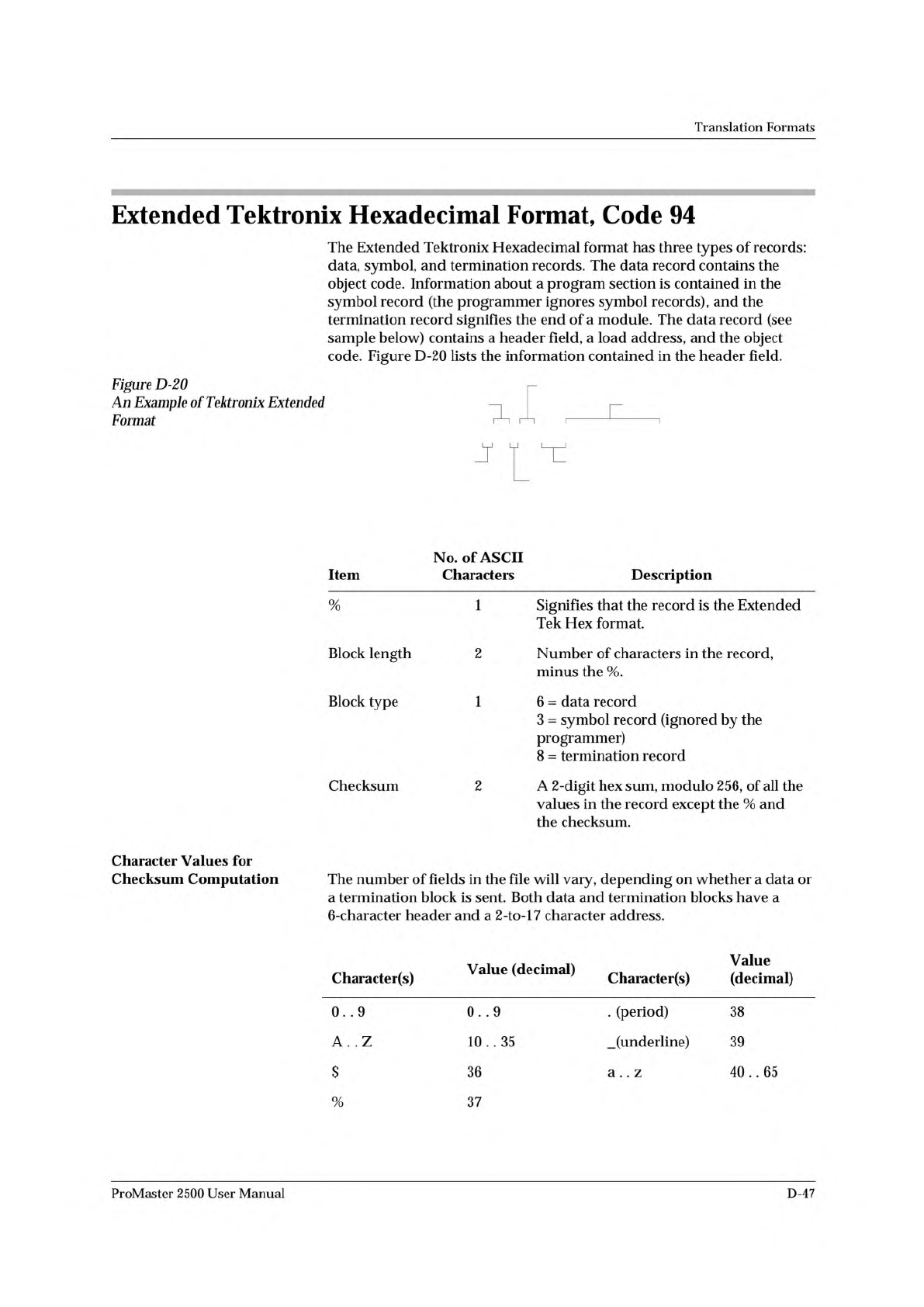
%1561C310020202020202
SUMCHECK: 1CH = 1+5+6+3+1+0+0+0+2+0+2+...
OBJECT CODE: 6 BYTES
LOAD ADDRESS: 100 H
BLOCK TYPE: 6 (DATA)
HEADER CHARACTER
BLOCK LENGTH: 15H = 21
0092-2
Translation
Formats
J
Figure
D-20
An
Example
of
Tektronix
Extended
Format
Extended
Tektronix
Hexadecimal
Format,
Code
94
The
Extended
Tektronix
Hexadecimal
format
has
three
types
of
records:
data,
symbol,
and
termination
records.
The
data
record
contains
the
object
code.
Information
about
a
program
section
is
contained
in
the
symbol
record
(the
programmer
ignores
symbol
records),
and
the
termination
record
signifies
the
end
of
a
module.
The
data
record
(see
sample
below)
contains
a
header
field,
a
load
address,
and
the
object
code.
Figure
D-20
lists
the
information
contained
in
the
header
field.
Item
No.
of
ASCII
Characters
Description
%
1
Signifies
that
the
record
is
the
Extended
Tek
Hex
format.
Block
length
2
Number
of
characters
in
the
record,
minus
the
%.
Block
type
1
6
=
data
record
3
=
symbol
record
(ignored
by
the
programmer)
8
=
termination
record
Checksum
2
A
2-digit
hex
sum,
modulo
256,
of
all
the
values
in
the
record
except
the
%
and
the
checksum.
Character
Values
for
Checksum
Computation
The
number
of
fields
in
the
file
will
vary,
depending
on
whether
a
data
or
a
termination
block
is
sent.
Both
data
and
termination
blocks
have
a
6-character
header
and
a
2-to-17
character
address.
Character(s)
Value
(decimal)
Character(s)
Value
(decimal)
0..9 0..9
.
(period)
38
A..Z
10
..
35
—(underline)
39
$
36
a
. .
z
40
. .
65
%
37
ProMaster
2500
User
Manual
D-47