2500_Users_Manual-.pdf - 第406页
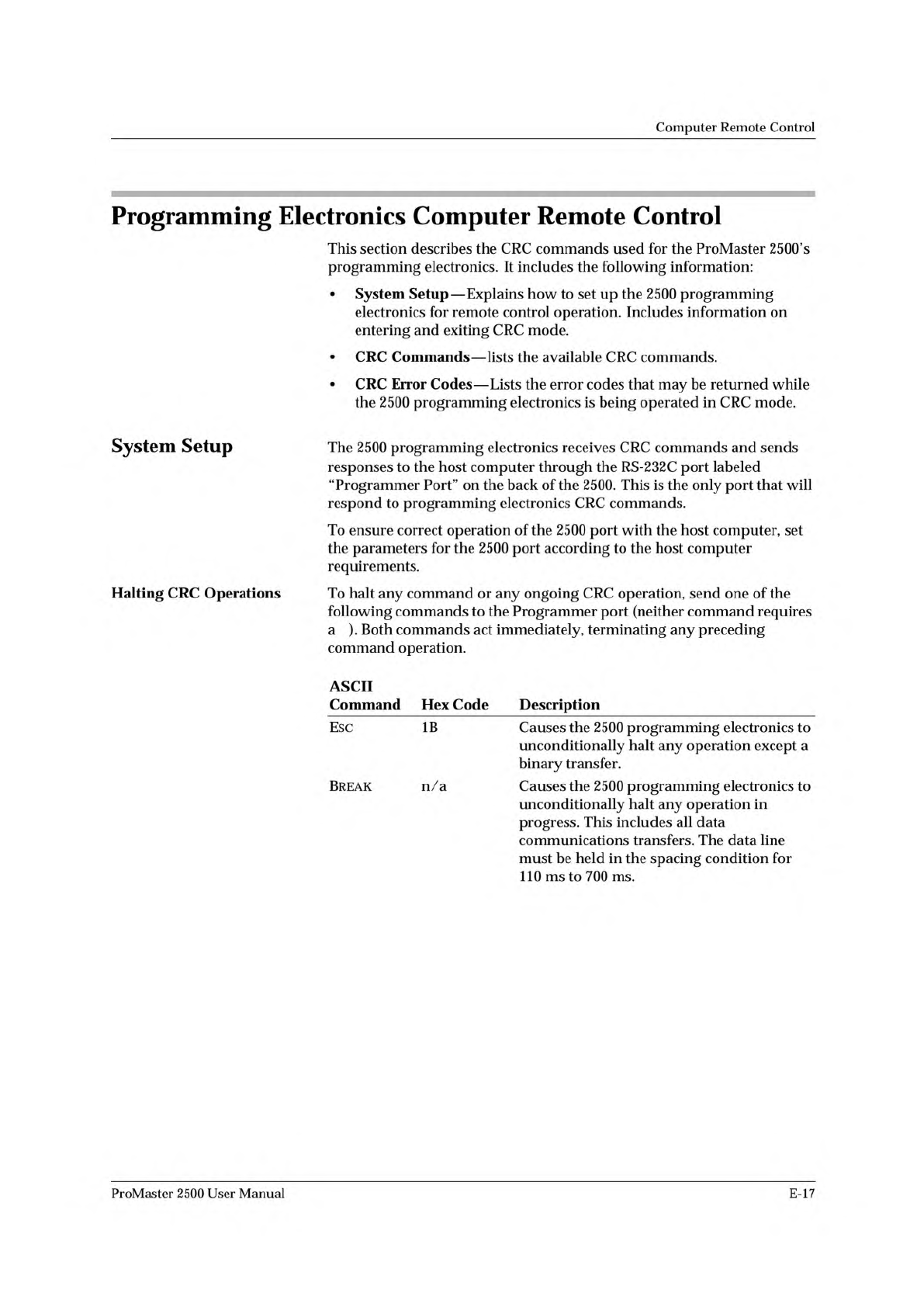
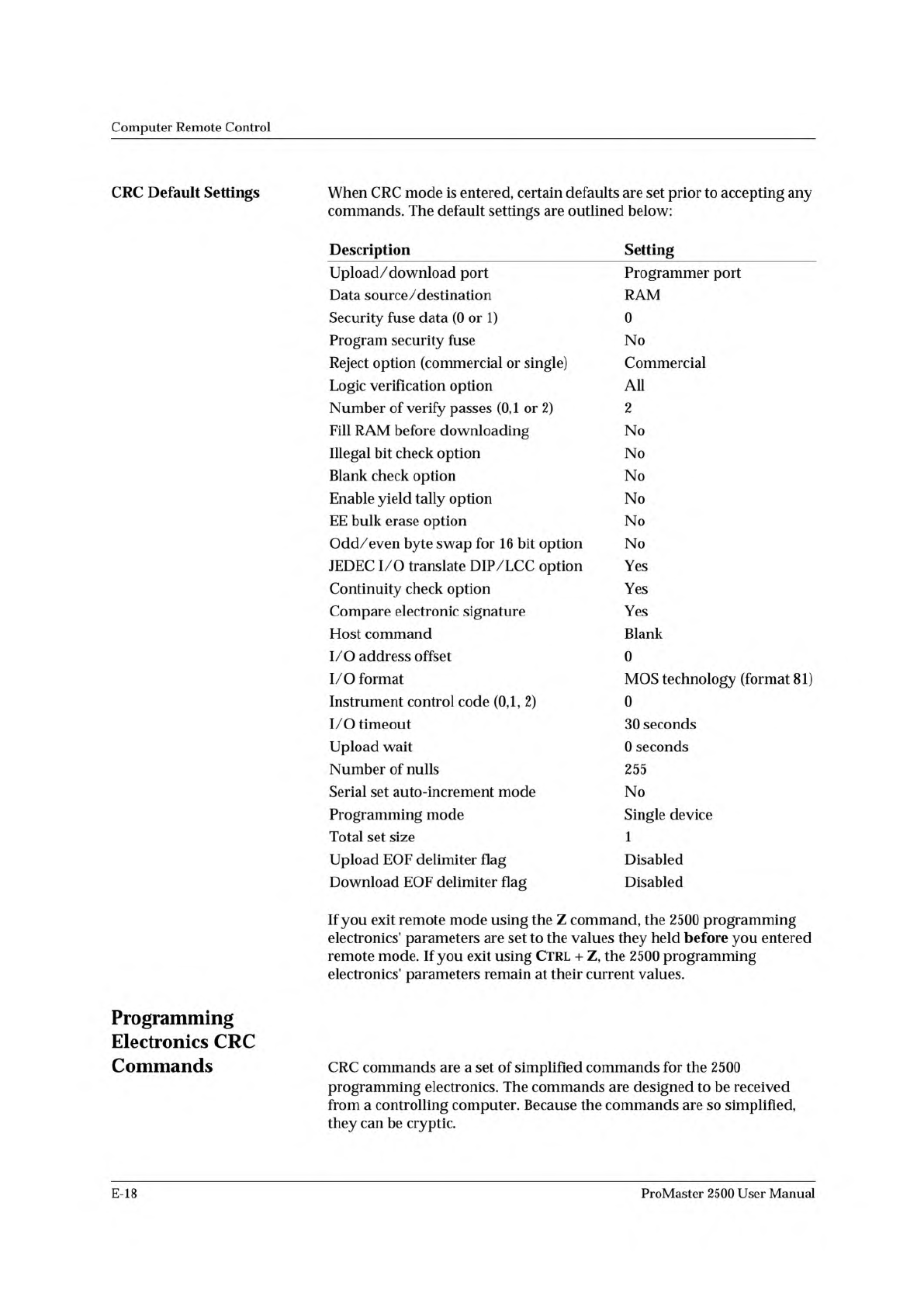
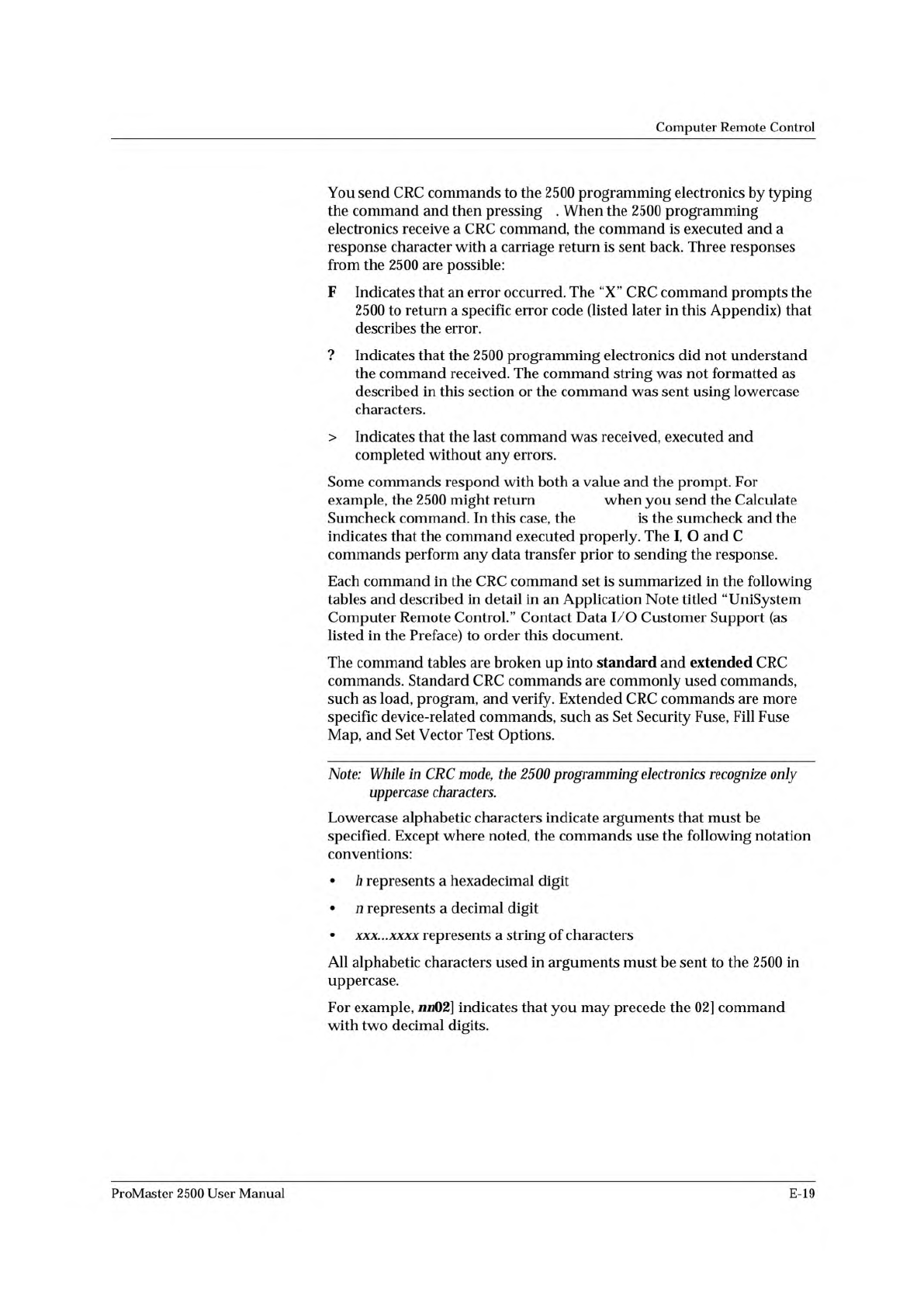
Computer Remote Control CRC Default Settings When CRC mode is entered, certain defaults are set prior to accepting any commands. The default settings are outlined below: Description Setting Upload/download port Programme…
↵
Computer
Remote
Control
Programming
Electronics
Computer
Remote
Control
This
section
describes
the
CRC
commands
used
for
the
ProMaster
2500's
programming
electronics.
It
includes
the
following
information:
•
System
Setup
—
Explains
how
to
set
up
the
2500
programming
electronics
for
remote
control
operation.
Includes
information
on
entering
and
exiting
CRC
mode.
•
CRC
Commands
—
lists
the
available
CRC
commands.
•
CRC
Error
Codes
—
Lists
the
error
codes
that
may
be
returned
while
the
2500
programming
electronics
is
being
operated
in
CRC
mode.
System
Setup
The
2500
programming
electronics
receives
CRC
commands
and
sends
responses
to
the
host
computer
through
the
RS-
232c
port
labeled
“Programmer
Port”
on
the
back
of
the
2500.
This
is
the
only
port
that
will
respond
to
programming
electronics
CRC
commands.
To
ensure
correct
operation
of
the
2500
port
with
the
host
computer,
set
the
parameters
for
the
2500
port
according
to
the
host
computer
requirements.
Halting
CRC
Operations
To
halt
any
command
or
any
ongoing
CRC
operation,
send
one
of
the
following
commands
to
the
Programmer
port
(neither
command
requires
a
).
Both
commands
act
immediately,
terminating
any
preceding
command
operation.
ASCII
Command
Hex
Code
Description
Esc
IB
Causes
the
2500
programming
electronics
to
unconditionally
halt
any
operation
except
a
binary
transfer.
Break
n/a
Causes
the
2500
programming
electronics
to
unconditionally
halt
any
operation
in
progress.
This
includes
all
data
communications
transfers.
The
data
line
must
be
held
in
the
spacing
condition
for
110
ms
to
700
ms.
ProMaster
2500
User
Manual
E-17
Computer
Remote
Control
CRC
Default
Settings
When
CRC
mode
is
entered,
certain
defaults
are
set
prior
to
accepting
any
commands.
The
default
settings
are
outlined
below:
Description
Setting
Upload/download
port
Programmer
port
Data
source/destination
RAM
Security
fuse
data
(0
or
1)
0
Program
security
fuse
No
Reject
option
(commercial
or
single)
Commercial
Logic
verification
option
All
Number
of
verify
passes
(0,1
or
2)
2
Fill
RAM
before
downloading
No
Illegal
bit
check
option
No
Blank
check
option
No
Enable
yield
tally
option
No
EE
bulk
erase
option
No
Odd/even
byte
swap
for
16
bit
option
No
JEDEC
I/O
translate
DIP/LCC
option
Yes
Continuity
check
option
Yes
Compare
electronic
signature
Yes
Host
command
Blank
I/O
address
offset
0
I/O
format
MOS
technology
(format
81)
Instrument
control
code
(0,1,
2)
0
I/O
timeout
30
seconds
Upload
wait
0
seconds
Number
of
nulls
255
Serial
set
auto-increment
mode
No
Programming
mode
Single
device
Total
set
size
1
Upload
EOF
delimiter
flag
Disabled
Download
EOF
delimiter
flag
Disabled
If
you
exit
remote
mode
using
the
Z
command,
the
2500
programming
electronics'
parameters
are
set
to
the
values
they
held
before
you
entered
remote
mode.
If
you
exit
using
Ctrl
+
Z,
the
2500
programming
electronics'
parameters
remain
at
their
current
values.
Programming
Electronics
CRC
Commands
CRC
commands
are
a
set
of
simplified
commands
for
the
2500
programming
electronics.
The
commands
are
designed
to
be
received
from
a
controlling
computer.
Because
the
commands
are
so
simplified,
they
can
be
cryptic.
E-18
ProMaster
2500
User
Manual
↵
00284295>
00284295
>
Computer
Remote
Control
You
send
CRC
commands
to
the
2500
programming
electronics
by
typing
the
command
and
then
pressing
.
When
the
2500
programming
electronics
receive
a
CRC
command,
the
command
is
executed
and
a
response
character
with
a
carriage
return
is
sent
back.
Three
responses
from
the
2500
are
possible:
F
Indicates
that
an
error
occurred.
The
“X”
CRC
command
prompts
the
2500
to
return
a
specific
error
code
(listed
later
in
this
Appendix)
that
describes
the
error.
?
Indicates
that
the
2500
programming
electronics
did
not
understand
the
command
received.
The
command
string
was
not
formatted
as
described
in
this
section
or
the
command
was
sent
using
lowercase
characters.
>
Indicates
that
the
last
command
was
received,
executed
and
completed
without
any
errors.
Some
commands
respond
with
both
a
value
and
the
prompt.
For
example,
the
2500
might
return
when
you
send
the
Calculate
Sumcheck
command.
In
this
case,
the
is
the
sumcheck
and
the
indicates
that
the
command
executed
properly.
The
I,
O
and
C
commands
perform
any
data
transfer
prior
to
sending
the
response.
Each
command
in
the
CRC
command
set
is
summarized
in
the
following
tables
and
described
in
detail
in
an
Application
Note
titled
“UniSystem
Computer
Remote
Control.”
Contact
Data
I/O
Customer
Support
(as
listed
in
the
Preface)
to
order
this
document.
The
command
tables
are
broken
up
into
standard
and
extended
CRC
commands.
Standard
CRC
commands
are
commonly
used
commands,
such
as
load,
program,
and
verify.
Extended
CRC
commands
are
more
specific
device-related
commands,
such
as
Set
Security
Fuse,
Fill
Fuse
Map,
and
Set
Vector
Test
Options.
Note:
While
in
CRC
mode,
the
2500
programming
electronics
recognize
only
uppercase
characters.
Lowercase
alphabetic
characters
indicate
arguments
that
must
be
specified.
Except
where
noted,
the
commands
use
the
following
notation
conventions:
•
h
represents
a
hexadecimal
digit
•
n
represents
a
decimal
digit
•
xxx
…
xxxx
represents
a
string
of
characters
All
alphabetic
characters
used
in
arguments
must
be
sent
to
the
2500
in
uppercase.
For
example,
nn02]
indicates
that
you
may
precede
the
02]
command
with
two
decimal
digits.
ProMaster
2500
User
Manual
E-19