2500_Users_Manual-.pdf - 第97页
Tasks and Kits Serializing Devices You may want to program a serial number into the devices and/or print the number on the label. TaskLink's Serialization... option offers an opportunity to do this in software. A sa…
Tasks
and
Kits
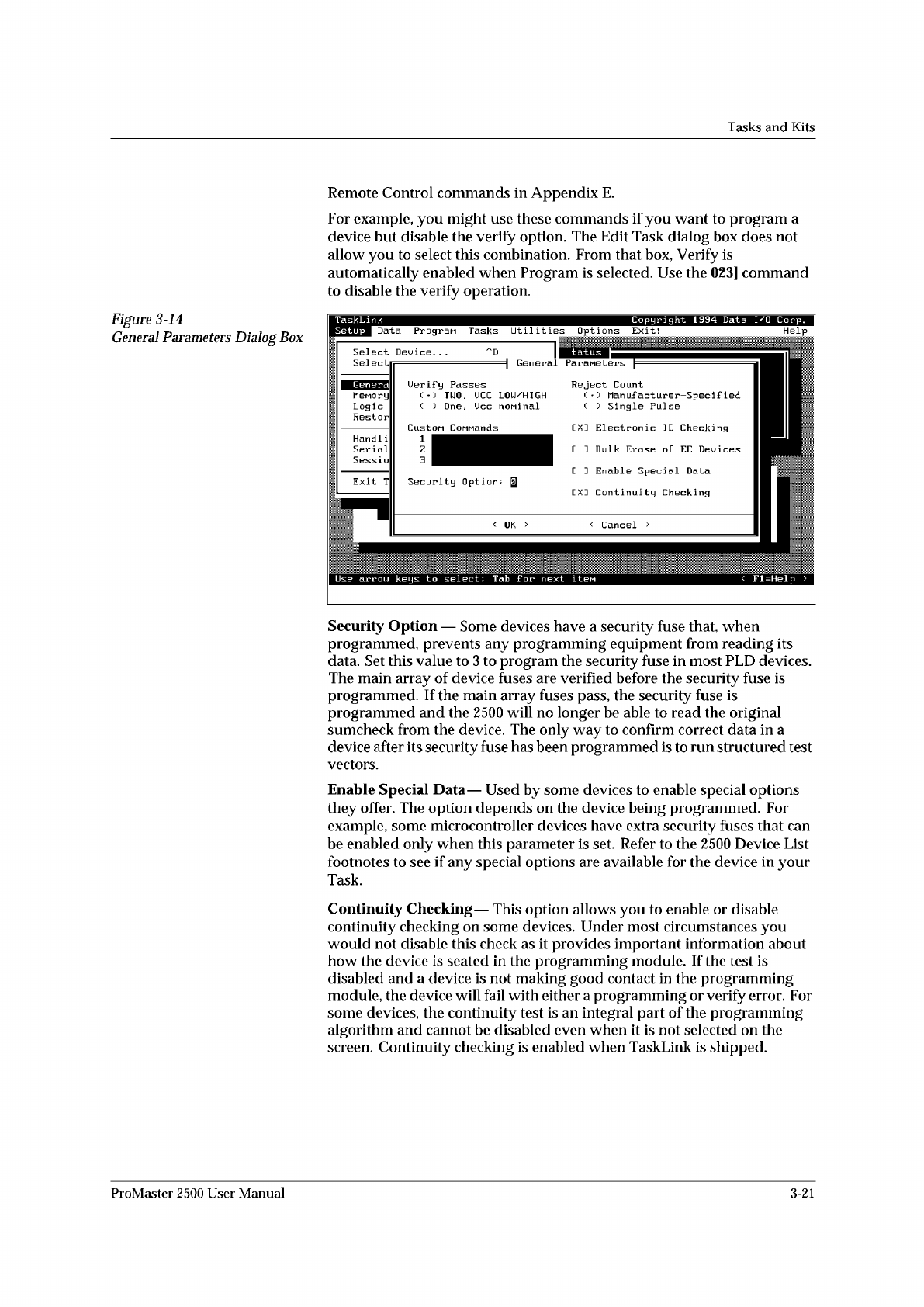
Figure
3-14
General
Parameters
Dialog
Box
Remote
Control
commands
in
Appendix
E.
For
example,
you
might
use
these
commands
if
you
want
to
program
a
device
but
disable
the
verify
option.
The
Edit
Task
dialog
box
does
not
allow
you
to
select
this
combination.
From
that
box,
Verify
is
automatically
enabled
when
Program
is
selected.
Use
the
023]
command
to
disable
the
verify
operation.
Security
Option
—
Some
devices
have
a
security
fuse
that,
when
programmed,
prevents
any
programming
equipment
from
reading
its
data.
Set
this
value
to
3
to
program
the
security
fuse
in
most
PLD
devices.
The
main
array
of
device
fuses
are
verified
before
the
security
fuse
is
programmed.
If
the
main
array
fuses
pass,
the
security
fuse
is
programmed
and
the
2500
will
no
longer
be
able
to
read
the
original
sumcheck
from
the
device.
The
only
way
to
confirm
correct
data
in
a
device
after
its
security
fuse
has
been
programmed
is
to
run
structured
test
vectors.
Enable
Special
Data
—
Used
by
some
devices
to
enable
special
options
they
offer.
The
option
depends
on
the
device
being
programmed.
For
example,
some
microcontroller
devices
have
extra
security
fuses
that
can
be
enabled
only
when
this
parameter
is
set.
Refer
to
the
2500
Device
List
footnotes
to
see
if
any
special
options
are
available
for
the
device
in
your
Task.
Continuity
Checking
—
This
option
allows
you
to
enable
or
disable
continuity
checking
on
some
devices.
Under
most
circumstances
you
would
not
disable
this
check
as
it
provides
important
information
about
how
the
device
is
seated
in
the
programming
module.
If
the
test
is
disabled
and
a
device
is
not
making
good
contact
in
the
programming
module,
the
device
will
fail
with
either
a
programming
or
verify
error.
For
some
devices,
the
continuity
test
is
an
integral
part
of
the
programming
algorithm
and
cannot
be
disabled
even
when
it
is
not
selected
on
the
screen.
Continuity
checking
is
enabled
when
TaskLink
is
shipped.
ProMaster
2500
User
Manual
3-21
Tasks
and
Kits
Serializing
Devices
You
may
want
to
program
a
serial
number
into
the
devices
and/or
print
the
number
on
the
label.
TaskLink's
Serialization...
option
offers
an
opportunity
to
do
this
in
software.
A
sample
serialization
program
called
serializ.exe
is
provided
with
TaskLink.
For
detailed
information
on
the
serialization
program,
refer
to
the
External
Serialization
Program
section
on
page
3-25
and
to
the
online
help
topic
“Writing
a
Serialization
Program”
under
TaskLink's
General
Help
Index.
To
implement
serialization
features
not
provided
by
serializ.exe,
you
will
need
to
write
a
short
external
serialization
program
(ESP)
to
generate
your
serial
number
and
save
it
in
an
ASCII
file
for
TaskLink
to
use.
To
print
a
serial
number
on
a
label,
enter
a
percent
sign
(%)
in
the
label
text
field
(ProMaster
2500
dialog
box)
for
each
character
to
be
printed
on
the
label
(refer
to
the
command
line
length
parameter
Note:
You
must
have
UI
5
version
1.06
or
greater
to
print
a
serial
number.
Figure
3-16
shows
the
process
steps
in
creating
a
file
to
be
used
for
serializing
devices.
The
Program
line
in
TaskLink's
Serialization
Parameters
screen
(see
Figure
3-15)
allows
you
to
enter
the
executable
name
for
your
external
program
(ESP).
You
can
also
include
the
path
and
command
line
arguments
that
define
the
characteristics
of
the
serial
number
to
pass
to
the
ESP.
The
ESP
is
called
from
the
command
line
using
a
command
similar
to
the
following:
drive:
\
path
\file_name
where
drive
is
the
drive
where
the
ESP
resides,
path
is
a
valid
DOS
path
to
the
subdirectory
where
the
ESP
is
written,
and
flle_name
is
the
ESP
executable
file
name
and
extension.
3-22
ProMaster
2500
User
Manual
↵
Tasks
and
Kits
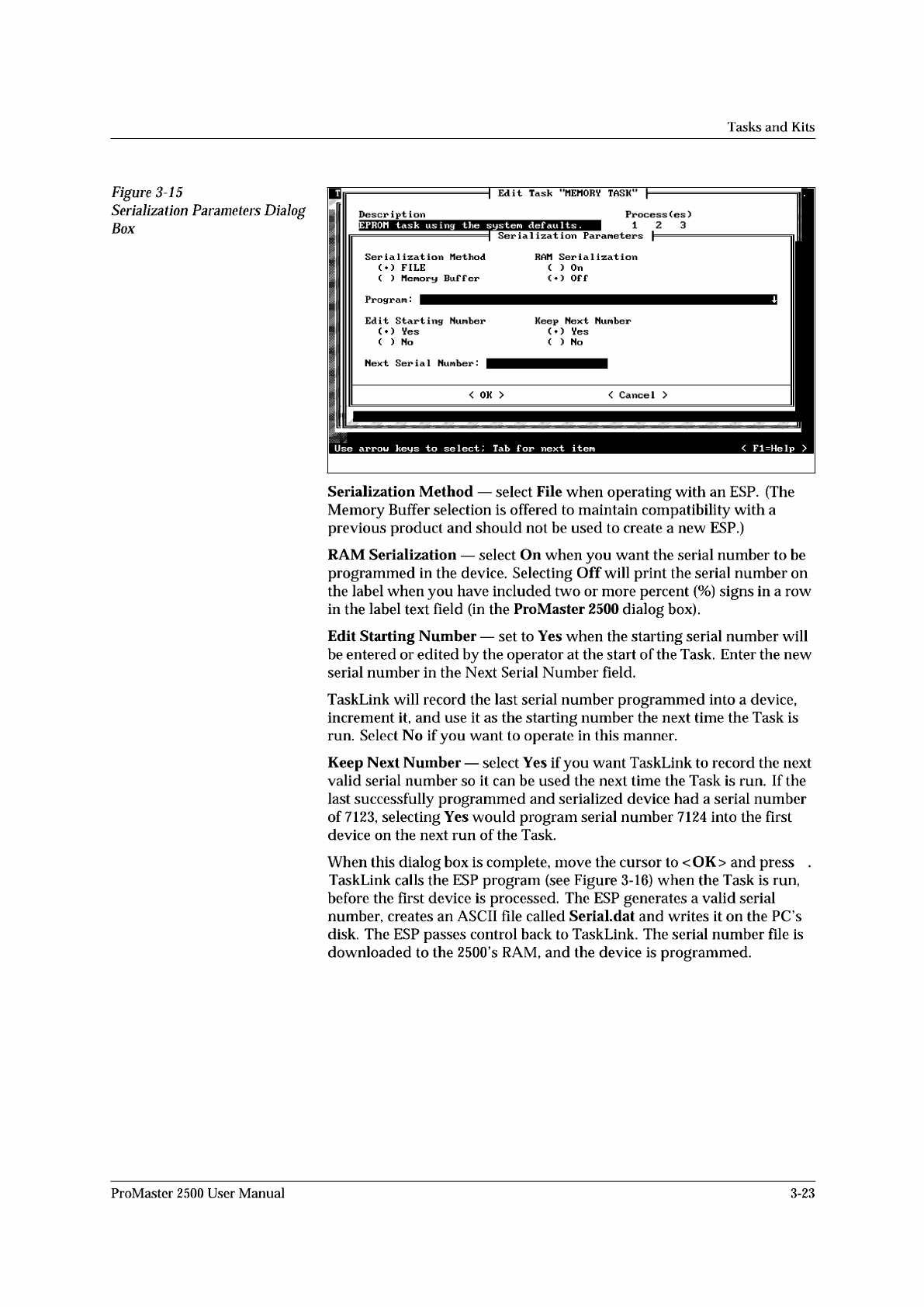
Figure
3-15
Serialization
Parameters
Dialog
Box
Serialization
Method
—
select
File
when
operating
with
an
ESP.
(The
Memory
Buffer
selection
is
offered
to
maintain
compatibility
with
a
previous
product
and
should
not
be
used
to
create
a
new
ESP.)
RAM
Serialization
—
select
On
when
you
want
the
serial
number
to
be
programmed
in
the
device.
Selecting
Off
will
print
the
serial
number
on
the
label
when
you
have
included
two
or
more
percent
(%)
signs
in
a
row
in
the
label
text
field
(in
the
ProMaster
2500
dialog
box).
Edit
Starting
Number
—
set
to
Yes
when
the
starting
serial
number
will
be
entered
or
edited
by
the
operator
at
the
start
of
the
Task.
Enter
the
new
serial
number
in
the
Next
Serial
Number
field.
TaskLink
will
record
the
last
serial
number
programmed
into
a
device,
increment
it,
and
use
it
as
the
starting
number
the
next
time
the
Task
is
run.
Select
No
if
you
want
to
operate
in
this
manner.
Keep
Next
Number
—
select
Yes
if
you
want
TaskLink
to
record
the
next
valid
serial
number
so
it
can
be
used
the
next
time
the
Task
is
run.
If
the
last
successfully
programmed
and
serialized
device
had
a
serial
number
of
7123,
selecting
Yes
would
program
serial
number
7124
into
the
first
device
on
the
next
run
of
the
Task.
When
this
dialog
box
is
complete,
move
the
cursor
to
<
OK>
and
press
.
TaskLink
calls
the
ESP
program
(see
Figure
3-16)
when
the
Task
is
run,
before
the
first
device
is
processed.
The
ESP
generates
a
valid
serial
number,
creates
an
ASCII
file
called
SeriaLdat
and
writes
it
on
the
PC
s
disk.
The
ESP
passes
control
back
to
TaskLink.
The
serial
number
file
is
downloaded
to
the
2500's
RAM,
and
the
device
is
programmed.
ProMaster
2500
User
Manual
3-23