2500_Users_Manual-.pdf - 第99页
TASKLINK PC HARD DRIVE "PROCESS DEVICES" Task runs EXTERNAL SERIALIZATION PROGRAM (ESP) Written by user. Generates a serial number. Creates an ASCII file called "serial.dat." "serializ.exe" …
↵
Tasks
and
Kits
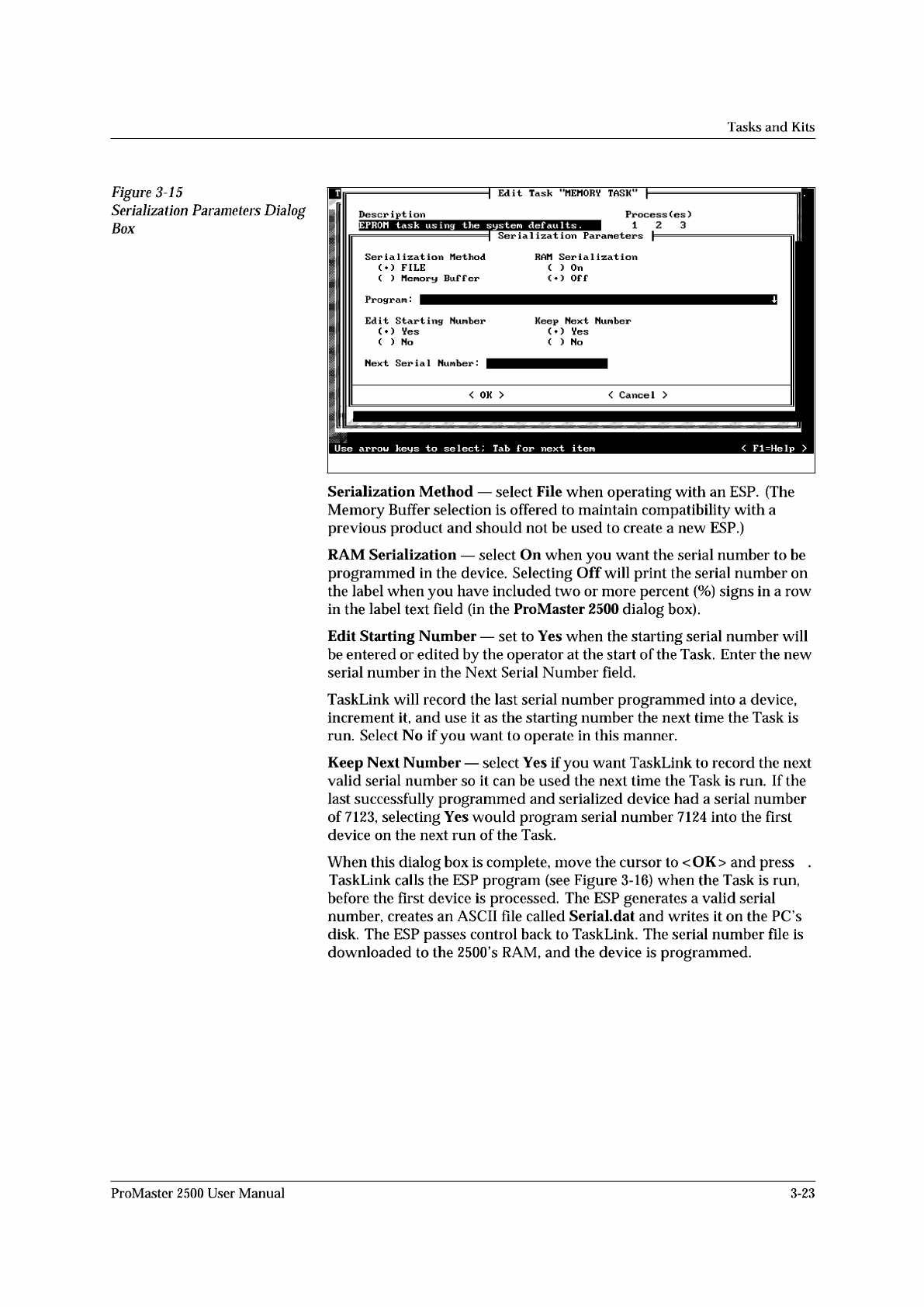
Figure
3-15
Serialization
Parameters
Dialog
Box
Serialization
Method
—
select
File
when
operating
with
an
ESP.
(The
Memory
Buffer
selection
is
offered
to
maintain
compatibility
with
a
previous
product
and
should
not
be
used
to
create
a
new
ESP.)
RAM
Serialization
—
select
On
when
you
want
the
serial
number
to
be
programmed
in
the
device.
Selecting
Off
will
print
the
serial
number
on
the
label
when
you
have
included
two
or
more
percent
(%)
signs
in
a
row
in
the
label
text
field
(in
the
ProMaster
2500
dialog
box).
Edit
Starting
Number
—
set
to
Yes
when
the
starting
serial
number
will
be
entered
or
edited
by
the
operator
at
the
start
of
the
Task.
Enter
the
new
serial
number
in
the
Next
Serial
Number
field.
TaskLink
will
record
the
last
serial
number
programmed
into
a
device,
increment
it,
and
use
it
as
the
starting
number
the
next
time
the
Task
is
run.
Select
No
if
you
want
to
operate
in
this
manner.
Keep
Next
Number
—
select
Yes
if
you
want
TaskLink
to
record
the
next
valid
serial
number
so
it
can
be
used
the
next
time
the
Task
is
run.
If
the
last
successfully
programmed
and
serialized
device
had
a
serial
number
of
7123,
selecting
Yes
would
program
serial
number
7124
into
the
first
device
on
the
next
run
of
the
Task.
When
this
dialog
box
is
complete,
move
the
cursor
to
<
OK>
and
press
.
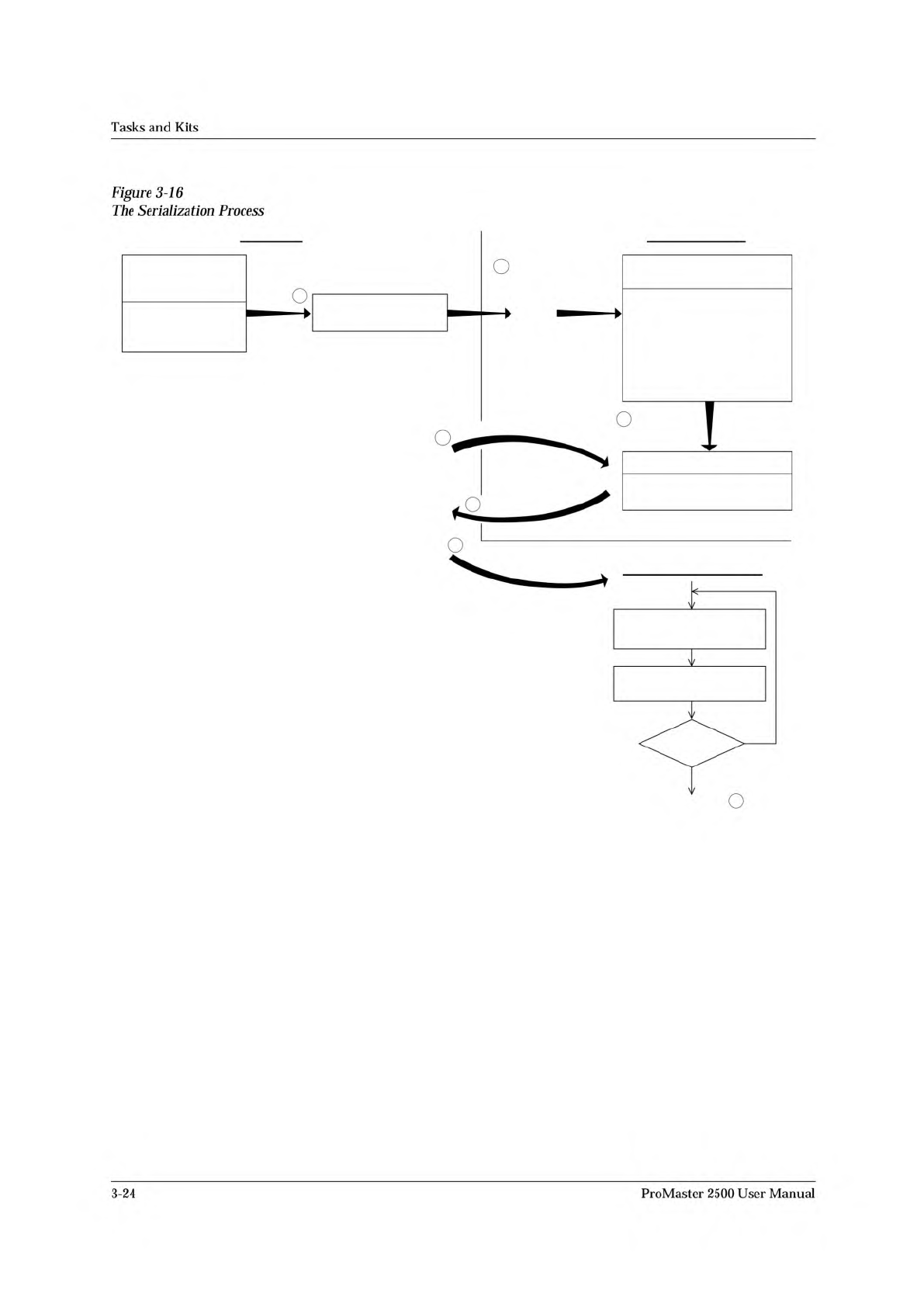
TaskLink
calls
the
ESP
program
(see
Figure
3-16)
when
the
Task
is
run,
before
the
first
device
is
processed.
The
ESP
generates
a
valid
serial
number,
creates
an
ASCII
file
called
SeriaLdat
and
writes
it
on
the
PC
s
disk.
The
ESP
passes
control
back
to
TaskLink.
The
serial
number
file
is
downloaded
to
the
2500's
RAM,
and
the
device
is
programmed.
ProMaster
2500
User
Manual
3-23
TASKLINK PC HARD DRIVE
"PROCESS DEVICES"
Task runs
EXTERNAL SERIALIZATION
PROGRAM (ESP)
Written by user.
Generates a serial number.
Creates an ASCII file called
"serial.dat."
"serializ.exe" is a sample of
a basic external serialization
program.
Calls "ESP" and
passes parameters
-a
-f
-i
-l
-h
-o
-s
-t
"SERIAL.DAT" (ASCII FILE)
Eight-line file containing
serial number
ESP creates "serial.dat"
T
a
s
k
L
i
n
k
l
o
o
k
s
f
o
r
"
s
e
r
i
a
l
.
d
a
t
"
R
e
a
d
s
"
s
e
r
i
a
l
.
d
a
t
"
Data file created
by "ESP" to handler
1920-2
SERIALIZATION
PARAMETERS
DIALOG BOX
Operator provides
TaskLink with "ESP"
program name.
1
2
3
4
5
Next blank device placed
in programming module
Program device
Device
pass?
Return to step .1
Yes
No
D
o
w
n
l
o
a
d
s
s
e
r
i
a
l
n
u
m
b
e
r
6
PROMASTER HANDLER
Tasks
and
Kits
Figure
3-16
The
Serialization
Process
3-24
ProMaster
2500
User
Manual
Tasks
and
Kits
Serialization
Parameters
TaskLink
supplies
a
sample
ESP
called
t4
serializ.exe
M
to
use
as
a
template
for
developing
your
program.
The
source
code
(named
<serializ.c^^)
for
this
program
is
included
with
TaskLink.
Figure
3-15
shows
the
Serialization
Parameters
dialog
box.
To
use
serializ.exe
to
place
a
serial
number
in
programmer
RAM,
set
the
parameters
as
follows:
Parameter
Setting
Serialization
Method
File
RAM
Serialization
On
Program
serializ.exe*
Edit
Starting
Number
No
Keep
Next
Number
Yes
Next
Serial
Number
starting_serial_number
*
Include
any
command
line
parameters
you
want,
as
described
in
the
next
section.
Note:
For
compatibility
with
external
serialization
programs
you
may
have
written
for
HandlerLink,
select
Memory
Buffer
for
the
Serialization
Method.
External
Serialization
Program
(ESP)
Serializ.exe
is
used
to
illustrate
passing
parameters
to
the
ESP.
This
is
a
simple
program
that
can
be
used
to
generate
a
serial
number
for
each
device
that
programs
successfully.
It
directs
the
labeler
to
print
a
label
with
that
serial
number.
Some
of
the
parameter
options
that
you
can
pass
to
the
external
software
program
on
the
Program
command
line
include:
•
Serial
number's
address
in
the
device
•
Serial
number's
format
(decimal,
hex,
binary)
•
Length
(number
of
bytes)
•
Byte
order
of
high
and
low
bytes
•
Value
used
to
increment
each
serial
number
•
Format
of
the
serial
number
printed
on
the
label
(binary,
ASCII
decimal,
or
ASCII
hexadecimal)
ProMaster
2500
User
Manual
3-25