00197790-01.pdf - 第6页
Installation Guide Ausgabe 08/2014 Edition 6 HINWEIS / NOT ICE Definition For the purposes of this manual, this note prov ides information about th e product or indicates a part of the manual that requires part icular at…
Installation Guide Ausgabe 08/2014 Edition
5
1 Introduction
When it comes to maintenance it is always good to have a bright view to all areas inside the
machine.
For that purpose, two adjustable carriers of both high performance and low power consumption
LED’s were mounted inside the machine. Located underneath the central machine cover support,
they brightly illuminate the entire working area without blinding the operator when opening the
hood.
The light power supply is connected to the emergency stop circuit. That way the light is
automatically activated e.g. by opening one of the hoods, pressing the emergency stop button,
removing the changeover tables, etc. The regular START and STOP buttons do not switch on the
light to make sure the illumination goes up only when needed, minimizing the power consumption
of the SOKO even further.
1.1 Safety Instructions
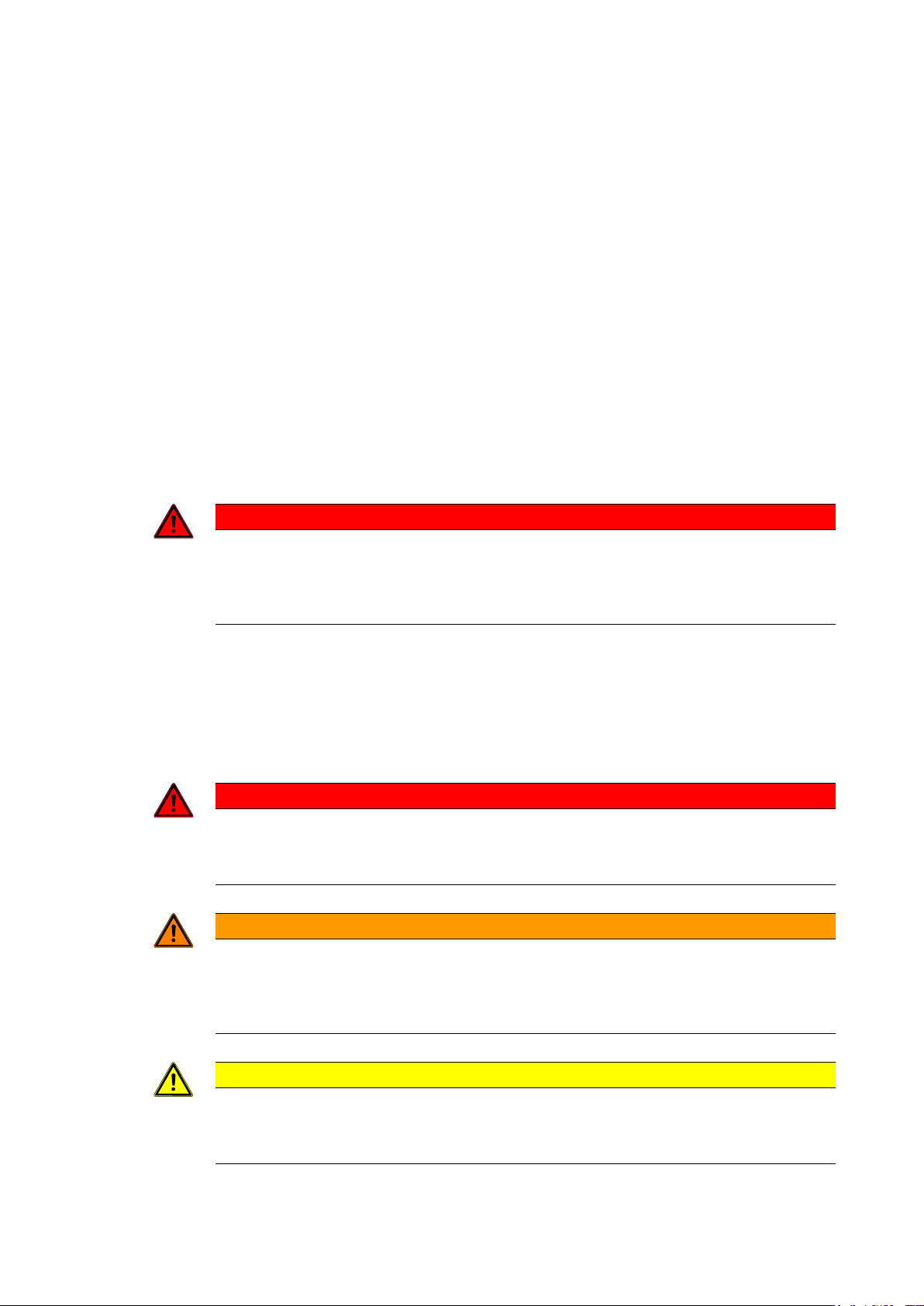
GEFAHR / DANGER
Nonobservance of these safety instructions may cause injury to personnel and damage
to the machine!
► Please observe the safety instructions in the user manual of the relevant machine for
all work!
1.1.1 Conventions for the use of safety instructions
This manual contains notes that must be observed to guarantee your personal safety and to avoid
damage to equipment. These notes are highlighted by warning triangles and are indicated as
follows according to the level of risk:
GEFAHR / DANGER
Definition
For the purposes of this manual, this indicates that fatal or severe injuries or
considerable damage to property will occur if this hazard warning is not observed.
WARNUNG / WARNING
Definition
For the purposes of this manual, this indicates that fatal or severe injuries or
considerable damage to equipment may occur if these warning instructions are not
followed.
VORSICHT / CAUTION
Definition
For the purposes of this manual, this indicates that minor injuries or damage to property
may occur if this caution is not observed.

Installation Guide Ausgabe 08/2014 Edition
6
HINWEIS / NOTICE
Definition
For the purposes of this manual, this note provides information about the product or
indicates a part of the manual that requires particular attention.
1.1.2 Safety Instructions for the Power Supply
WARNUNG / WARNING
Hazardous Voltages!
The machine is supplied with 3 x 400 V~ (or. 3 x 204 V~ / 3 x 220 V~ / 3 x 230 V~ / 3 x
380 V~/ 3 x 415 V~) ± 5 %, 50/60 Hz mains voltages.
► Observe the safety instructions in the user manual during all service work!
This means that some parts of the system carry potentially lethal voltages - even when
switched off at the main power switch.
Incorrect handling of the placement system can therefore result in fatal injuries, severe
injuries or considerable damage to equipment.
Measurements as well as service, assembly and maintenance work must always be
carried out by appropriately qualified personnel.
Always follow the applicable accident prevention and DIN regulations (particularly DIN EN
60 204, part 1) or the regulations specific to your country.
Before starting any service, assembly and maintenance work, switch the machine off at the
main switch and disconnect the machine from the main power supply.
Always secure the machine against unauthorized reactivation. If these instructions are not
followed, you may be able to touch live parts, which could result in fatal or severe injuries.
1.2 Preparatory Work
Purpose and Scope
Before performing any preventive maintenance work, conversion work or service work, a procedure
of locking and tagging must be followed and warning signs must be attached if not stated
otherwise. If it is not necessary to switch off the machine, it is explicitly mentioned.
The procedure, when followed correctly, eliminates the possibility of an employee being injured.
HINWEIS / NOTICE
Additional safety measures
These procedures represent the minimum lock/tag out requirements for the machine
during preventive maintenance work and service work. Any additional safeguards
needed to complete work safely can be specified by facilities supervision, the safety
officer, the safety committee and the health department.
Description
Whenever it becomes necessary to isolate, control and release energy, the following procedure is
to be followed.
► Notify affected employees.
► Switch off the machine and all additional devices. Carry out all normal stopping procedures:
⇨ Press the STOP button.
Installation Guide Ausgabe 08/2014 Edition
7
⇨ Shut down the station computer.
⇨ Switch the machine off at the main switch.
► Isolate the machine from all its energy sources:
⇨ Shut off the compressed air supply.
⇨ Shut off the main power supply.
► Lock out the machine.
⇨ Attach a lock wherever possible (e.g. to the main power switch or the motor contactor).
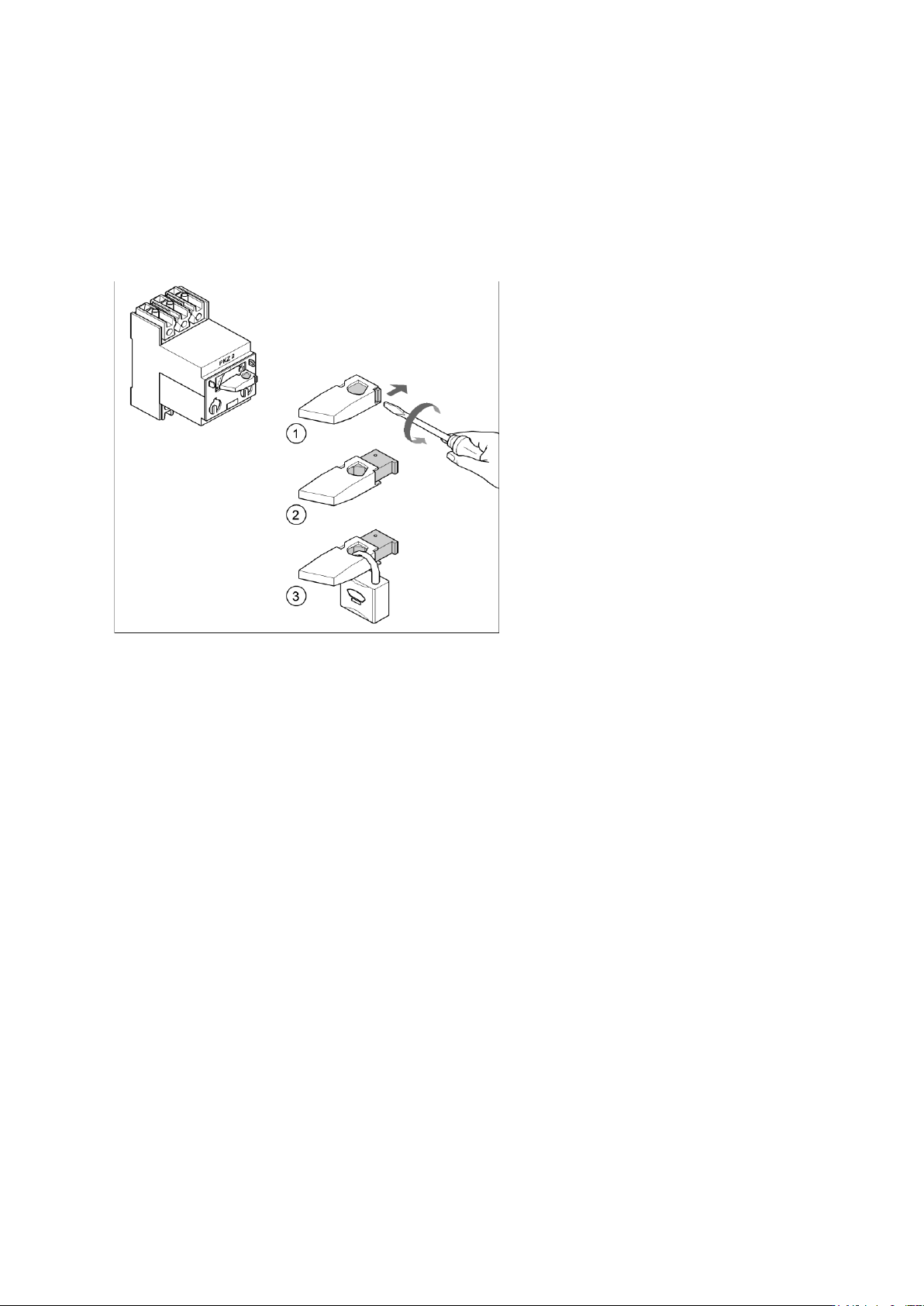
Example: attaching a padlock to the motor contactor
► Turn the operating lever (1) counterclockwise.
► Use the screwdriver to push the locking lug (2) out
of the operating lever (1).
► Secure the operating lever with a padlock (3).
► Alternative: attaching warning signs
If a machine can be locked, it must be. However, there are situations where energy isolating
devices cannot accommodate locks. In these cases, the energy isolating devices must be
tagged to warn employees that the machine is de-energized for servicing. The tag or label must
be securely fastened, it must be placed in a position visible to all and it may only be removed
by the person who attached it.
► Release of stored energy:
Stored energy in the compressed air supply or electrical energy in electrolytic capacitors must
be released by appropriate means.
⇨ After switching off the machine, wait until the voltages and the compressed air have
discharged, so that work can be performed without any risk.
► Testing the lock out:
The lock can be easily tested by pressing the START button.
► The following steps must be taken to restore the machine to operation.
► Check the working area. Authorized employees should remove all of their tools and reinstall all
safety features.
► Notify all affected employees.
► Before removing even one lock or tag, inform all workers in the affected area that the machine is
going to be restarted.
► Remove locks/tags
► Every authorized employee must remove his own lock and shut it away.