sh030106u.pdf - 第85页
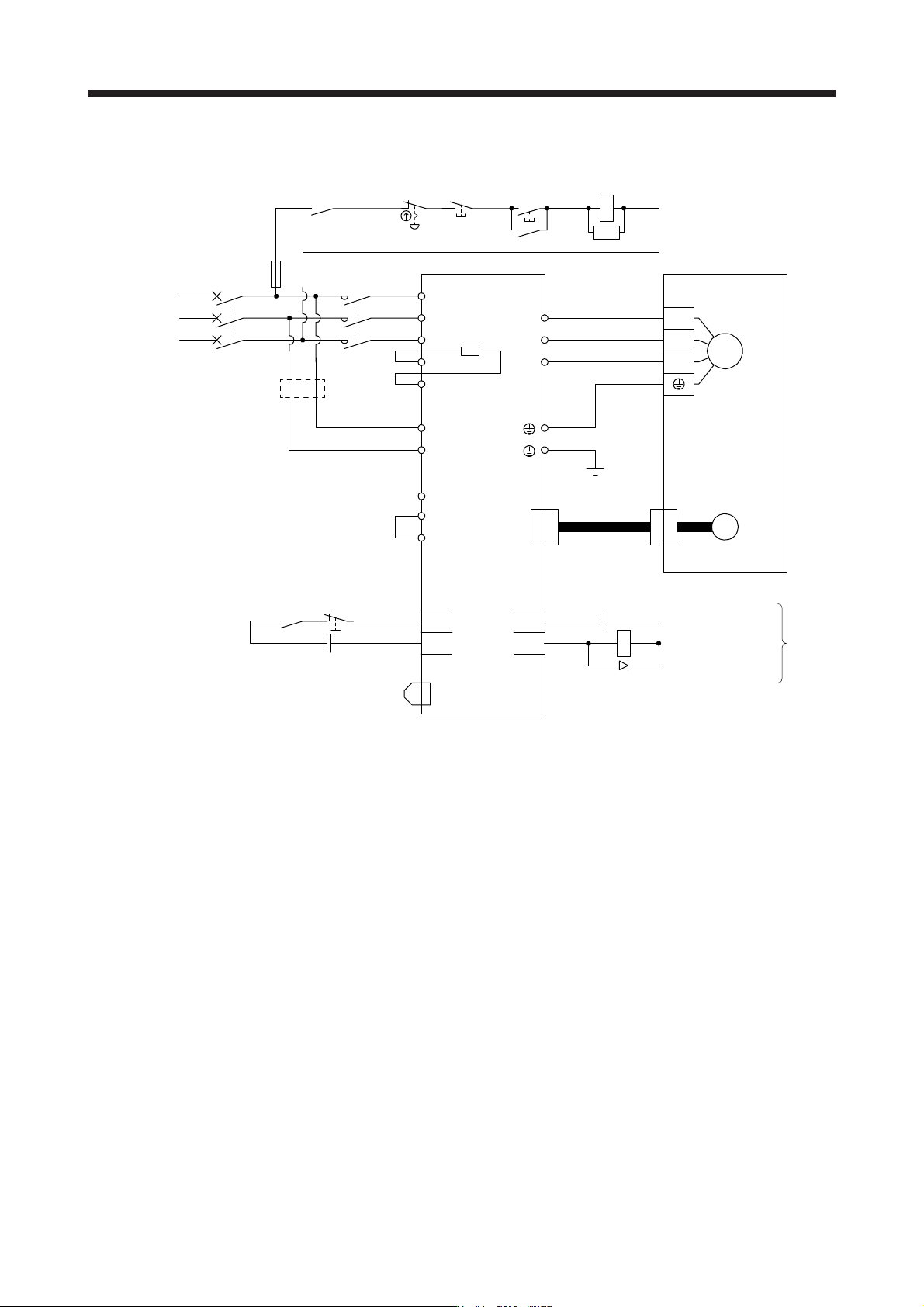
3. SIG NALS A ND WIRI NG 3 - 8 (5) MR-J4-11KB(-RJ)/MR-J4-15KB (-RJ)/MR-J4-22KB(-RJ) C P+ L11 L21 P3 P4 N- L1 L2 L3 U V W U V W M CN2 MC MC SK CN8 MCCB BU BV BW MCCB ALM DOCOM CN3 RA1 CN3 EM2 DICOM MC (Note 7) (Note 5) 24…
3. SIGNALS AND WIRING
3 - 7
(4) MR-J4-700B(-RJ)
C
P+
L11
L21
P3
P4
N-
L1
L2
L3
U
V
W
U
V
W
M
CN2
MC
MC
SK
CN8
MCCB
ALM
DOCOM
CN3
RA1
CN3
EM2
DICOM
Built-in
regenerative
resistor
MC
(Note 7)
(Note 5)
24 V DC (Note 12)
Malfunction (Note 4)
3-phase
2
00 V AC to
2
40 V AC
Servo amplifier
(Note 1)
(Note 13)
(Note 10)
(Note 2)
Servo motor
Motor
Encoder
(Note 3)
Encoder
cable
(Note 6)
(Note 4)
Malfunction
RA1
OFF
ON
Emergency stop switch
(Note 5) Forced stop 2
(Note 9)
Short-circuit connector
(Packed with the servo amplifier)
(Note 8)
Main circuit power supply
(Note 11)
(Note 11)
24 V DC (Note 12)
Note 1. Between P3 and P4 is connected by default. When using the power factor improving DC reactor, remove the short bar
between P3 and P4. Refer to section 11.11 for details. Additionally, a power factor improving DC reactor and power factor
improvin
g
AC reactor cannot be used simultaneousl
y
.
2. When usin
g
the re
g
enerative option, refer to section 11.2.
3. For the encoder cable, use of the option cable is recommended. For selecting cables, refer to "Servo Motor Instruction
Manual
(
Vol. 3
)
".
4. If ALM (Malfunction) output is disabled with the parameter, configure up the power supply circuit which switches off the
ma
g
netic contactor after detection of alarm occurrence on the controller side.
5. This dia
g
ram shows sink I/O interface. For source I/O interface, refer to section 3.8.3.
6. For connectin
g
servo motor power wires, refer to "Servo Motor Instruction Manual
(
Vol. 3
)
".
7. Use a magnetic contactor with an operation delay time (interval between current being applied to the coil until closure of
contacts) of 80 ms or less. Depending on the main circuit voltage and operation pattern, bus voltage decreases, and that
may cause the forced stop deceleration to shift to the dynamic brake deceleration. When dynamic brake deceleration is
not required, slow the time to turn off the ma
g
netic contactor.
8. Configure a circuit to turn off EM2 when the main circuit power is turned off to prevent an unexpected restart of the servo
amplifier.
9. When not usin
g
the STO function, attach the short-circuit connector came with a servo amplifier.
10. When wires used for L11 and L21 are thinner than wires used for L1, L2, and L3, use a molded-case circuit breaker.
(
Refer to section 11.10.
)
11. Connectin
g
a servo motor of the wron
g
axis to U, V, W, or CN2 of the servo amplifier ma
y
cause a malfunction.
12. The illustration of the 24 V DC power supply is divided between input signal and output signal for convenience. However,
the
y
can be confi
g
ured b
y
one.
13. Do not
g
round L11 and L21.
3. SIGNALS AND WIRING
3 - 8
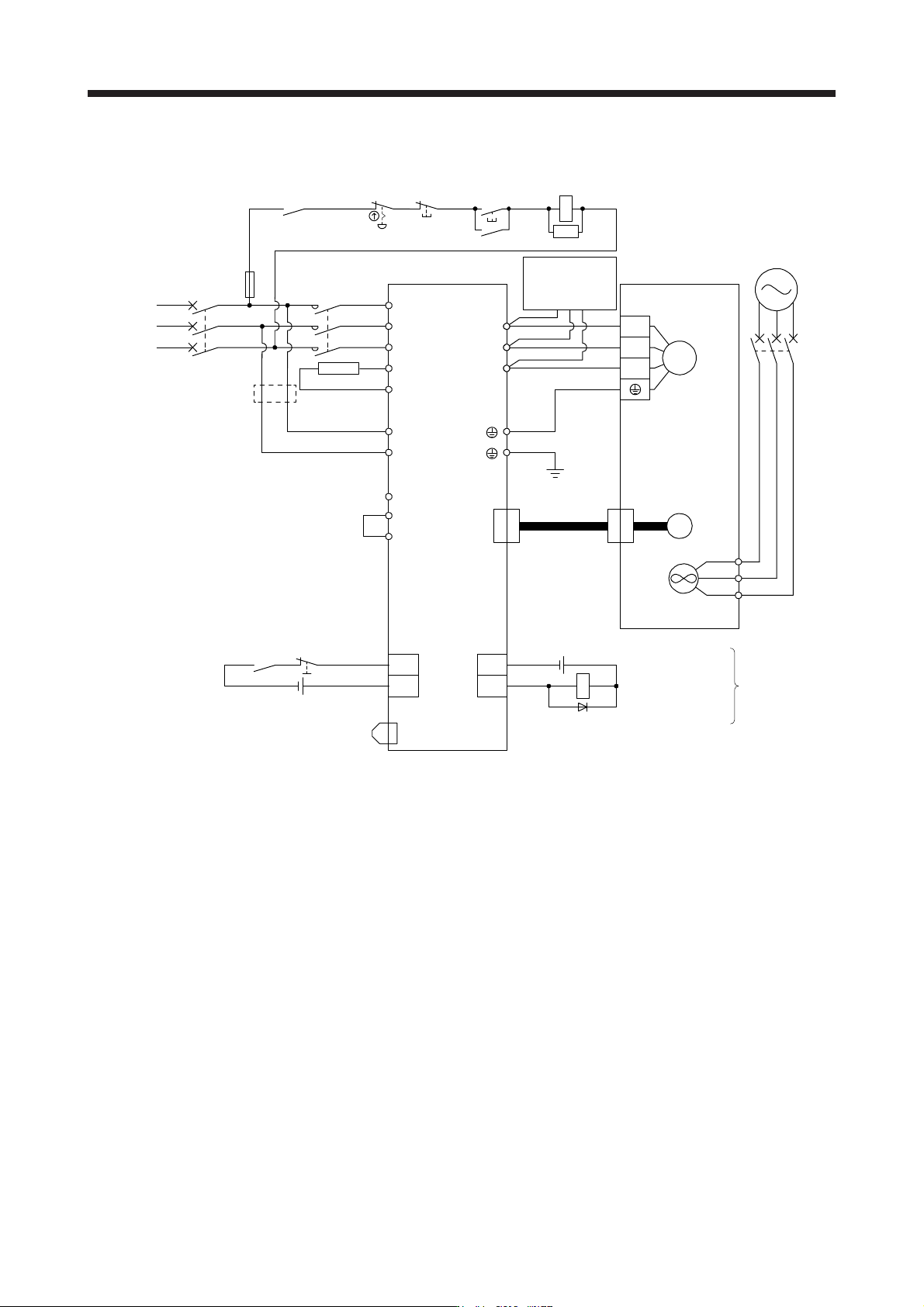
(5) MR-J4-11KB(-RJ)/MR-J4-15KB(-RJ)/MR-J4-22KB(-RJ)
C
P+
L11
L21
P3
P4
N-
L1
L2
L3
U
V
W
U
V
W
M
CN2
MC
MC
SK
CN8
MCCB
BU
BV
BW
MCCB
ALM
DOCOM
CN3
RA1
CN3
EM2
DICOM
MC
(Note 7)
(Note 5)
24 V DC (Note 12)
Malfunction (Note 4)
3-phase
200 V AC to
240 V AC
Servo amplifier
(Note 1)
(Note 10)
(Note 2)
(Note 17)
Servo motor
Motor
Encoder
(Note 3)
Encoder
cable
(Note 6)
(Note 4)
Malfunction
RA1
OFF
ON
Emergency stop switch
(Note 5) Forced stop 2
(Note 9)
Short-circuit connector
(Packed with the servo amplifier)
(Note 8)
Main circuit power supply
(Note 11)
(Note 11)
24 V DC (Note 12)
(Note 15, 16)
External
dynamic
brake (optional)
(Note 14)
Cooling fan
power supply
Cooling fan
(Note 13)

3. SIGNALS AND WIRING
3 - 9
Note 1. Between P3 and P4 is connected by default. When using the power factor improving DC reactor, remove the short bar
between P3 and P4. Refer to section 11.11 for details. Additionally, a power factor improving DC reactor and power factor
improvin
g
AC reactor cannot be used simultaneousl
y
.
2. When usin
g
the re
g
enerative option, refer to section 11.2.
3. For the encoder cable, use of the option cable is recommended. For selecting cables, refer to "Servo Motor Instruction Manual
(
Vol. 3
)
".
4. If ALM (Malfunction) output is disabled with the parameter, configure up the power supply circuit which switches off the
ma
g
netic contactor after detection of alarm occurrence on the controller side.
5. This dia
g
ram shows sink I/O interface. For source I/O interface, refer to section 3.8.3.
6. For connectin
g
servo motor power wires, refer to "Servo Motor Instruction Manual
(
Vol. 3
)
".
7. Use a magnetic contactor with an operation delay time (interval between current being applied to the coil until closure of
contacts) of 80 ms or less. Depending on the main circuit voltage and operation pattern, bus voltage decreases, and that may
cause the forced stop deceleration to shift to the dynamic brake deceleration. When dynamic brake deceleration is not
required, slow the time to turn off the ma
g
netic contactor.
8. Configure a circuit to turn off EM2 when the main circuit power is turned off to prevent an unexpected restart of the servo
amplifier.
9. When not usin
g
the STO function, attach the short-circuit connector came with a servo amplifier.
10. When wires used for L11 and L21 are thinner than wires used for L1, L2, and L3, use a molded-case circuit breaker. (Refer to
section 11.10.
)
11. Connectin
g
a servo motor of the wron
g
axis to U, V, W, or CN2 of the servo amplifier ma
y
cause a malfunction.
12. The illustration of the 24 V DC power supply is divided between input signal and output signal for convenience. However, they
can be confi
g
ured b
y
one.
13. For the servo motor with a coolin
g
fan.
14. For the coolin
g
fan power suppl
y
, refer to "Servo Motor Instruction Manual
(
Vol. 3
)
".
15. Use an external dynamic brake for this servo amplifier. Failure to do so will cause an accident because the servo motor does
not stop immediately but coasts at an alarm occurrence for which the servo motor does not decelerate to stop. Ensure the
safety in the entire equipment. For alarms for which the servo motor does not decelerate to stop, refer to chapter 8. For wiring
of the external d
y
namic brake, refer to section 11.17.
16. The external dynamic brake cannot be used for compliance with SEMI-F47 standard. Do not assign DB (Dynamic brake
interlock) in [Pr. PD07] to [Pr. PD09]. Failure to do so will cause the servo amplifier to become servo-off when an
instantaneous power failure occurs.
17. Do not
g
round L11 and L21.