252301 Issue 2.0.pdf - 第31页
GEM Manual for DEK Printers Capabilities I ssue 2.0 June 9th, 2011 page 31 of 156 5.4 Control 5.4.1 Control (operator initiated) The operator of the equipment can co ntrol the communications betwee n the equipment and Ho…

GEM Manual for DEK Printers Capabilities
Issue 2.0 June 9th, 2011 page 30 of 156
Scenarios:
Send alarm report: (Alarm state change detected by equipment)
Comments Host Equipment Comments
<-- S5F1 [IF] ALIDn enabled, send report.
Host Acknowledges S5F2 -->
<-- S6F11 [IF] CEIDm enabled, send associated event
report.
Host Acknowledges S6F12 -->

GEM Manual for DEK Printers Capabilities
Issue 2.0 June 9th, 2011 page 31 of 156
5.4 Control
5.4.1 Control (operator initiated)
The operator of the equipment can control the communications between the equipment and
Host. This is done using the function keys on the operators Host Comms screen and allows for:
On-Line / Off-Line Control.
Local / Remote Control.
Control State Definitions:
Off-Line - During the Off-Line state, the SECS-II link is severely restricted. The equipment
operator console controls all operations. With the exception of the messages used for connect
and On-Line, the equipment sends no primary SECS-II messages to the Host, and refuses
primary SECS-II messages from the Host. This state is active until the operator enables Host
communications on the equipment.
On-Line: Local - In the local state, the SECS-II link operates normally. The equipment
imposes restrictions on the level of communications with the Host. This state is active for as
long as the operator requires, until the equipment is powered down or a fault occurs.
On-Line: Remote - In the remote state, the SECS-II link operates normally. The equipment
imposes no restrictions on the level of communications with the Host. This state is active for
the as long as the operator requires, until the equipment is powered down or a fault occurs.
5.4.2 Remote Control
The remote control capability provides the host with the ability to initiate processing and to
modify process parameters during operation. The ability to modify operating parameters
permits the use of feed-forward process control.
The host can exercise control by sending a remote command RCMD and parameter data
CPNAM and CPVAL. For details of available commands and parameters, see appendix A.
Command completion’s are notified to the host by event reports.
The ability, of the host to exert control depends upon the equipment control state. See control
(operator initiated) section 3.4.1.
GEM Manual for DEK Printers Capabilities
Issue 2.0 June 9th, 2011 page 32 of 156
5.4.3 Control (host initiated)
The host has the capability to cycle the equipment between the ON-LINE and OFF-LINE states.
The equipment can either ‘deny’, and not process the request, or ‘acknowledge’ the request and
transit to the required ON-LINE or OFF-LINE, state as dictated by the host.
The ability, of the host to exert control depends upon the equipment control state.
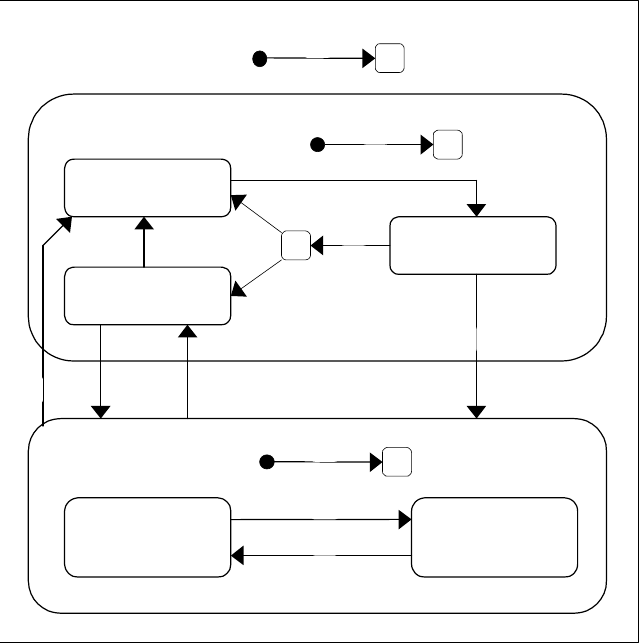
Control State Model
The control state behaviour is described by the following state model:
State Diagram:
C
POWER UP
EQUIPMENT
OFF-LINE
EQUIPMENT
ON-LINE
ATTEMPT
ON-LINE
LOCAL REMOTE
1
C
C
2
C
OFF-LINE
ON-LINE
C
7
3
4
5
6
8
9
10
11
12
State Definitions:
OFF-LINE - The SECS-II link is limited to the transactions below:
OFF-LINE: EQUIPMENT OFF-LINE
The operator can manually transit the equipment to the OFF-LINE state, sub-state
EQUIPMENT OFF-LINE. In this state, the SECS-II link operation is severely restricted, except
for the messages used for Connect and On-Line.
• No primary messages are sent to the Host, with the exception of S1F13 (Connect Request).
• If the Host sends S1F13 (Connect Request) the equipment replies with S1F14 (Connect
Acknowledge). If the Host sends any primary message with the W-bit "1" (reply expected)
other than S1F13 (Connect Request), the equipment refuses by sending an SxF0 reply.