MR8740T_user_manual_eng_20191016H.pdf - 第113页
108 T riggering the Instrument Using Analog Signals (Analog T rigger) With the [Event] setting If the trigger condition is repeatedly satised, setting the number of events prevents an analog trigger from being generated…
107
Triggering the Instrument Using Analog Signals (Analog Trigger)
1. [Level] trigger
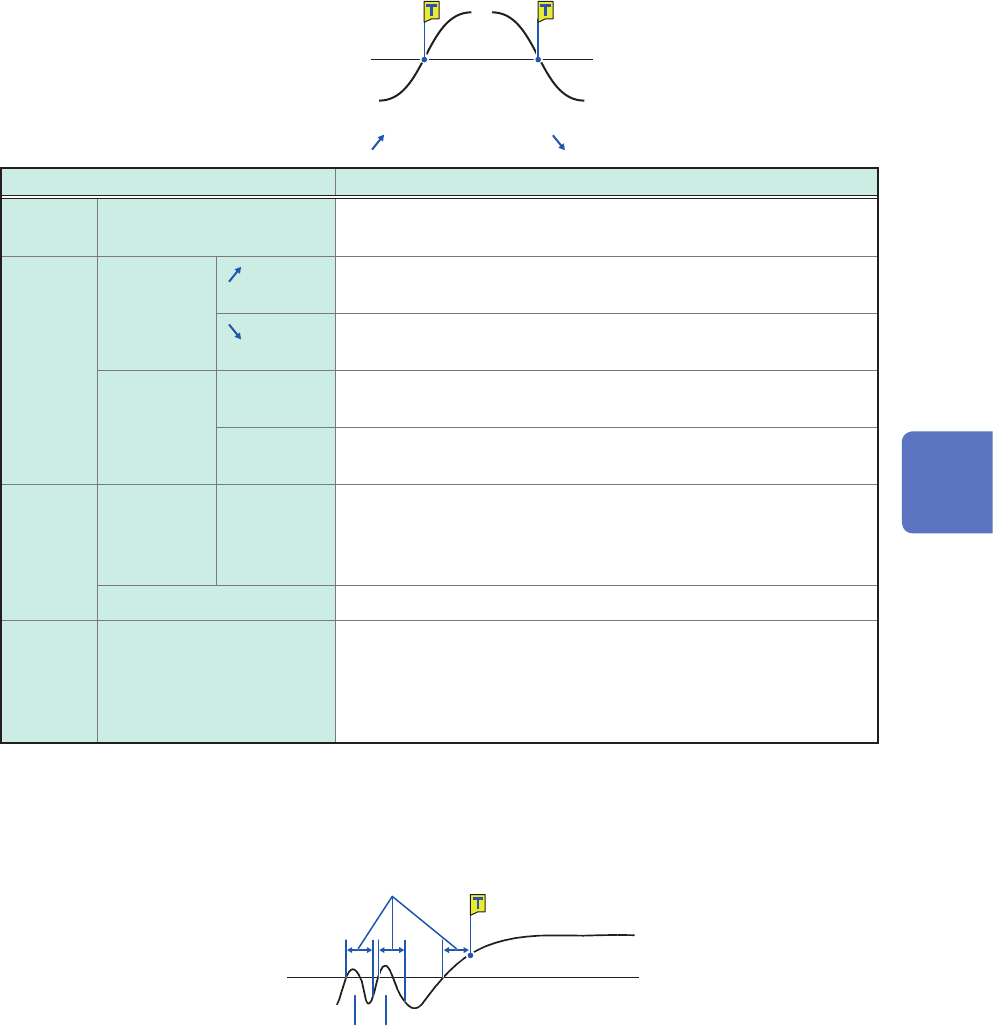
When an input signal crosses the specied level in the positive or negative direction, an analog
trigger is generated.
Level
Input waveform
Slope: [
] [ ]
Setting Description
Level –f.s. to +f.s.
Default: 0
Allows you to enter a level of the level trigger.
Slope With OR
The level-trigger condition is satised when a waveform crosses
the threshold value (level) in the positive direction.
The level-trigger condition is satised when a waveform crosses
the threshold value (level) in the negative direction.
With AND HIGH
The level-trigger condition is satised when a waveform is higher
than the threshold value (level).
LOW The level-trigger condition is satised when a waveform is lower
than the threshold value (level).
Event With OR 1
to 4,000 Allows you to enter the number of events.
The instrument counts the number of times the level-trigger
condition is satised. An analog trigger is generated when the
count reaches the specied number of events.
With AND Not available
Filter Off
, 10 to 10,000 Allows you to enter a lter width in the number of samples. Only
after the level-trigger condition is continuously satised during
the specied period, an analog trigger is generated. Specifying
this option prevents the instrument from being unintentionally
triggered due to noise.
With the [Filter] setting
Specifying the lter duration prevents the analog trigger from being unintentionally generated due
to noise, allowing it to be generated only after the level-trigger condition continues to be satised
during the specied duration (period) or longer.
Filter
Level at time
Noise does not generate any analog trigger.
5
Conguring the Trigger Settings
108
Triggering the Instrument Using Analog Signals (Analog Trigger)
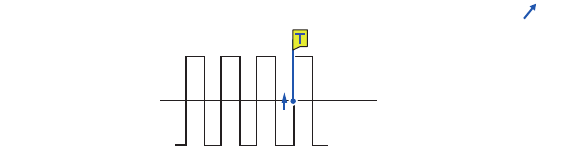
With the [Event] setting
If the trigger condition is repeatedly satised, setting the number of events prevents an analog
trigger from being generated until the number of times the level-trigger condition is satised reaches
the specied number of counts.
1 2 3 4
Example: When the number of events is set at [4] (Slope: [
]).
Level 2.5 V
5 V
0 V
Event count
109
Triggering the Instrument Using Analog Signals (Analog Trigger)
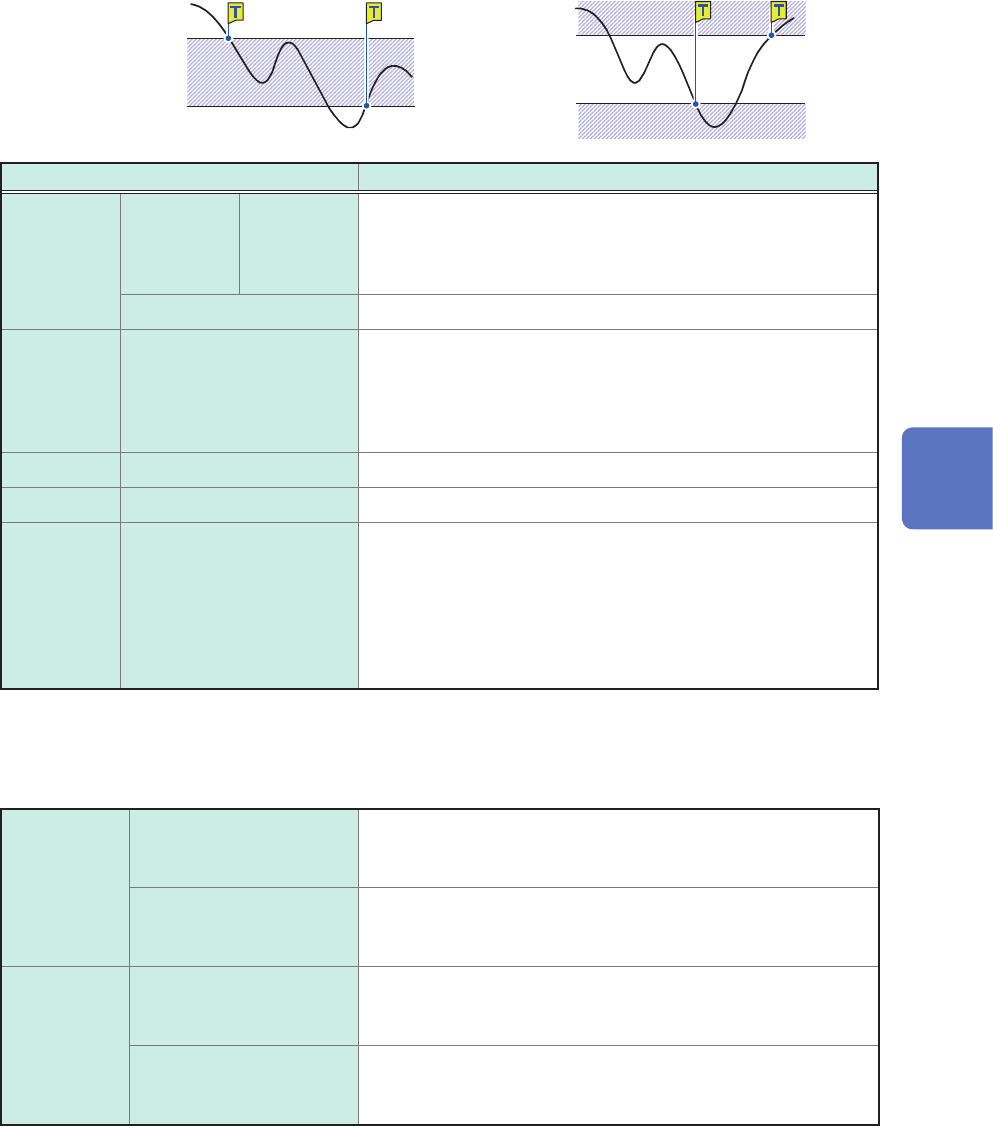
2. [In] trigger, [Out] trigger
When an input signal falls within ([In]) or gets out of a range ([Out]), which is determined by
specifying upper and lower values, an analog trigger is generated.
[In]
Upper limit value
Lower limit value
[Out]
Upper limit value
Lower limit value
Setting Description
Event With OR 1
to 4,000 Allows you to enter the number of events.
The instrument counts the number of times the window-trigger
condition is satised. Only after the count reaches the specied
number of events, an analog trigger is generated.
With AND Not available
Filter Off
,
10 to 10,000
Allows you to enter a lter width in the number of samples.
Only after the window-trigger condition continues to be satised
during the specied period, an analog trigger is generated.
Specifying this option prevents the instrument from being
unintentionally triggered due to noise.
Upper –f.s. to +f.s. Allows you to enter an upper limit value.
Lower –f.s. to +f.s. Allows you to enter a lower limit value.
Auto-
trigger
level*
Off
, On With the [On] setting, the instrument automatically species a
reference level and is triggered when an input signal exceeds
the range between the lower value, the sum of the reference
level and the lower limit value, and the higher value, the sum of
the reference level and the upper limit value. (p. 121)
In [Level of the last time], the reference level used in the
previous measurement appears.
*: Available for the out trigger function only
The operation related to the in and out triggers varies depending on the trigger logical-conditions
(AND and OR).
With OR In The window-trigger condition is satised when an input signal
crosses the upper or lower limit value of the threshold (level)
and thereby falls within the range.
Out The window-trigger condition is satised when an input signal
crosses the upper or lower limit value of the threshold (level)
and thereby gets out of the range.
With AND In The window-trigger condition is satised when an input signal
is inside the range, which is specied by the upper and lower
limit values of the threshold (level).
Out The window-trigger condition is satised when an input signal
is outside the range, which is specied by the upper and lower
limit values of the threshold (level).
5
Conguring the Trigger Settings