MR8740T_user_manual_eng_20191016H.pdf - 第124页
11 9 Issuing an Alert Using T riggers (Alert Function) 5.1 1 Issuing an Alert Using T riggers (Alert Function) The alert function detects trigger-condition satisfying points based on trigger settings. When [Beep sound] i…
118
Externally Triggering the Instrument (External Trigger)
5.9 Externally Triggering the Instrument (External
Trigger)
External signals applied to the external control terminals can serve as trigger sources.
External signals can also be used to operate multiple instruments in synchronization with each
other.
Refer to “External trigger terminal (EXT.TRIG)” (p. 215).
5.10 Manually Triggering the Instrument (Forcible
Trigger)
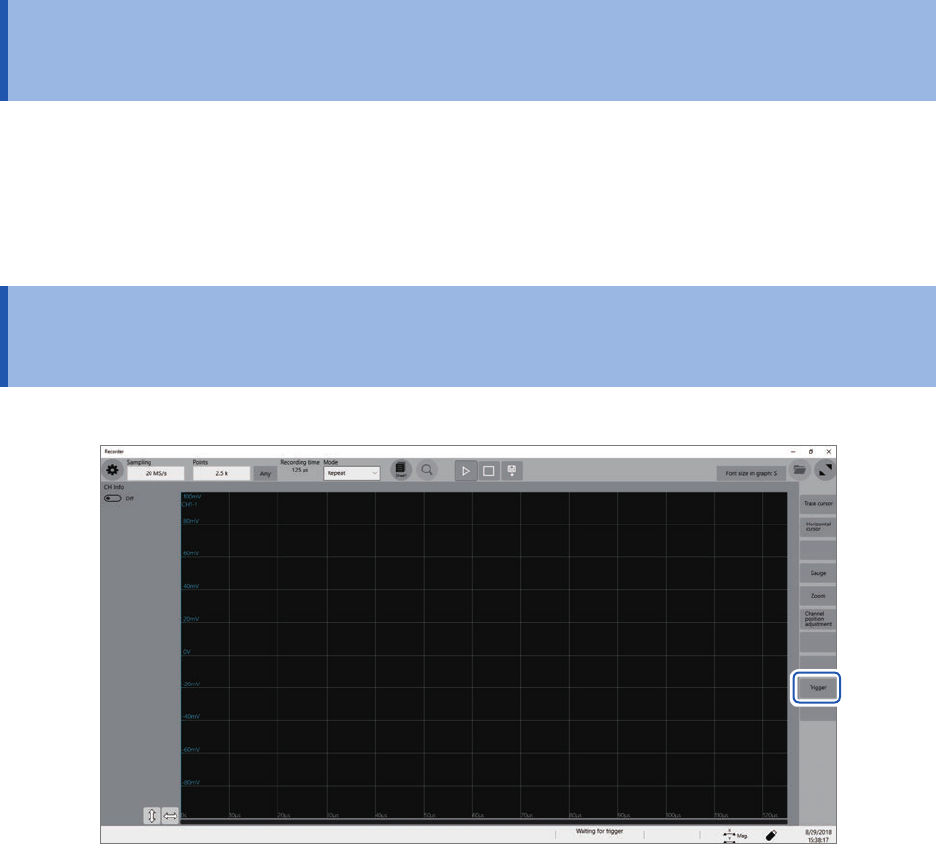
Clicking [Trigger] on the right side of the waveform screen allows you to manually trigger the
instrument while the instrument is waiting time for a trigger.
The forcible trigger triggers the instrument regardless of the other trigger source settings.
To stop the measurement, click the stop icon.
• Clicking the stop icon once stops the measurement after the instrument has acquired recording-
length waveforms.
• Click the stop icon once and click [OK] on the dialog box displayed to stop the measurement.
119
Issuing an Alert Using Triggers (Alert Function)
5.11 Issuing an Alert Using Triggers (Alert Function)
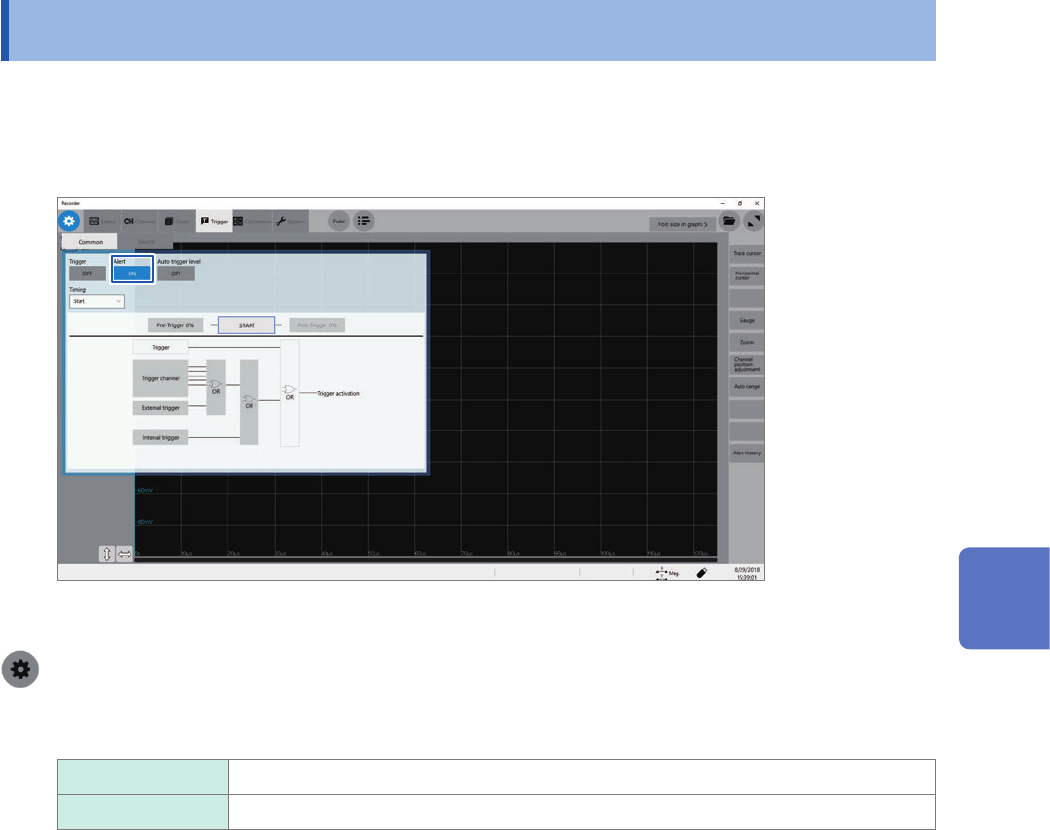
The alert function detects trigger-condition satisfying points based on trigger settings.
When [Beep sound] is set to [Alert] or [Alert+Action], the instrument continues to beep while
the trigger condition is being satised. Also, the CMD ERR red LED lights up when the instrument
alerts you. The LED goes off when the instrument lifts the alert.
Setting [Alert] to [On] limits the sampling rate to 100 kS/s or lower.
The event count of the trigger setting is xed at 1.
> [Trigger] > [Common]
1
Click the [Trigger] to set it to [On] or [Off].
Off
Does not alert you.
On Alerts you.
5
Conguring the Trigger Settings
120
Issuing an Alert Using Triggers (Alert Function)
Event mark
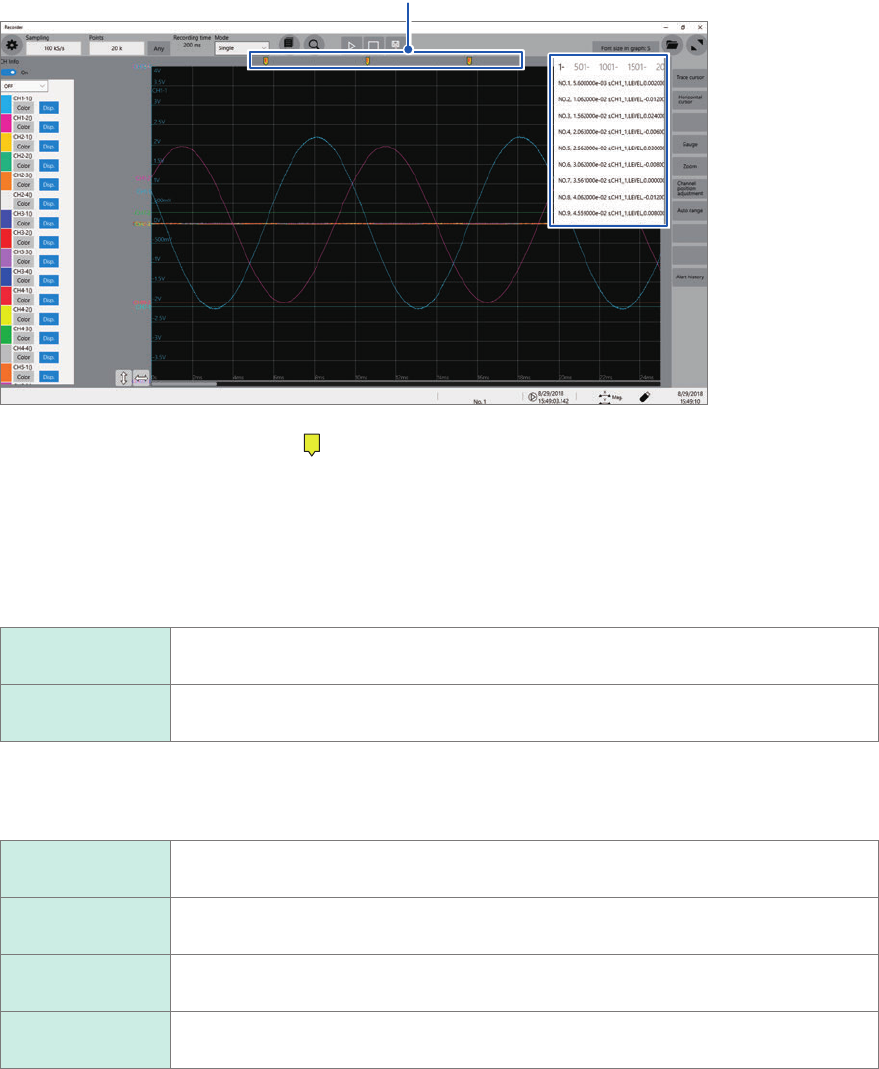
The instrument puts event marks (
E
) at the positions when the specied trigger condition is
satised (alert issued) and when the condition fails to be satised (alert terminated). At the upper
right of the screen, the instrument displays the time when the condition is satised, channel
number, trigger type, measured value and a character string [Out] or [In].
The string [Out] or [In] is intended for use with the out trigger setting; however, with another trigger
setting, the instrument displays [Out] when the condition is satised and [In] when the condition
fails to be satised.
Out When a condition is satised (for the out trigger setting, when a signal gets out of the
specied range)
In When a condition is not satised (for the out trigger setting, when a signal falls within
the specied range)
If the condition is satised and fails to be satised repeatedly within 100 ms, the instrument may
group this condition changes into one and display it as the following.
Out_In When a condition is rst not satised, then the status repeatedly changes, and nally
fails to be satised
Out_In_Out When a condition is rst not satised, then the status repeatedly changes, and is nally
satised
In_Out When a condition is rst satised, then the status repeatedly changes, and is nally
satised
In_Out_In
When a condition is rst satised, then the status repeatedly changes, and nally fails to
be satised
When an alert condition specied for a channel has been already satised, the instrument with
the alert settings specied for multiple channels displays the rst alert at the same position as a
position a condition for another channel is next satised at.