MR8740T_user_manual_eng_20191016H.pdf - 第127页
122 Automatically Specifying the T rigger Level (Auto-trigger Level)
121
Automatically Specifying the Trigger Level (Auto-trigger Level)
5.12
Automatically Specifying the Trigger Level (Auto-
trigger Level)
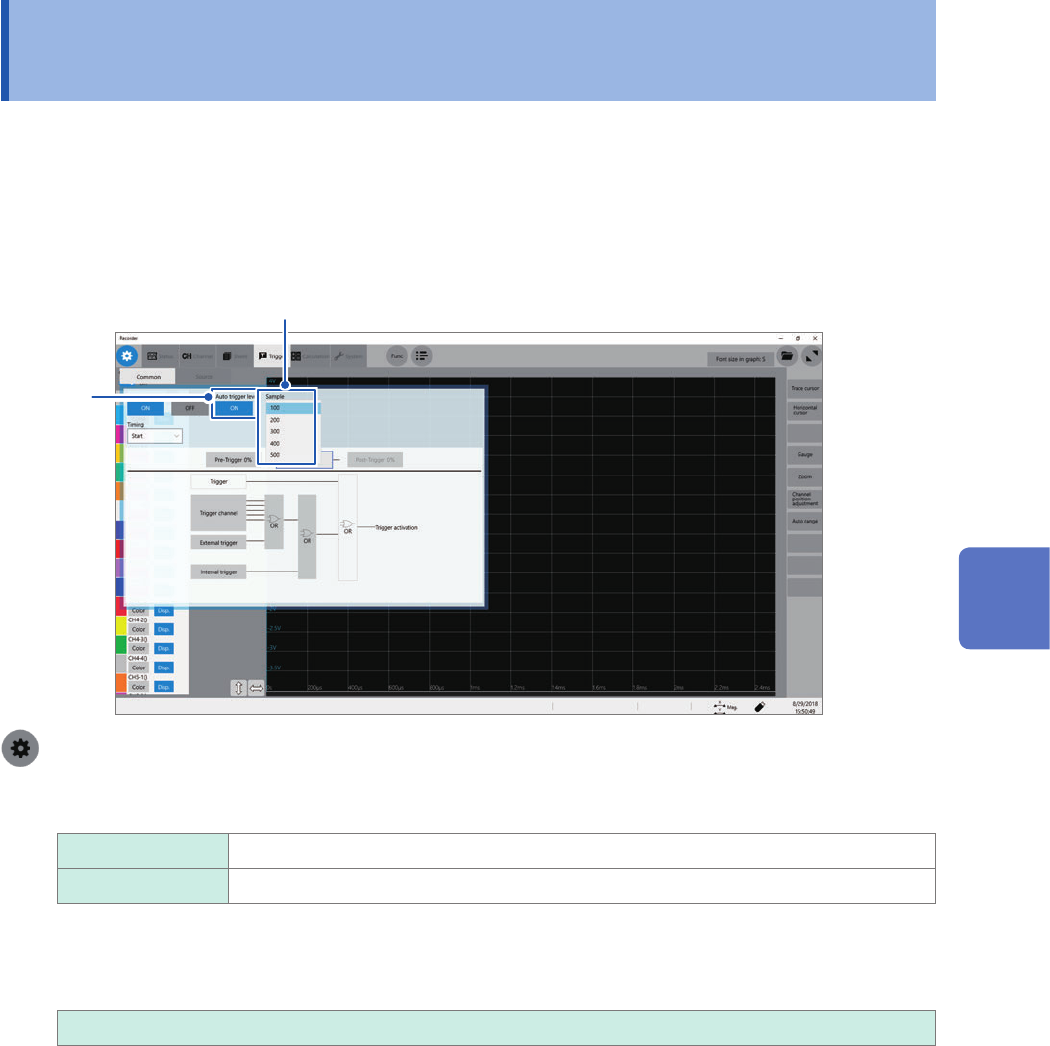
When you enable this setting, the instrument performs a preliminary measurement before an actual
measurement.
In the preliminary measurement, the instrument acquires the specied number of data points and
calculates the average value of them. Then, the instrument species the average value as the
reference of the out trigger and performs the actual measurement using this trigger.
This function is useful when you use the out trigger setting with the trigger and alert functions.
1
2
> [Trigger] > [Common]
1
Click the [Trigger] to set it to [On] or [Off].
Off
Disables the auto-trigger level function.
On Automatically species the reference level of the out trigger.
2
Click the [Samples] box, and then choose an option for the number of sampling points from
the list.
100
, 200, 300, 400, 500
3
Congure the trigger setting for each channel.
On the trigger source setting screen, set the trigger type of a channel to be used to the out trigger,
and set [Auto-trigger level] to [On]. (p. 109)
5
Conguring the Trigger Settings
122
Automatically Specifying the Trigger Level (Auto-trigger Level)
123
6
Search Function
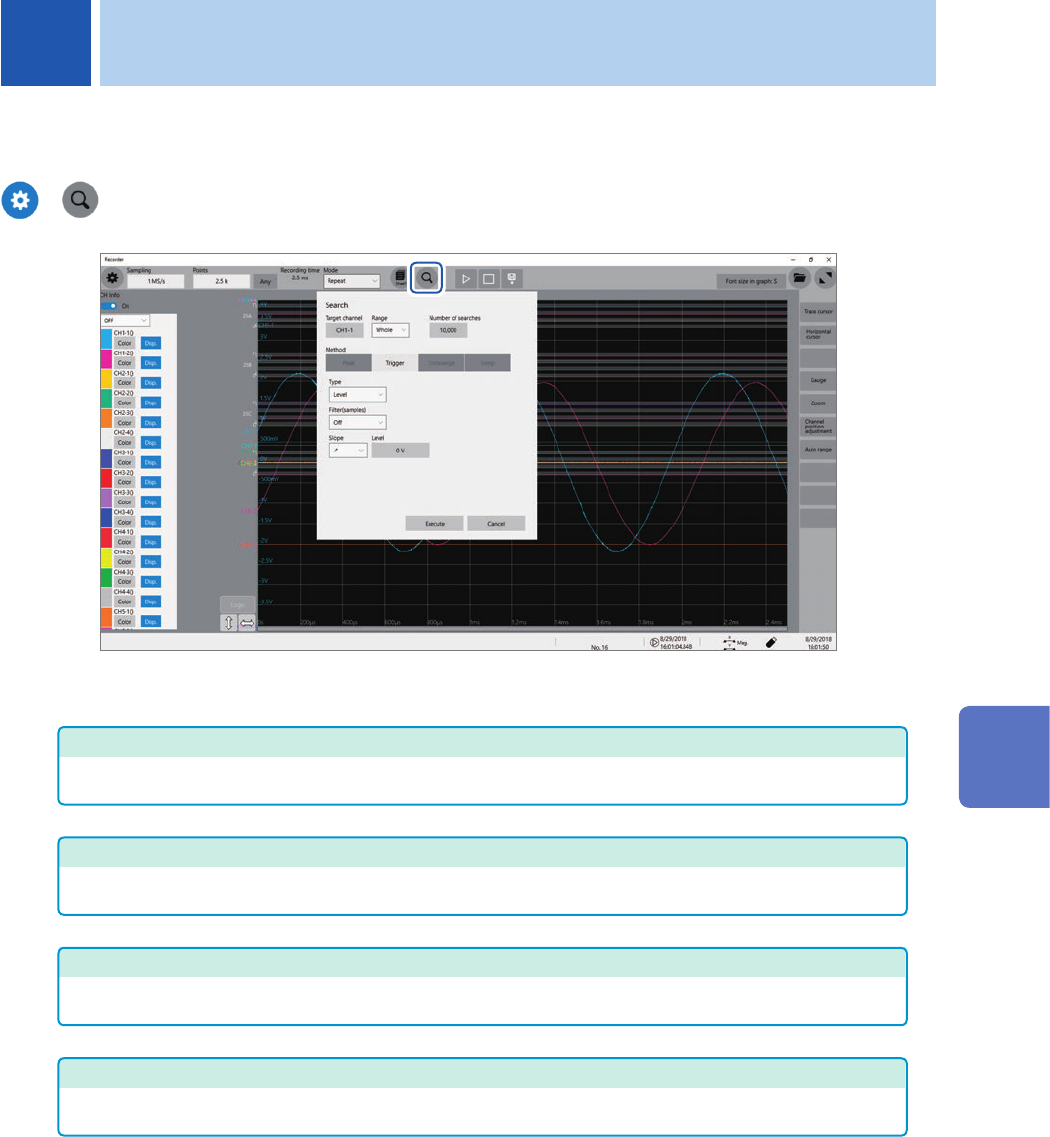
Using the search function allows you to search measured waveform data for positions where user-
dened search criteria have been satised.
>
Operation available on the search screen
Peak search
You can search for the maximum, minimum, local maximum (maximal), or local minimum (minimal)
value. Select one of them. (p. 124)
Trigger search
You can search for the position where the specied trigger condition is satised. Specify the trigger
condition. (p. 126)
Memory HiConcierge
You can automatically detect differences from the fundamental wave based on the histogram or
standard deviation. Specify the fundamental wave. (p. 130)
Jump
The display can jump to the specied time, trace cursor position, event number, trigger point, or search
mark. (p. 132)
6 Search Function
6
Search Function