MR8740T_user_manual_eng_20191016H.pdf - 第162页
157 Numerical Calculation T ypes and Descriptions Calculation type Description Accumulation Method : Positive (Only the positive- amplitude part) Calculates an accumulation (unit: V) enclosed by the zero-level (zero-pote…
156
Numerical Calculation Types and Descriptions
Calculation
type
Description
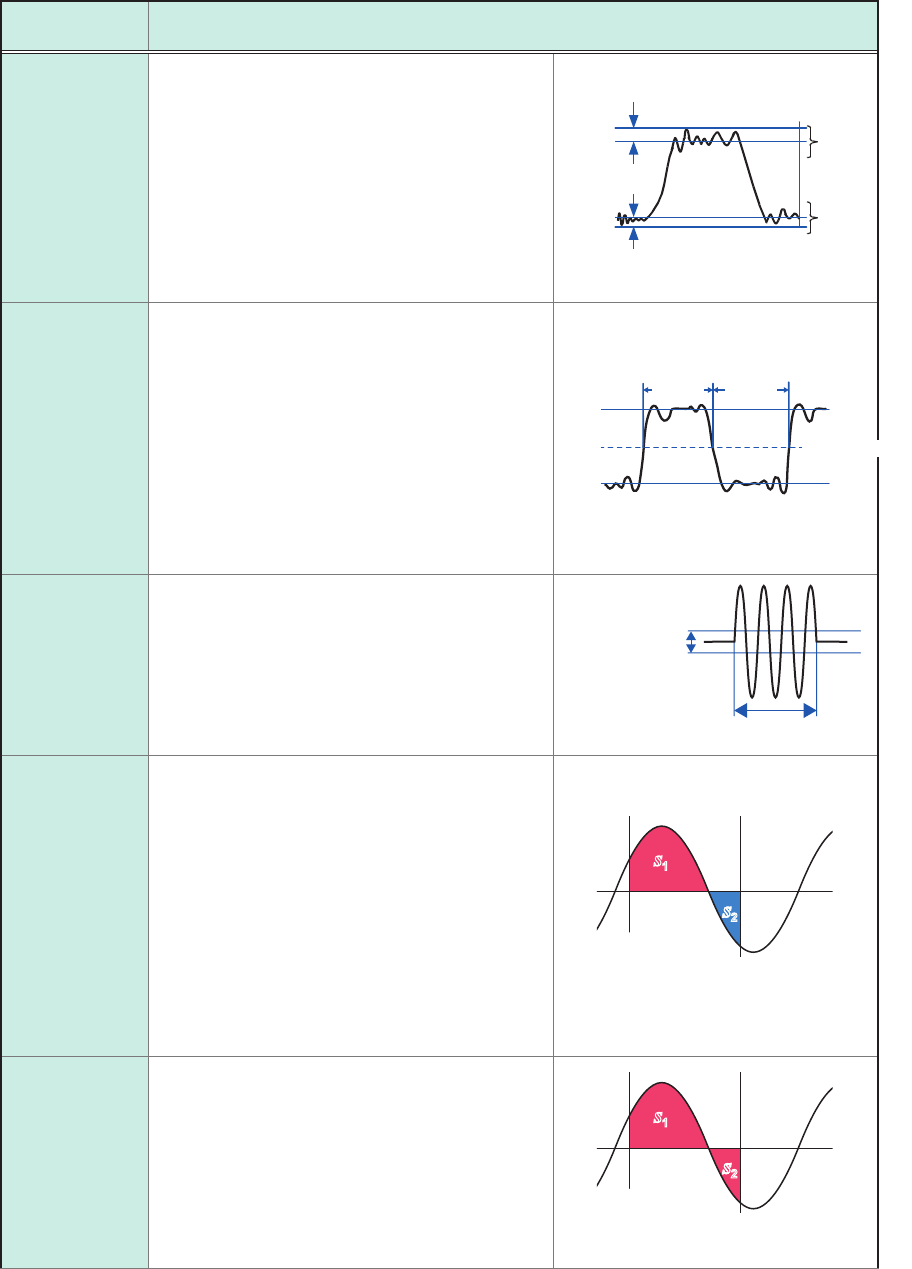
Overshoot
Undershoot
Calculates a ratio of a difference between the
maximum (or minimum) value and a high (or
low) level to a difference between a high and
low levels, which are calculated letting 0% and
100% of acquired waveform data be them,
respectively, based on a histogram (frequency
distribution).
[(Maximum value) − (High level)] / [(High level) −
(Low level)] × 100
[(Low level) − (Minimum value)] / [(High level) −
(Low level)] × 100
0%
1
00%
High
level
Low
level
Number of data points
Overshoot
Undershoot
+Width (Period
during which
a waveform
is above the
intermediate
level)
−Width (Period
during which
a waveform
is below the
intermediate
level)
Calculates a time lag between the time a
waveform crossed the intermediate line level
(50%) in the positive (or negative) direction and
the time it next crossed the intermediate level in
the opposite direction.
Settings: Filter, Stat.
+Width
High
−Width
Low
100%
0%
50%
Intermediate level
Burst width
Calculates a time during which a burst signal is
outputted.
Settings: Filter, Burst end lter, Window (Up,
Low), Stat.
T
Window-level range
Burst width
Accumulation
Method: Total
Calculates an accumulation by subtracting an
accumulation (V) enclosed by the zero-level
(zero-potential) line and the negative-amplitude
part of a signal waveform from an accumulation
(unit: V) enclosed by the zero-level (zero-
potential) line and the positive-amplitude part of
a signal waveform.
When the range is specied, calculates the
accumulation between the cursors.
S: Accumulation
n
: Number of data points
di
:
i
th data point acquired
across the channel
di
S =
∑
i = 1
n
s
1
sss
2
s
1
ss
2
Cursor A
Cursor B
S
=
s
1
−
s
2
Accumulation
Method:
Absolute value
Calculates an accumulation (unit: V) enclosed by
the zero-level (zero-potential) line and a signal
waveform.
When the range is specied, calculates the
accumulation between the cursors.
S: Accumulation
n
: Number of data points
di
:
i
th data point acquired
across the channel
|di|
S =
∑
i = 1
n
s
1
sss
2
s
1
ss
2
Cursor A
Cursor B
S
=
s
1
+
s
2
157
Numerical Calculation Types and Descriptions
Calculation
type
Description
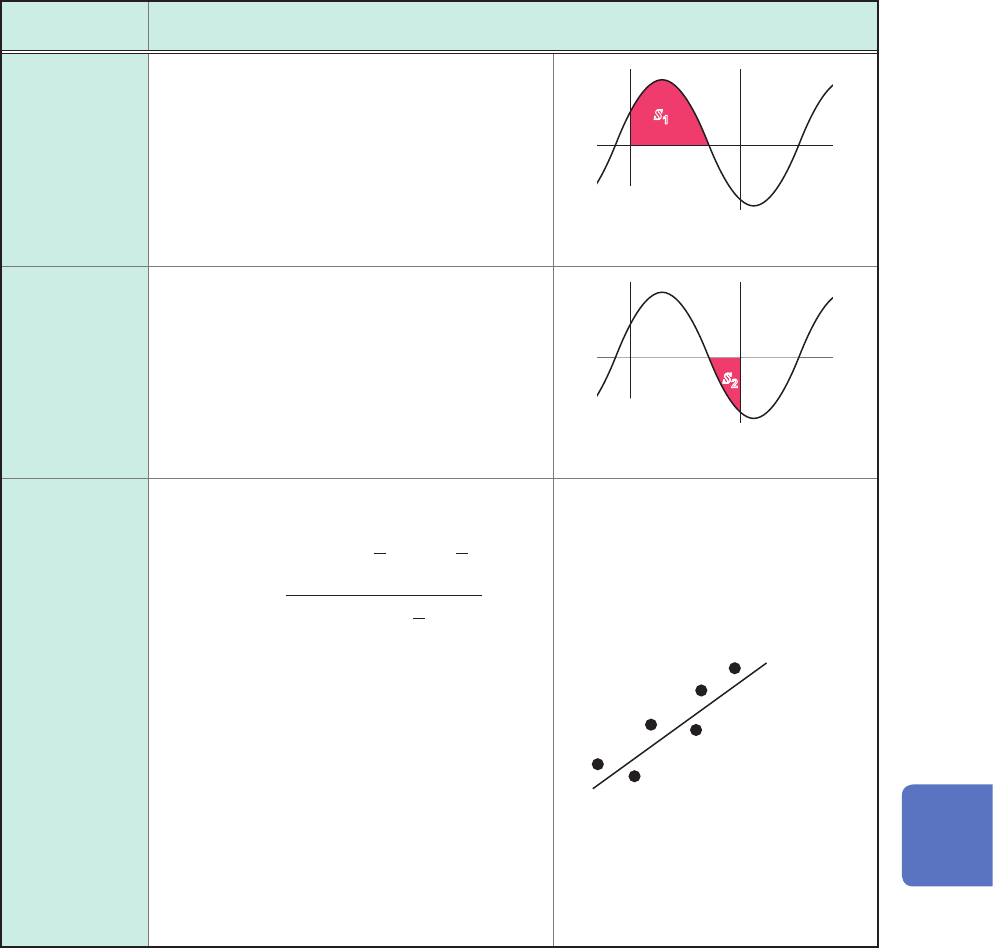
Accumulation
Method:
Positive
(Only the
positive-
amplitude part)
Calculates an accumulation (unit: V) enclosed
by the zero-level (zero-potential) line and the
positive-amplitude part of a signal waveform.
When the range is specied, calculates the
accumulation between the cursors.
S: Accumulation
n
: Number of data points
di
:
i
th data point acquired
across the channel
di
S =
∑
i = 1, di > 0
n
s
1
s
1
Cursor A
Cursor B
S
=
s
1
Accumulation
Method:
Negative
(Only the
negative-
amplitude part)
Calculates an accumulation (unit: V) enclosed
by the zero-level (zero-potential) line and the
negative-amplitude part of a signal waveform.
When the range is specied, calculates the
accumulation between the cursors.
S: Accumulation
n
: Number of data points
di
:
i
th data point acquired
across the channel
di
S =
∑
i = 1, di < 0
n
sss
2
ss
2
Cursor A
Cursor B
S
= −
s
2
Angle of XY
waveform
Calculates a regression line of an X-Y composite
curve, and then a slope angle.
°[]
θ
= arctan(SLOPE)
180 /
π
θ
: Angle at which the regression line is
with X-axis
xi
:
i
th data point acquired across the
X-axis channel
yi
:
i
th data point acquired across the
Y-axis channel
x
―
: Average value of the X-axis channel
y
―
: Average value of the Y-axis channel
SLOPE =
∑
n
i=1
(x
i
− x )
2
∑
n
i=1
(x
i
− x )
(y
i
− y )
Regression line
7
Numerical Calculation Function
158
Numerical Calculation Types and Descriptions