MR8740T_user_manual_eng_20191016H.pdf - 第44页
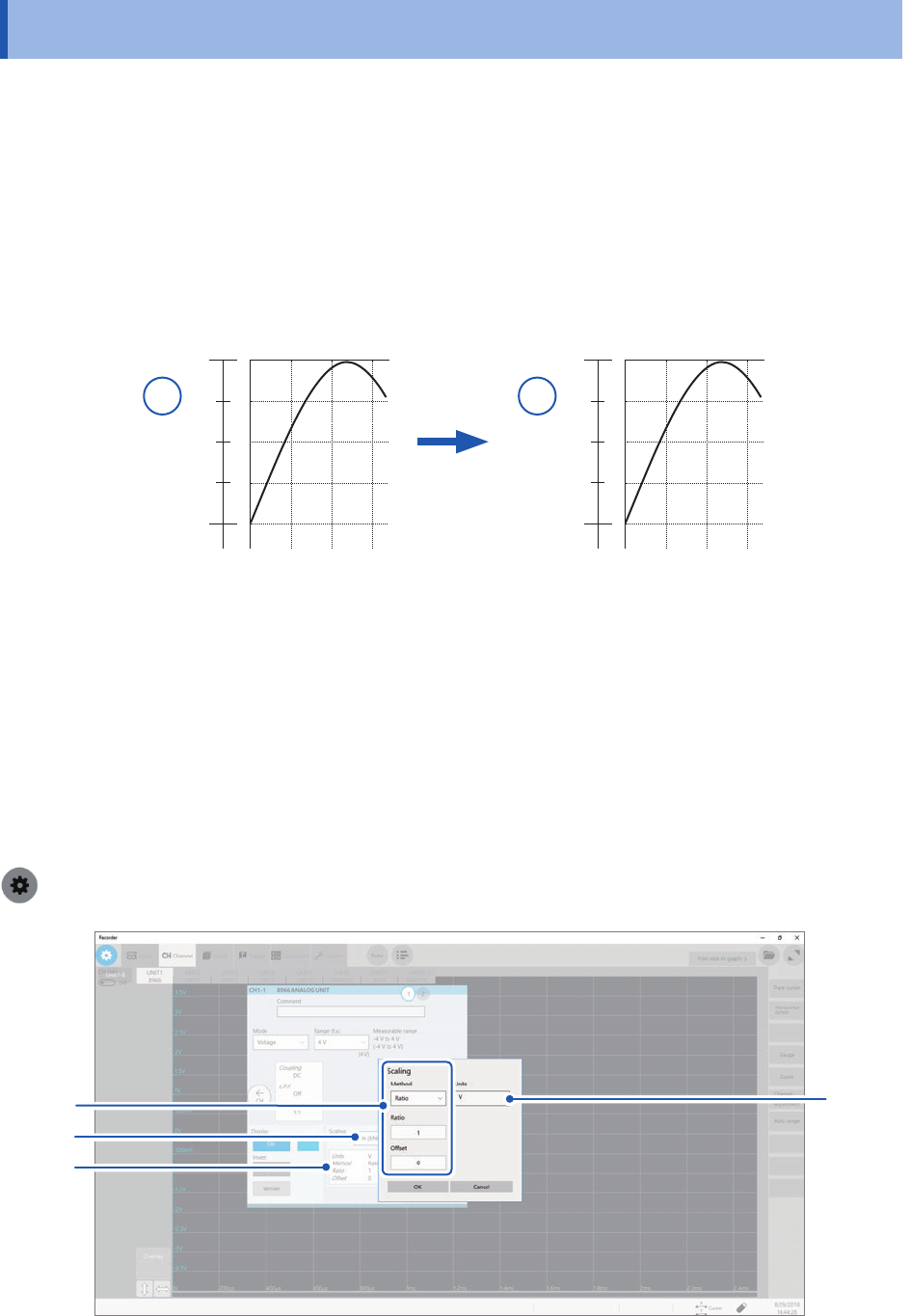
39 Converting Input V alues (Scaling Function) 1 Click the [Scaling] box, and then choose a scaling setting from the list. Off Does not scale any values. On (ENG) Displays values in decimal notation with a unit prex (…
38
Converting Input Values (Scaling Function)
3.2 Converting Input Values (Scaling Function)
About the scaling function
The scaling function enables you to convert voltage outputted from measuring devices such as
sensors into physical quantities of measuring objects.
Hereafter, the term “scale” refers to converting numerical values using the scaling function.
Gauge scales, scaled values (upper and lower limits of the vertical axis or voltage axis), and
measured values using trace cursors are represented as scaled values in the specied units.
You can congure different scale settings for each channel.
Before scaled After scaled
[
V
]
0
0.1
0.2
[
A
]
0
5.0
10
Scaling methods
The following six methods are available:
• Specifying a conversion ratio and offset
• Specifying two points
• Choosing a model name of a connected current sensor or differential probe
• Choosing an output rate
• Specifying an input value in decibels and value after scaled
• Specifying a rated capacity and rated output according to an inspection record of a strain gauge
converter (for Model U8969 Strain Unit only)
> [Channel]
3
4
1
2
39
Converting Input Values (Scaling Function)
1
Click the [Scaling] box, and then choose a scaling setting from the list.
Off
Does not scale any values.
On (ENG) Displays values in decimal notation with a unit prex (such as m and k).
On (SCI) Displays values in scientic notation (as a power of 10).
2
Click the setting items area.
The setting dialog box appears.
3
Click the [Method] box, and then choose a setting method from the list.
Ratio
Allows you to specify conversion ratio and an offset.
2-Point Allows you to specify two points
Sensor Allows you to choose a model name and measurement range of a connected current
sensor or differential probe.
Output rate Allows you to choose an output rate (ratio) of a current sensor or a division ratio of a
voltage dividing probe.
dB Allows you to specify an input value in decibels and value after scaled.
Rating Allows you to specify a rated capacity and rated output according to an inspection
record of a strain gauge converter to be used. (For Model U8969 Strain Unit only)
When using [Ratio]
Enter a conversion ratio in the [Ratio] box.
−9.9999E+9 to 9.9999E+9
Enter an offset value in the [Offset] box.
−9.9999E+19 to 9.9999E+19
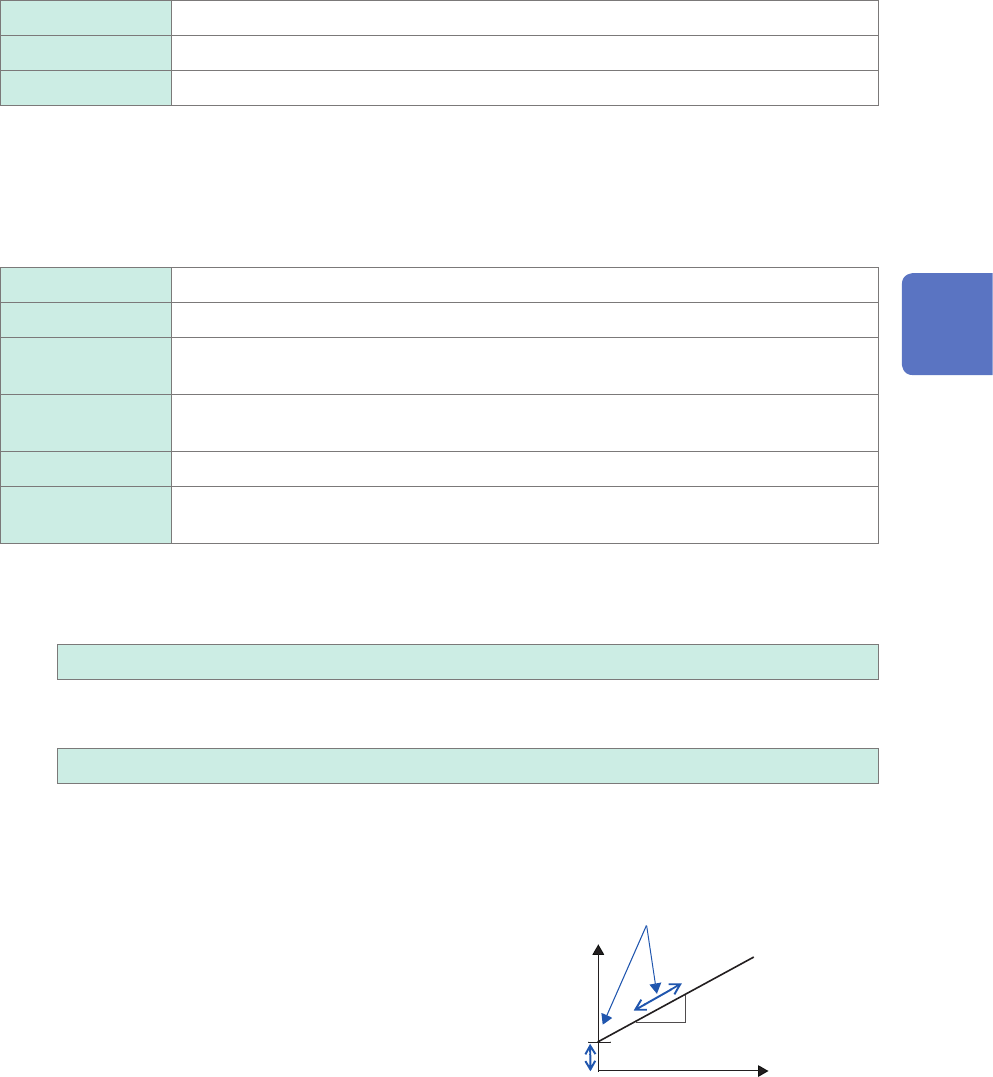
To inputted voltage values into current values
Specify a physical quantity per one volt of an inputted
signal (conversion ratio: eu/V), an offset value, and a
measurement unit to be used. The instrument converts
(scales) measured values acquired in volts into that in the
specied measurement unit. (eu: engineering unit)
Example:
Ratio: Change in amperes per volt; offset value: B
Unit: A
[A]
B
Scaling values using a slope
(conversion ratio) and offset
value
[V]
3
Advanced Functions
40
Converting Input Values (Scaling Function)
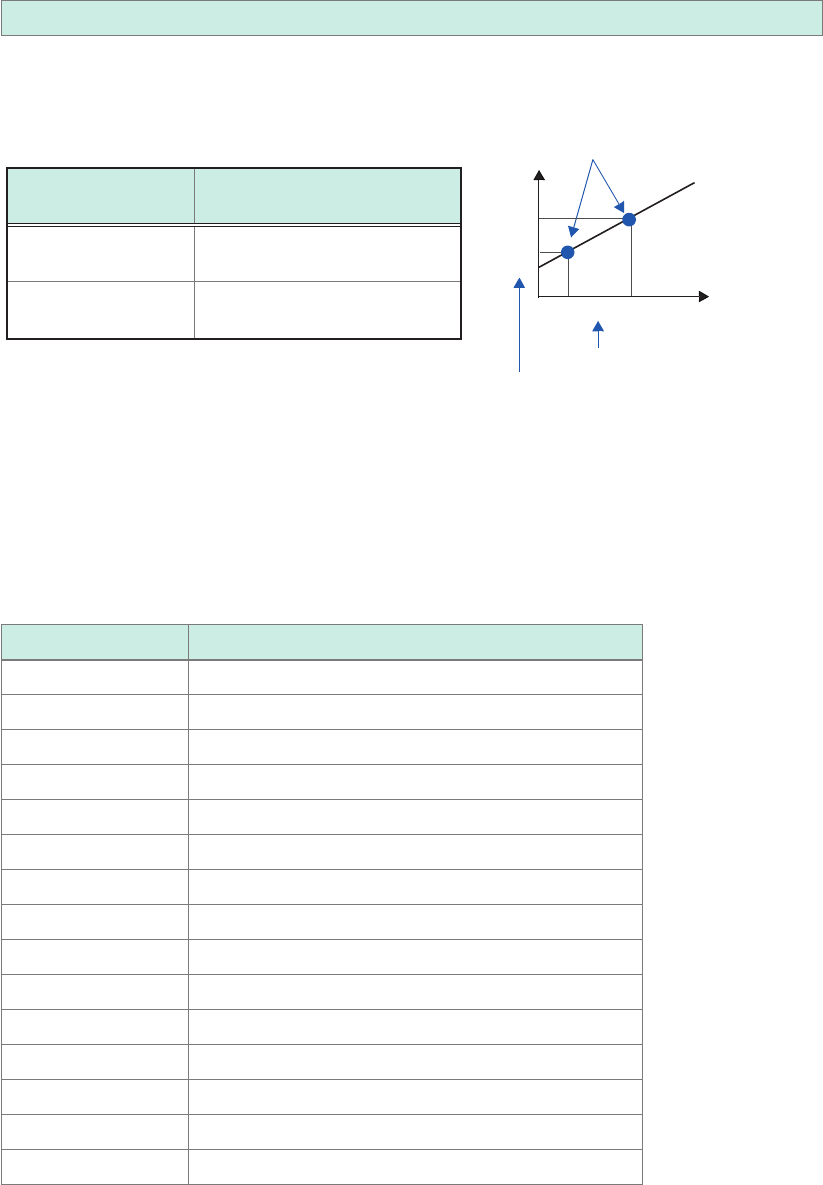
When using [2-Point]: Specify two input values and those after scaling.
Enter two voltage values of an inputted signal in the [Input1] and [Input2] boxes.
Enter each of two scaled value in the [Scale1] and [Scale2] boxes.
−9.9999E+29 to 9.9999E+29
The instrument converts (scales) measured values in
volts into values in the specied measurement unit.
Example:
2 points of values
in volts
Values after scaled
V
H
: Higher potential
point
A
H
: Value for the higher
potential point
V
L
: Lower potential
point
A
L
: Value for the lower potential
point
Unit: A
[A]
A
H
A
L
V
L
V
H
Scaling values using a
conversion ratio and offset value,
both of which are calculated
using two points
Values after scaled
Actual measured values
[V]
When changing the value with the [Ratio] setting, the instrument does not change the values
for V
L
or V
H
, but the values for A
L
and A
H
, all of which have been specied with [Method] set
to [2-Point].
When using [Sensor]
• Click the [Sensor] box, and then choose a model name of a current sensor or differential probe from
the list.
• Click the [Range] box, and then choose a measurement range from the list.
Sensor Range
Model 3273-50 30 A
Model 3274 150 A
Model 3275 500 A
Model 3276 30 A
Model 3283
10 mA
, 100 mA, 1 A, 10 A, 200 A
Model 3284 20 A
, 200 A
Model 3285 200 A
, 2000 A
Model 9010-50 10 A
, 20 A, 50 A, 100 A, 200 A, 500 A
Model 9018-50 10 A
, 20 A, 50 A, 100 A, 200 A, 500 A
Model 9132-50 20 A
, 50 A, 100 A, 200 A, 500 A, 1000 A
Model 9322 –
Model 9657-10 10 A
Model 9675 10 A
CT6700, CT6701 5 A
CT6710, CT6711 500 mA, 5 A, 30 A
Setting example:
To display values measured with Model 9018-50 Clamp on Probe using the 10 A range as values in
amperes (A)
Sensor: Model 9018-50
Range: 10 A
Unit A