MR8740T_user_manual_eng_20191016H.pdf - 第69页
64 Conguring Measuring-Module-Specic Settings When using an out-of-setting-range current sensor Y ou can use an out-of-setting-range current sensor using the scaling function. Refer to “Automatically saving waveform da…
63
Conguring Measuring-Module-Specic Settings
4
Click the [A.A.F.] box, and then choose a anti-aliasing lter setting from a list.
The anti-aliasing lter can prevent aliasing distortion that may be produced during FFT calculation. The cutoff
frequency automatically changes according to the sampling rates or frequency range (for the FFT function)
settings.
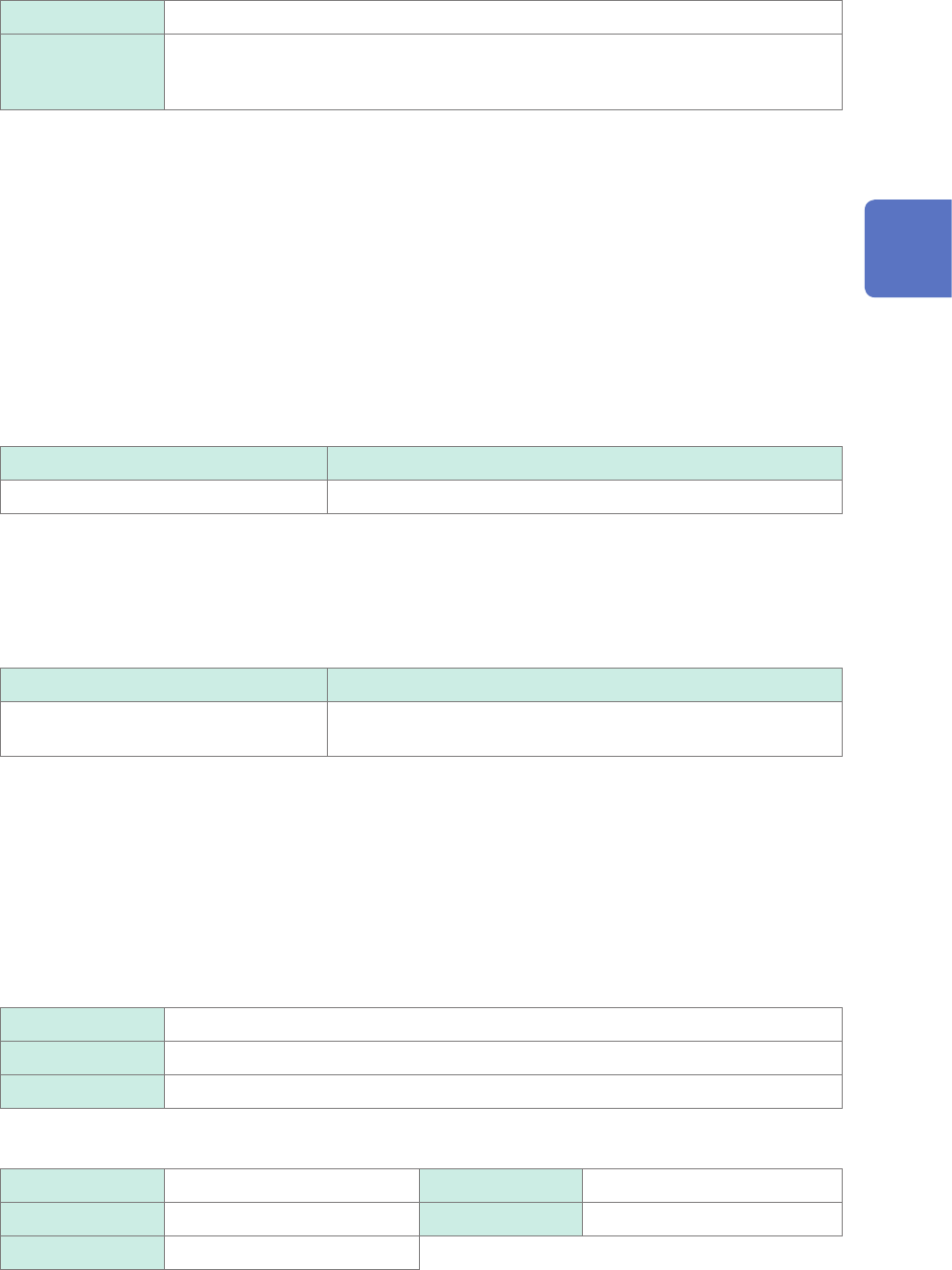
Off
Disables the anti-aliasing lter.
On Enables the anti-aliasing lter.
(Disabled when the external sampling is used, or the sampling rate is set at 100 kS/s
or faster)
5
Click [Sensitivity] box, and then enter sensor sensitivity.
You can enter sensor sensitivity to two decimal places. For a charge-output acceleration sensor or non-TEDS-
compliant sensor, enter its sensitivity marked on the sensor, which represents sensitivity per meter per second
squared.
6
Click [Close].
The setting dialog box closes.
Setting example for sensor sensitivity
Example 1
For a sensor with its sensor sensitivity per meter per second squared marked
Sensor sensitivity Setting value
1.08 pC/(m/s
2
) 1.08
Example 2
For a sensor with its sensor sensitivity per gravity (G) marked.
For a sensor with its sensitivity per gravity (G) marked, enter a quotient of the marked sensitivity
divided by 9.8 m/s
2
.
Sensor sensitivity Setting value
For sensor sensitivity of 64 pC/G
64.0 / 9.8 = 6.53061... pC/(m/s
2
)
6.531 (to two decimal places)
To convert a unit from meter per second squared into gravity (G)
The instrument measures charge quantities per meter per second squared. You can convert such
charge quantities into those per gravity (G) using the scaling function.
Refer to “3.2 Converting Input Values (Scaling Function)” (p. 38).
Congure the scaling setting as follows;
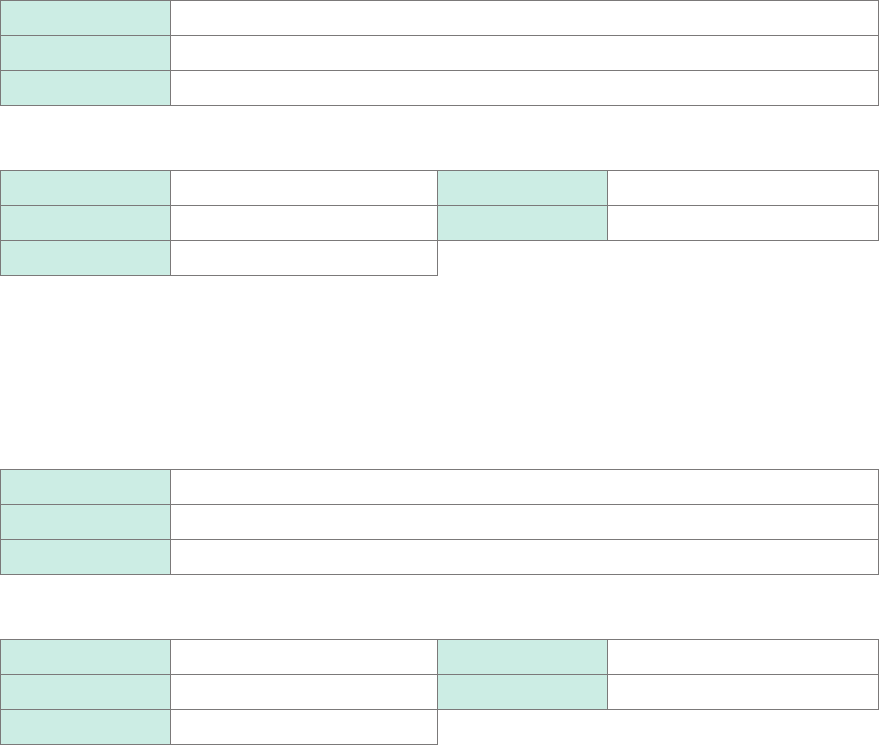
Example 1
Specifying a conversion ratio
Ratio 0.1020E+00 (= 1/9.8)
Offset 0.0000E+00
Units G
Example 2
Specifying two points
Input1 9.8000E+00 Scale1 1.0000E+00
Input2 0.0000E+00 Scale2 0.0000E+00
Units G
3
Advanced Functions
64
Conguring Measuring-Module-Specic Settings
When using an out-of-setting-range current sensor
You can use an out-of-setting-range current sensor using the scaling function.
Refer to “Automatically saving waveform data” (p. 84).
1
Click the area that includes [Sensitivity].
The setting dialog box appears.
2
Click [Sensitivity] box, and then enter sensor sensitivity.
Multiply the sensor sensitivity of a sensor to be used by a certain value to allow a product to fall within the
setting range (0.1 to 10), and enter the product.
3
Click [Close].
The setting dialog box closes.
4
Click the [Scaling] box, and then congure the scaling setting.
Congure the scaling setting so that a scaling ratio is the same value as the number you multiplied the sensor
sensitivity by.
Example 1
For sensor sensitivity of 23.4 pC/(m/s
2
)
Specify 10 pC/(m/s
2
), which results from multiplying the sensor sensitivity by 1/2.34, as the sensor sensitivity.
To display measured values after multiplying them by 1/2.34, congure the scaling setting as follows:
To congure the scaling setting using the conversion ratio method
Ratio 0.4274E+00 (= 10/23.4)
Offset 0.0000E+00
Units m/s
2
To congure the scaling setting using the 2-point method
Input1 2.3400E+00 Scale1 1.0000E+00
Input2 0.0000E+00 Scale2 0.0000E+00
Units m/s
2
Example 2
For sensor sensitivity of 0.05 pC/(m/s
2
)
Specify 0.1 pC/(m/s
2
), which results from multiplying the sensor sensitivity by two, as the sensor sensitivity.
To display measured values after multiplying them by two, congure the scaling setting as follows:
To congure the scaling setting using the conversion ratio method
Ratio 2.0000E+00 (= 0.1/0.05)
Offset 0.0000E+00
Units m/s
2
To congure the scaling setting using the 2-point method
Input1 0.0500E+00 Scale1 1.0000E+00
Input2 0.0000E+00 Scale2 0.0000E+00
Units m/s
2
65
Conguring Measuring-Module-Specic Settings
Conguring Model U8991 Digital Voltmeter Unit settings
> [Channel] > [U8991]
to
1
4
1
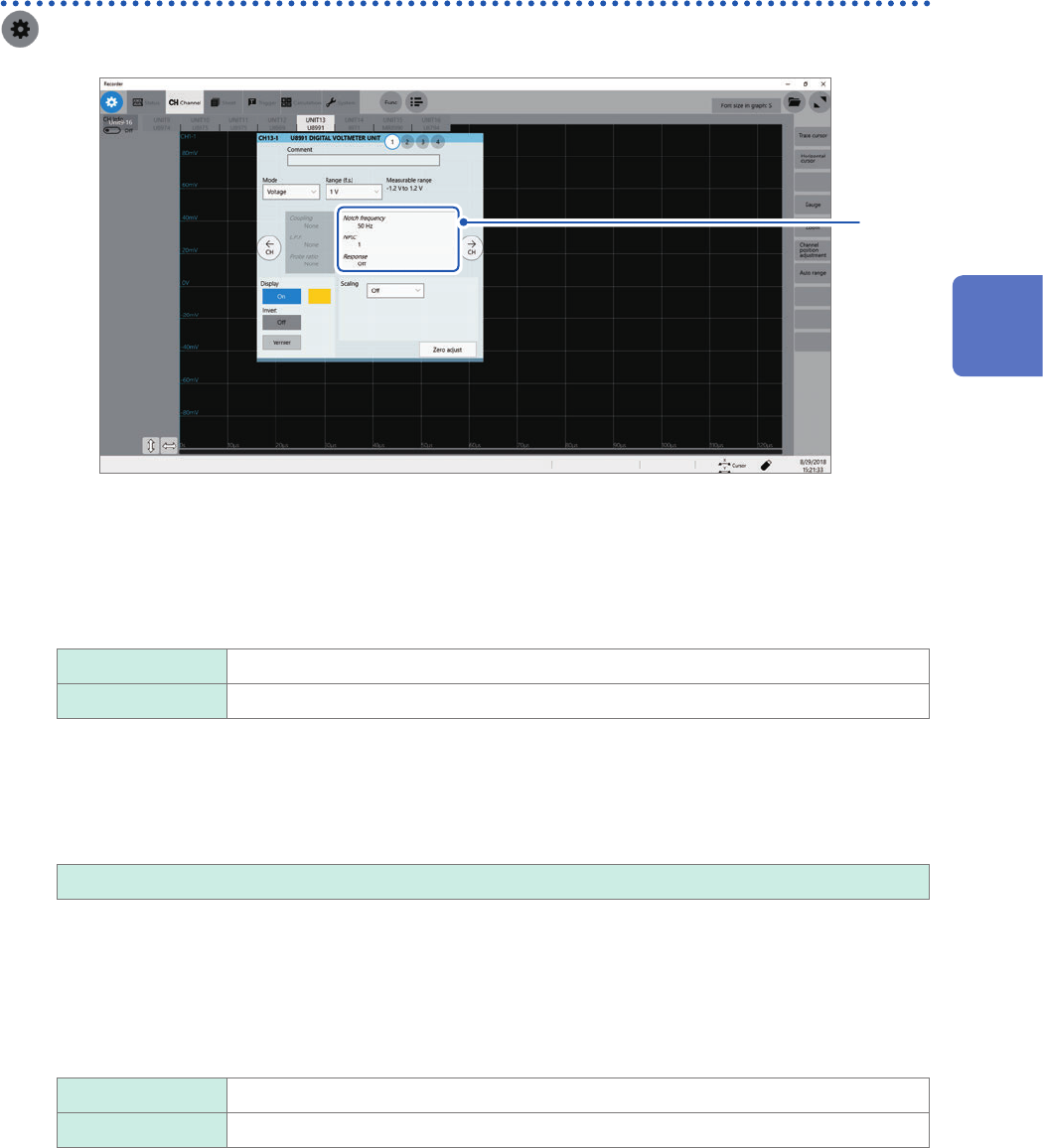
Click the area that includes [Notch frequency].
The setting dialog box appears.
2
Click the [Notch frequency] box, and then choose a power frequency from the list.
Choose a power frequency of your region.
50 Hz
Sets the period at 20 ms.
60 Hz Sets the period at 16.67 ms.
An incorrect power frequency setting causes measured values to be unstable.
3
Click the [NLPC] box, and then enter an integration time.
Dene an integration time based on the power line cycle (PLC), which is the time equivalent to one period of
the power frequency.
1
, 10, 100
Example: When the power frequency is 50 Hz and NPLC is set at 10, then 20 ms × 10 = 200 ms is obtained.
The instrument updates measured data every 200 ms.
(Increasing NPLC may reduce uctuation in measured values caused due to exogenous noise or an EMC
environment.
4
Click the [Response] box, and then choose a data update interval from the list.
Off
Updates data at intervals the time entered in the [NPLC] box.
On Calculates moving averages every 1 PLC and updates the data.
5
Click [Close].
The setting dialog box closes.
3
Advanced Functions